JUÁREZ Y ASOCIADOS, INC.
Tercer informe trimestral FY2021: Lifelong Learning Project
The Lifelong Learning (LLL) Project in Guatemala aims to improve reading outcomes and increase quality educational access, particularly for children and indigenous youth aged 15 to 24 years old who are out-of-school.
2021 · 33 pages
Sign in to readA free account is required to download.
Abstract
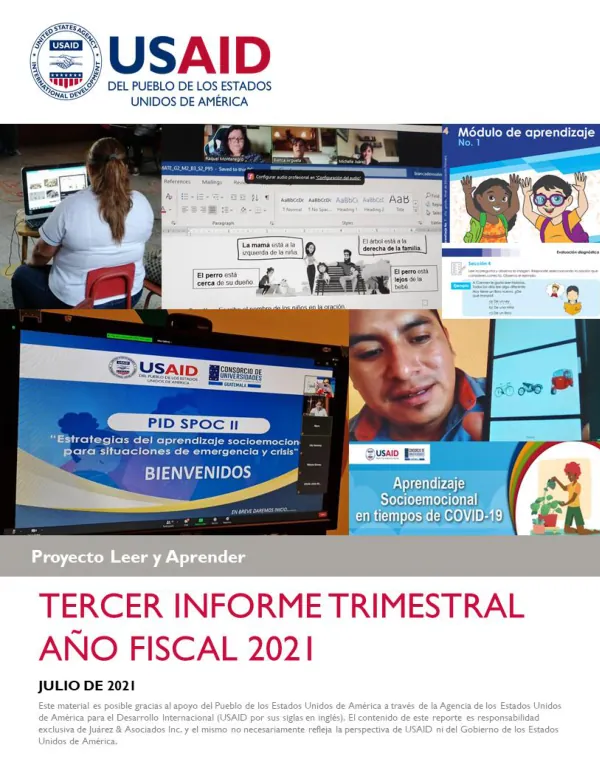
The project has been extended to support the Ministry of Education (MOE) in designing and implementing an educational response to the COVID-19 pandemic. The project's results contribute to USAID and the State COVID-19 Response Strategy Pillar 4, as well as the MOE's Strategic Directions. During the period from April 1 to June 30, 2021, the project focused on collaborating with the MOE to respond to changes in the educational context and promote learning continuity under prevention measures and non-face-to-face modalities. The project maintained close and constant communication with the MOE to focus technical assistance and align activities to the needs and requirements prioritized for the development of the 2021 school year. The project redirected and strengthened activities related to the generation of support resources for a hybrid modality of face-to-face and distance education, the adoption of protocols for prevention and health security measures, and different processes aimed at improving the installed technical capacity. The team worked in collaboration with staff from various directorates of the MOE, as well as with the National System of Educational Accompaniment (SINAE) and some Departmental Directorates of Education (Dideduc). As part of Component I: Response and Recovery, the project provided technical assistance to facilitate training spaces that favor the implementation of safe back-to-school protocols and the MOE's vaccination plan. The project reached 130,036 participants at the central and departmental level of the different units and directorates of the MOE. The project also initiated the development of a mobile application for Android devices to facilitate access to information on procedures to be followed to ensure conditions that minimize the possibilities of contagion of COVID-19 in school contexts nationwide. The project continued to support non-formal education through technical assistance with various inputs required by Digeex for decision-making and educational response planning. An inventory of alternative education services was completed, and quantitative and qualitative data were collected by the rapid appraisal of basic secondary education modalities available in rural areas. Efforts to generate resources that can support teaching practice and promote learning continued, including the design of formative assessment tools and the development of daily self-learning sessions. In Component II: Preparation and Planning, the project revised quality criteria for alternative education educational resources and adapted materials from the Adult Correspondence Education Program (PEAC) with the support of the Guatemalan Institute of Radio Education (IGER). The project also responded to different requests to adjust the design of the evaluation of socio-emotional skills of pre-primary students and proposed an evaluation of the impact of student learning due to confinement.
Related documents