USAID DEC
Self-Efficacy Youth Scale
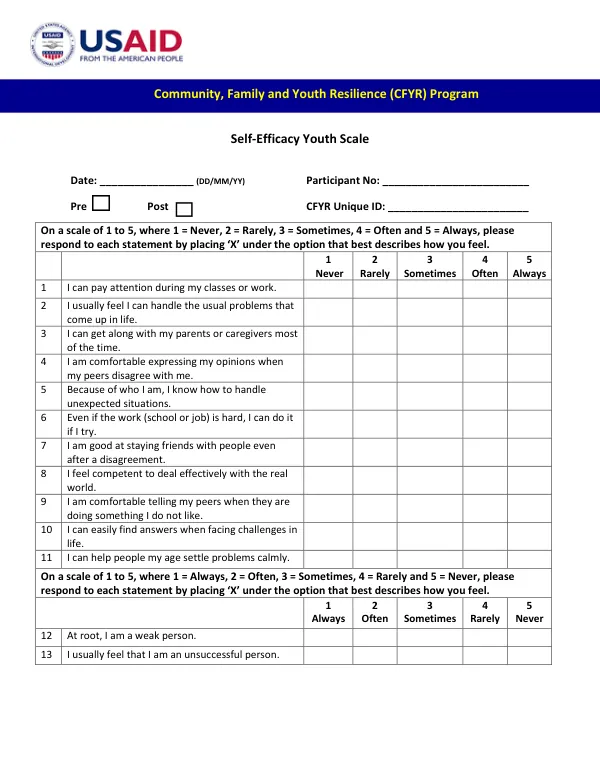
The Self-Efficacy Youth Scale is a tool used to assess an individual's level of self-efficacy, which is the belief in one's ability to perform tasks and achieve goals.
2019 · 1 pages
Sign in to readA free account is required to download.
Abstract
The scale consists of 13 statements that assess various aspects of self-efficacy, including attention, problem-solving, relationships, and self-expression. The first 5 statements assess the ability to perform everyday tasks and handle problems. Statement 1 asks about the ability to pay attention in classes or work, while statement 2 asks about the ability to handle everyday problems. Statements 3 and 4 assess the ability to get along with parents or caregivers and express opinions in a disagreement, respectively. Statement 5 asks about the ability to handle unexpected situations due to one's identity. The next 4 statements assess the ability to perform tasks and achieve goals. Statement 6 asks about the ability to complete difficult tasks, while statement 7 assesses the ability to stay friends with people after a disagreement. Statement 8 asks about the ability to feel competent in dealing with the real world, and statement 9 assesses the ability to express opinions to peers. The final 4 statements assess the ability to cope with challenges and setbacks. Statement 10 asks about the ability to find answers to challenges, while statement 11 assesses the ability to help others settle problems calmly. Statement 12 asks about the perception of oneself as a weak person, and statement 13 asks about the perception of oneself as an unsuccessful person. The CFYR Program, which is likely the organization behind the Self-Efficacy Youth Scale, is likely focused on promoting resilience and self-efficacy in young people. The program may use this scale as a tool to assess the effectiveness of its programs and interventions."