USAID DEC
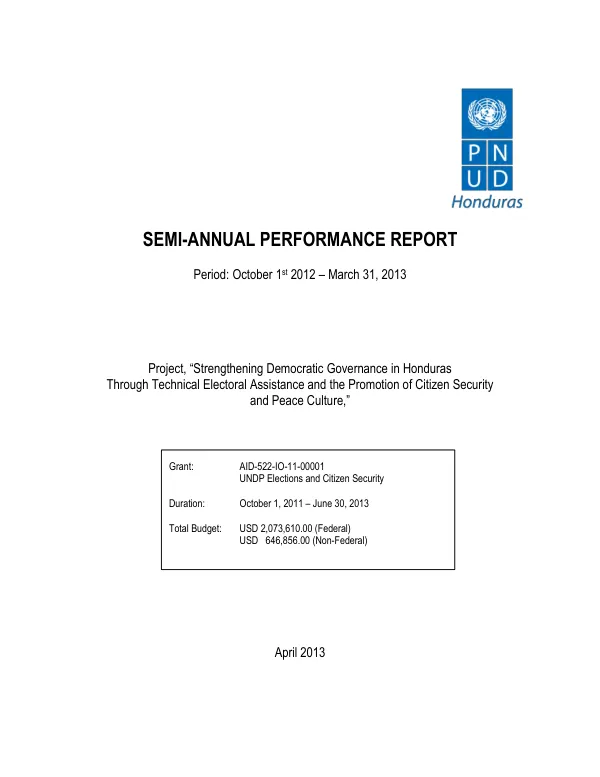
Semi-annual Performance Report: Strengthening Democratic Governance in Honduras Through Technical Electoral Assistance and the Promotion of Citizen Security and Peace Culture
Sign inUNDP
Semi-annual Performance Report: Strengthening Democratic Governance in Honduras Through Technical Electoral Assistance and the Promotion of Citizen Security and Peace Culture
The project "Strengthening Democratic Governance in Honduras Through Technical Electoral Assistance and the Promotion of Citizen Security and Peace Culture" was initiated in October 2011 with a total budget of USD 2,073,610.00, comprising USD 2,080,856.00 in federal funding and USD 646,856.00 in non-federal funding.
2013 · 38 pages
Sign in to readA free account is required to download.
Abstract
The project aimed to provide technical electoral assistance to the Honduran electoral management body, the Tribunal Supremo Electoral (TSE), and promote citizen security and peace culture. Component 1 of the project, Electoral Technical Assistance, had a total budget of USD 1,080,000.00, consisting of USD 800,000.00 in federal funding and USD 280,000.00 in non-federal funding. The component focused on providing technical assistance to the TSE to strengthen its operational units and legal framework. During the reporting period of October 2012 to March 2013, several challenges were encountered, including the lack of timeliness in political and technical decisions, coordination issues among cooperation and aid agencies, and the introduction of the "electronic-voting" topic. Proposed remedial actions included improving channels of communication with the TSE, supporting the TSE in promoting necessary and timely reforms, and closely monitoring the Electronic Voting issue and the National Electoral Census. The project achieved several results during the reporting period, including the creation of the Census and Mapping Unit, the implementation of a protocol to construct and purge the electoral census, and the validation of the procedure. The Transmission of Preliminary Election Results Project (TREP) was also successfully conducted, with three drills conducted without technical inconsistencies. However, the project faced several challenges, including the lack of training, polarization at polling stations, and delays in the design of documents containing consensus candidacies. The project team repeatedly reported on the situation and warned of the risk involved, but the system was never tested, and only some minor tests were run. The project also assisted in the coordination with the National Registry of Persons (RNP) concerning the Census, and 171,970 forms with barcodes were issued during this period. An evaluation of the forms revealed an unusually high percentage of change of address requests, which the TSE decided to audit. Irregular changes of address were detected in several municipalities, and the TSE decided to end the period stipulated to request said changes. The project's achievements and challenges highlight the complexities of electoral reform and the need for continued technical assistance and support to the TSE. The project's efforts to strengthen the TSE's operational units and legal framework, as well as its promotion of citizen security and peace culture, are crucial for the consolidation of democratic governance in Honduras. The project's semi-annual performance report provides a comprehensive overview of its achievements and challenges during the reporting period. The report highlights the project's commitment to supporting the TSE in its efforts to strengthen democratic governance in Honduras and promotes continued collaboration and support to achieve this goal.