FHI 360
Semi-Annual Program Performance Report
The Integrated Humanitarian Assistance to Yemen project, funded by USAID/OFDA Award No.
2019 · 15 pages
Sign in to readA free account is required to download.
Abstract
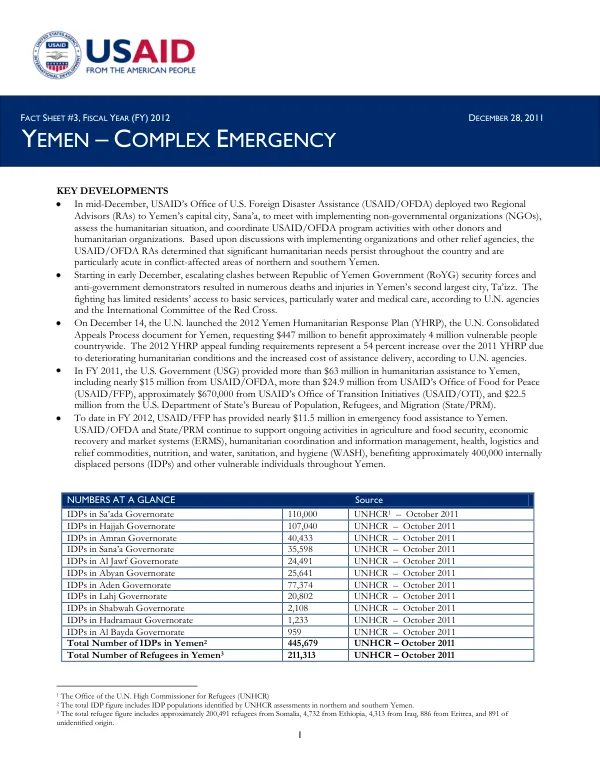
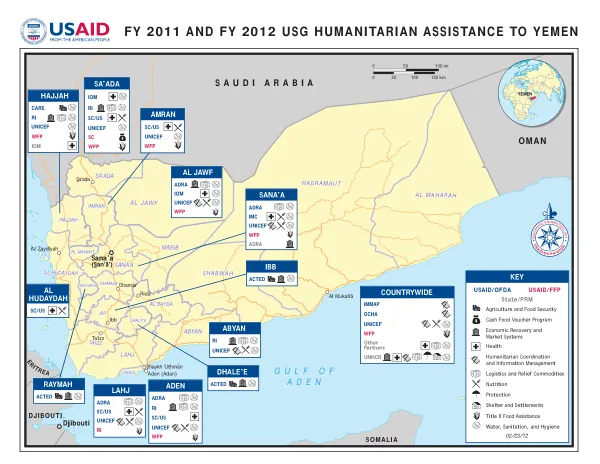
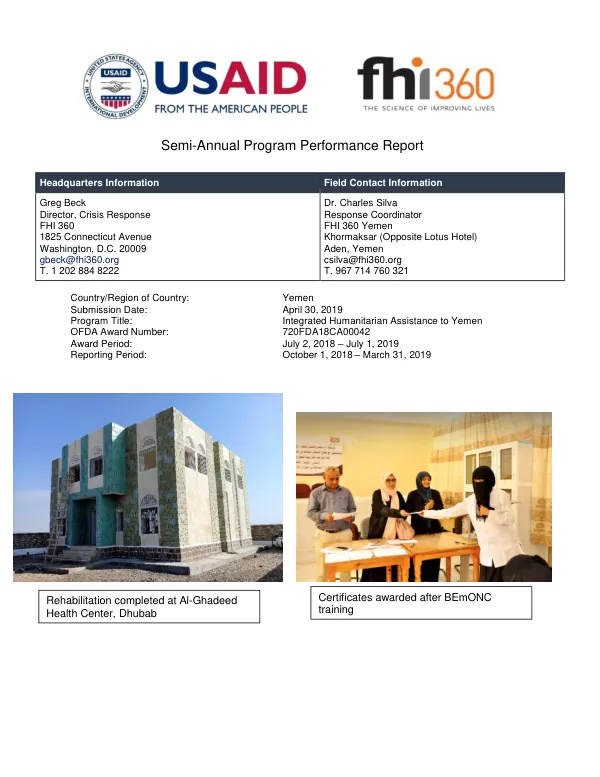
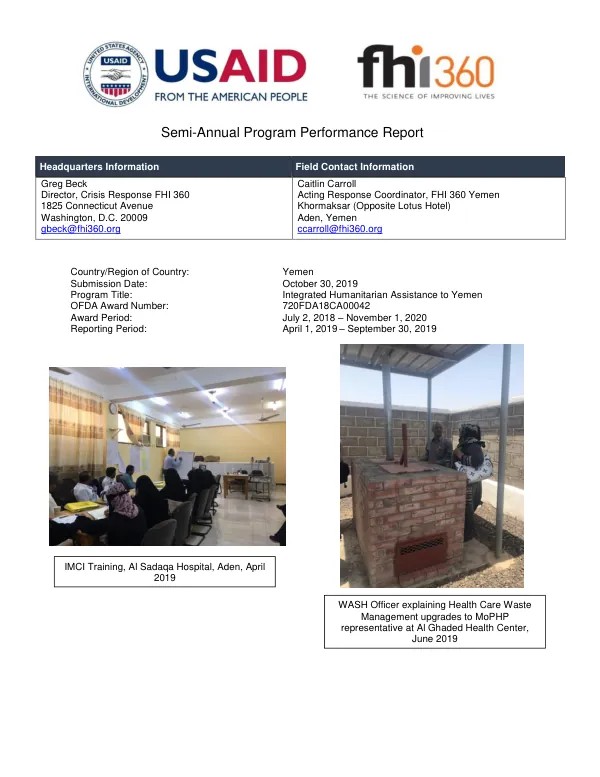
720FDA18CA00042, aims to provide comprehensive support to host communities and internally displaced persons (IDPs) in Yemen. The project, implemented by FHI 360, focuses on Health, Nutrition, WASH, and Humanitarian Coordination activities in three sites along the Western Coast of Yemen: Al Mokha Maternal and Child Health (MCH) Center and Al Ghaded Health Center (HC) in Dhubab, Taiz Governorate; and Al Khawkhah MCH, Hudaydah Governorate. During the reporting period, a cost modification was executed on the award, extending the period of performance and adding scope, with FHI 360 expanding coverage to three additional sites. FHI 360 recorded progress on several main activities during the reporting period. The organization provided incentives and technical support to over 60 frontline health workers in Al Ghaded HC, Al Mokha MCH, and Al Khawkhah MCH. A 10-day training on Integrated Management of Childhood Illness (IMCI) was facilitated for incentivized health workers from supported sites at Al Sadaqa Hospital in Aden, showing a significant improvement in health staff's knowledge of the subject matter. FHI 360 also finalized a major procurement of pharmaceuticals, with the cold chain received in early October 2019 and an additional shipment arriving imminently. The rehabilitation of Al Ghaded HC, including upgrades to WASH facilities and health care waste management systems, was completed, and medical equipment was provided to Al Ghaded HC, making it a fully functioning health facility per Minimum Service Package (MSP) guidelines. The project's sector-level targets were updated per FHI 360's cost modification proposal, with the overall target comprised of the catchment populations of the targeted health facilities. FHI 360 notes that several factors have impeded achievement to date, including health facilities withholding of reports, delays in approval of the sub-agreement by MoPHP and MoPIC, civil unrest in Aden, challenges faced by the health facility management and District Health Office (DHO) officials related to the change in incentive rates, and relocation for facility intervention due to an overlap of planned intervention by FHI 360 and other NGOs. Weak coordination by health partners, coupled with a lack of transparency by governorate level officials, have also been contributing factors to FHI 360's program delays. FHI 360 continued to provide primary health care and reproductive health services as part of the MSP in the three supported health facilities, including the provision of medicines, medical supplies, payment of incentives targeting frontline health workers, and completion of trainings for key health staff in IMCI. FHI 360 also took steps to expand service delivery to two more facilities and one MHT. The organization supported a total of 17,787 reported consultations during the reporting period, with 8,520 cases being communicable diseases, 9,481 cases being non-communicable diseases and trauma-related injuries, and 488 cases being for reproductive health services. FHI 360 faced challenges obtaining reports from the facilities, which are reflected in the relatively low consultation numbers. FHI 360 incentivized a total of 69 frontline health workers over the reporting period, with 34 in Al Mokha MCH, 26 in Al Khawkhah MCH, and 9 in Al Ghaded HC. Through ongoing coordination with other INGOs and a change in incentive rates approved by the MoPHP, FHI 360 decreased the number of MoPHP health workers supported with incentives as follows: 20 in Al Mokha MCH, 14 in Al Khawkhah MCH, and ten in Al Ghaded HC. Additional incentivized staff are planned for newly supported facilities and the MHT. FHI 360 provided IMCI training from April 14-29, 2019 at Al Sadaqa Hospital in Aden, with four male and six female health workers completing the ten-day training. The trainees undertook a pre-test on the first day of their training, and a post-test on their last day, showing a demonstrable increase in knowledge in the post-test results. FHI 360 staff continued to conduct regular visits to all supported facilities twice per month for monitoring activities and providing supportive supervision for targeted health facility staff.
Related documents