USAID DEC
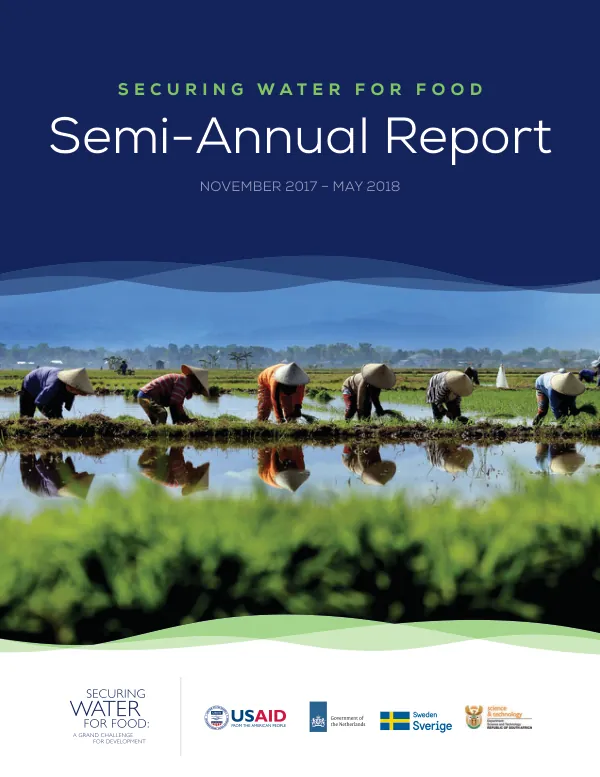
Semi-Annual Report
The SWFF program has met or exceeded its expected outcomes, with innovators reaching a combined 3.6 million smallholder farmers, families, and other end users, well ahead of the expected 3 million target.
2018 · 82 pages
Sign in to readA free account is required to download.
Abstract
For every $1,000 of donor funding spent, SWFF innovators have produced 156 customers, 156 customers, 156 tons of crops, reduced water consumption by more than 156,000 liters, and improved water management on 156 hectares of agricultural land. In addition, SWFF innovators have helped produce nearly 4 million tons of crops on more than 2.4 million hectares of land, exceeding the expected 3.5 million tons and 2.2 million hectares. However, SWFF innovators have not yet hit their sales targets, with $4.3 million in sales, well below the expected $6.4 million. The SWFF program has made significant progress in integrating gender-equitable concepts into its projects, with innovators making concrete, actionable next steps a major focus. The program has also collected data on the overall impact of the program and individual innovations, helping innovators pivot and make cost-effective choices to increase the likelihood of reaching scale. SWFF innovators have experienced increased usage and technical capacity, with 95% of current innovators experiencing increased usage and 100% of innovators receiving technical assistance. The program has also found that organizations with strong customer data and business intelligence are more rapidly able to respond to their customers' needs, helping them identify weaknesses and improve their market targets. The SWFF program is increasing its efforts to connect innovators to other implementing organizations, USAID Missions, and potential partners and investors. However, the program has limited data on the long-term sustainability of its innovations, and SWFF believes that its efforts to connect innovators to other organizations will help ensure the sustainability of its innovations. The SWFF program has a pipeline of innovators, with 101-1,000 innovators in the active stage, 1,001-10,000 innovators in the graduate stage, and 10,001-999,999 innovators in the alumni stage. The program has also established a verification program to ensure the quality and impact of its innovations. In terms of geographic focus, the SWFF program has a strong presence in Africa, with a focus on countries such as South Africa, Kenya, and Tanzania. The program has also established partnerships with local organizations and governments to ensure the sustainability of its innovations. The SWFF program has a strong commitment to environmental sustainability, with a focus on reducing water consumption and improving water management. The program has also established a verification program to ensure the quality and impact of its innovations. In terms of timeframes, the SWFF program has a five-year program cycle, with a focus on achieving its expected outcomes by the end of the program. The program has also established a verification program to ensure the quality and impact of its innovations. The SWFF program has a strong commitment to gender empowerment and integration, with a focus on ensuring that its innovations are accessible and beneficial to women and other marginalized groups. The program has also established a verification program to ensure the quality and impact of its innovations. In terms of grants management, the SWFF program has a strong focus on ensuring the financial sustainability of its innovations. The program has also established a verification program to ensure the quality and impact of its innovations. The SWFF program has a strong commitment to innovation and entrepreneurship, with a focus on supporting innovators and entrepreneurs to develop and implement new ideas and technologies. The program has also established a verification program to ensure the quality and impact of its innovations. In terms of partnerships, the SWFF program has established partnerships with local organizations and governments to ensure the sustainability of its innovations. The program has also established a verification program to ensure the quality and impact of its innovations. The SWFF program has a strong focus on monitoring and evaluation, with a focus on ensuring the quality and impact of its innovations. The program has also established a verification program to ensure the quality and impact of its innovations. In terms of lessons learned, the SWFF program has identified several key lessons, including the importance of integrating gender-equitable concepts into its projects and the need for innovators to have strong customer data and business intelligence. The program has also established a verification program to ensure the quality and impact of its innovations. The SWFF program has a strong commitment to transparency and accountability, with a focus on ensuring that its innovations are accessible and beneficial to women and other marginalized groups. The program has also established a verification program to ensure the quality and impact of its innovations. In terms of recommendations, the SWFF program has several key recommendations, including the need for innovators to have strong customer data and business intelligence and the importance of integrating gender-equitable concepts into its projects. The program has also established a verification program to ensure the quality and impact of its innovations. The SWFF program has a strong focus on innovation and entrepreneurship, with a focus on supporting innovators and entrepreneurs to develop and implement new ideas and