USAID DEC
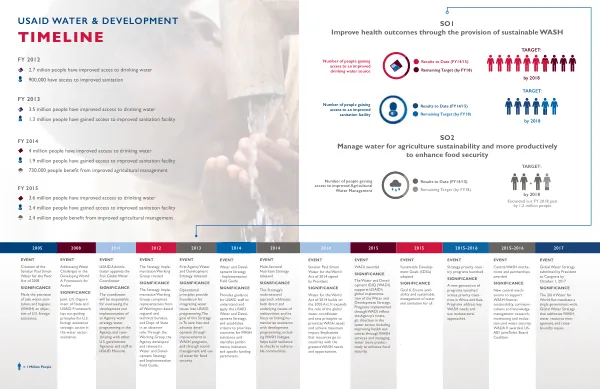
USAID Water and Development Timeline
The USAID Water and Development initiative began in 2005 with the creation of the Senator Paul Simon Water for the Poor Act, which made the provision of safe water, sanitation, and hygiene (WASH) an objective of U.S.
2017 · 1 pages
Sign in to readA free account is required to download.
Abstract
foreign assistance. This legislation marked a significant shift in the U.S. government's approach to addressing global water challenges. In 2008, the U.S. Department of State and USAID jointly released a Framework for Action, which outlined guiding principles for U.S. foreign assistance strategic action in the water sector. This framework provided a foundation for the development of a comprehensive water strategy. The same year, the USAID Administrator appointed the first Global Water Coordinator, who was responsible for overseeing the development and implementation of an Agency water strategy. The Strategy Implementation Working Group was established in 2012 to facilitate the development and release of a Water and Development Strategy and Implementation Field Guide. This guide provided guidance for USAID staff on understanding and applying the Agency's water and development strategy, as well as establishing criteria to prioritize countries for WASH assistance and identifying performance indicators and specific funding parameters. The first Agency Water and Development Strategy was released in 2013, which provided operational principles for integrating water issues into USAID programming. The goal of this strategy was to save lives and advance development through improvements in WASH programs and sound management and use of water for food security. The strategy emphasized the importance of addressing the root causes of water-related challenges and promoting sustainable water management practices. In 2014, the Water and Development Strategy - Implementation Field Guide was released, which provided further guidance for USAID staff on implementing the Agency's water and development strategy. This guide established criteria for prioritizing countries for WASH assistance and identified performance indicators and specific funding parameters. The same year, the Multi-Sectoral Nutrition Strategy was released, which addressed both direct and underlying causes of malnutrition and linked humanitarian assistance with development programming, including WASH linkages. The Water for the World Act of 2014 was signed by President Barack Obama, which built on the 2005 Act and expanded the role of the global water coordinator. This legislation emphasized the importance of prioritizing WASH needs and achieving maximum impact, and it set principles for allocating resources to address global water challenges. The Act also emphasized the need to address the root causes of water-related challenges and promote sustainable water management practices. The Water and Development IDIQ (WADI) was established in 2014 to support USAID's global implementation of the Water and Development Strategy. Programs implemented through WADI reflected the Agency's strategic direction in the water sector, including improving health outcomes through WASH services and managing water for food security. The WADI program also supported the implementation of the Sustainable Development Goals (SDGs), particularly Goal 6, which aimed to ensure the availability and sustainable management of water and sanitation for all. In 2015, a new generation of programs was launched across priority countries in Africa and Asia, which addressed key WASH needs and used multisectoral approaches. These programs were designed to promote sustainable water management practices and improve health outcomes through WASH services. The USAID also established new central mechanisms to support WASH finance, sustainability, communications, and knowledge management, as well as research, monitoring, and evaluation, and water security. The 2014 Water for the World Act mandated a single government-wide Global Water Strategy that addresses WASH, water resource management, and transboundary issues. This strategy was submitted to Congress by October 1, 2017, and it provided a framework for addressing global water challenges and promoting sustainable water management practices. The strategy emphasized the importance of prioritizing WASH needs and achieving maximum impact, and it set principles for allocating resources to address global water challenges.