DAI GLOBAL, LLC
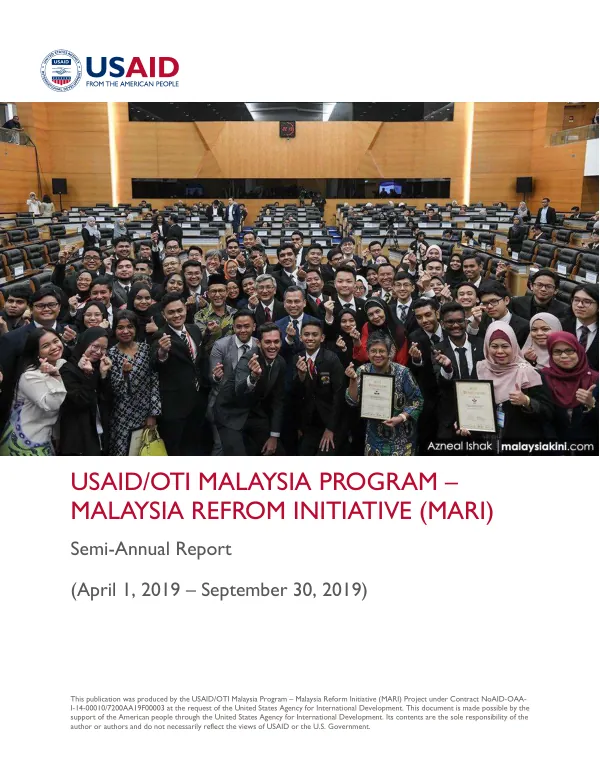
Semi-Annual Report (April 1, 2019 – September 30, 2019)
The Malaysia Reform Initiative (MARI) is a program implemented by DAI Global LLC under a Task Order through February 2021.
2019 · 18 pages
Sign in to readA free account is required to download.
Abstract
The program aims to support Malaysians' aspirations for a more democratic society by working through two program objectives: to assist the Malaysian government in enhancing standards of transparency, accountability, and responsiveness to the public, and to empower voices to engage more meaningfully on issues important to the people. MARI fosters partnerships with the Malaysian Government, civil society, and other interested stakeholders across diverse sectors to contribute to the momentum generated by the historic May 2018 elections towards democratic reform. The program's strategy is to support the Government's implementation of priority reforms, facilitate civic engagement in the reform process, and consolidate post-election gains for free media. Between February and June 2019, MARI worked towards three initial key program objectives. However, in July 2019, the program team considered its approach during a three-day Strategy Review Session (SRS) in response to shifts in the political landscape and analysis of program results to date. The team articulated a program goal and revised and condensed its three previous program objectives into two, focusing on issue-focused objectives rather than actor-focused objectives. The two issue-focused objectives are: to assist the Malaysian government in enhancing standards of transparency, accountability, and responsiveness to the public, and to empower voices to engage more meaningfully on issues important to the people. In support of Malaysia's democracy, the team identified priority issue areas and critical reforms where political will within the government and sufficient public support or tolerance for constructive engagement was present. During the reporting period, Pakatan Harapan (PH) completed their one-year term of governance and achieved 53 of the 464 initiatives stated in their March 2018 Manifesto. PH's "report card" highlighted their key achievements, including abolishing the goods and services tax (GST), pursuing legal action against former PM Najib Razak, reforming the Malaysian Anti-Corruption Commission (MACC) and the Election Commission (EC), and founding Parliament Select Committees (PSCs). However, report cards by electoral watchdogs Bersih 2.0 and other CSOs highlighted PH's slow pace of reforming repressive legislation that is still used to prosecute fundamental freedoms of expression and peaceful assembly, and continue to target marginalized communities such as women's groups and students. The Sedition Act (1948) and Communications and Multimedia Act (1998) were applied to suppress activists, students, and the general public who allegedly insulted the royalty, undermining PH's reform initiatives. As of September 2019, the CIVICUS monitor still rates the civic space in Malaysia as "Obstructed". Although PH's formation of the Institutionary Reform Committee (IRC) enables CSOs to establish a formal oversight relationship with the Government and probe insights to PH's own reform efforts, it has only made apparent inconsistencies between Ministries' commitments and actions. MARI has concluded three activities, continues to implement 19, and has 14 in pending status, all developed and implemented in close collaboration with Malaysian civil society, governmental, and USG partners. The program has received $7,500,000 in obligated funds as of September 15, 2019.