CDS
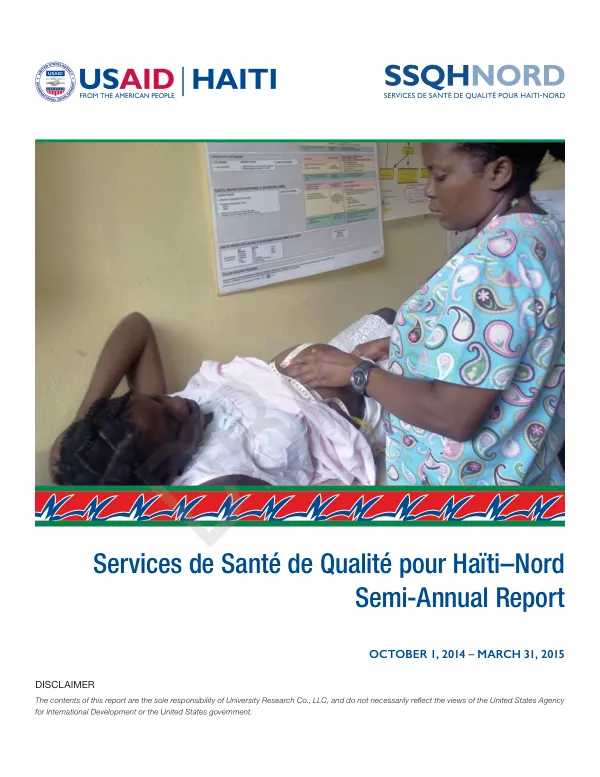
Semi-Annual Report: October 1, 2014 – March 31, 2015
The SSQH-CS project in Haiti is a collaborative effort between various organizations, including Pathfinder International, Deloitte Consulting, and Partners In Health, among others.
2015 · 42 pages
Sign in to readA free account is required to download.
Abstract
The project aims to improve health services in Haiti, particularly in the areas of HIV/AIDS, tuberculosis, maternal and child health, family planning, and gender-based violence. The project's second year (Y2) first semester progress report highlights several key accomplishments. Technical assistance site visits were conducted at 71 facilities, resulting in notable upgrades to ART and PMTCT sites, the establishment of a CD4 diagnostic hub facility, and the expansion of the ASCP network. Additionally, the CHW Supervisor module was launched under the mSanté program, and facility and departmental CQI plans were developed. The project is on track to achieving many of its expected results for the year, with most service delivery indicators performing as expected or surpassing mid-point expectations. Referral network and health systems strengthening (HSS) indicators excelled across the board, with many already reaching or outperforming Y2 targets. Partnerships with MSPP, national programs, individual DDS, and USG partners played critical roles in helping the project achieve its success. For HIV/AIDS, the project is on track to meeting or surpassing targets for five of six indicators. Some indicators that exceeded expected performance include people with advanced HIV receiving ART, registered TB patients screened for HIV, percent of HIV+ pregnant women receiving ART to reduce MTCT, and people known to be alive and on treatment 12 months after ART initiation. Tuberculosis (TB) indicators also posted impressive results, with 94.1% of the Y2 target already met for patients receiving isoniazid preventive therapy (IPT). The project's success is attributed to its partnerships and the critical groundwork laid in the first year. The project's personnel conducted 175 technical assistance site visits, which resulted in notable upgrades to facilities and the expansion of the ASCP network. The establishment of a CD4 diagnostic hub facility and the launching of the CHW Supervisor module under the mSanté program also contributed to the project's success. The project's focus on integration of programmatic implementation and partner leveraging has resulted in significant outcomes in service delivery and health systems strengthening. The project's partnerships with MSPP, national programs, individual DDS, and USG partners have played critical roles in helping the project achieve its success. Overall, the project is on track to achieving many of its expected results for the year, with most service delivery indicators performing as expected or surpassing mid-point expectations. The project's success highlights the importance of partnerships and collaboration in achieving health outcomes. The project's focus on integration of programmatic implementation and partner leveraging has resulted in significant outcomes in service delivery and health systems strengthening. The project's partnerships with MSPP, national programs, individual DDS, and USG partners have played critical roles in helping the project achieve its success. The project's results demonstrate the effectiveness of the SSQH-CS project in improving health services in Haiti. The project's focus on HIV/AIDS, tuberculosis, maternal and child health, family planning, and gender-based violence has resulted in significant outcomes, with most service delivery indicators performing as expected or surpassing mid-point expectations. The project's partnerships and collaboration have played critical roles in helping the project achieve its success.
Related documents