FLORIDA INTERNATIONAL UNIVERSITY
Semi-annual Report, October 1, 2016-March 31, 2017
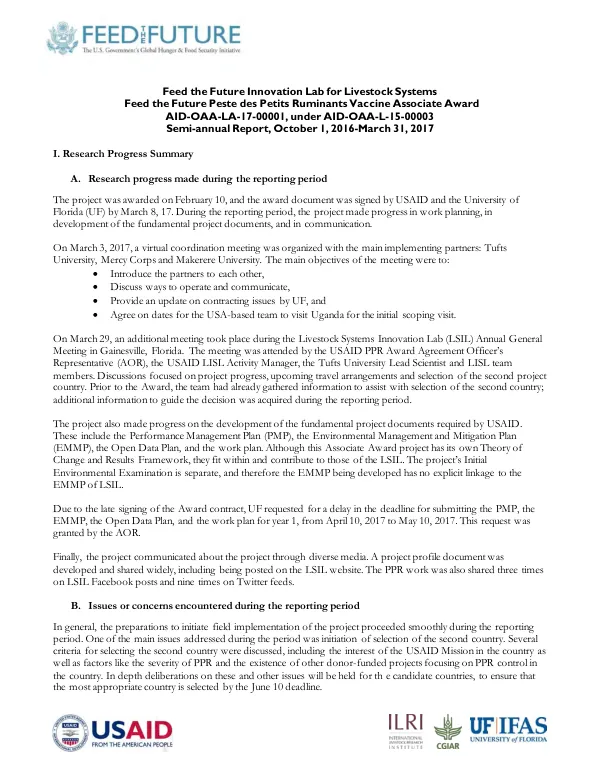
The Feed the Future Innovation Lab for Livestock Systems, in collaboration with the University of Florida, was awarded the Feed the Future Peste des Petits Ruminants Vaccine Associate Award on February 10, 2017.
2017 · 2 pages
Sign in to readA free account is required to download.
Abstract
The award, AID-OAA-LA-17-00001, is under the umbrella of AID-OAA-L-15-00003. The semi-annual report for the period of October 1, 2016, to March 31, 2017, highlights the progress made during this period. Research progress was made in work planning, development of fundamental project documents, and communication. A virtual coordination meeting was organized on March 3, 2017, with main implementing partners, including Tufts University, Mercy Corps, and Makerere University. The meeting aimed to introduce partners to each other, discuss ways to operate and communicate, provide an update on contracting issues, and agree on dates for the USA-based team to visit Uganda for the initial scoping visit. On March 29, an additional meeting took place during the Livestock Systems Innovation Lab Annual General Meeting in Gainesville, Florida. Discussions focused on project progress, upcoming travel arrangements, and selection of the second project country. The project also made progress on the development of fundamental project documents required by USAID, including the Performance Management Plan, Environmental Management and Mitigation Plan, Open Data Plan, and work plan. Due to the late signing of the Award contract, the University of Florida requested a delay in the deadline for submitting these documents, which was granted by the Award Agreement Officer. The project communicated about the project through diverse media, including a project profile document shared widely and posted on the LSIL website. The PPR work was also shared on LSIL Facebook posts and Twitter feeds. In general, the preparations to initiate field implementation of the project proceeded smoothly during the reporting period. One of the main issues addressed during the period was the initiation of selection of the second country, which will be done by June 10 after further discussions with country stakeholders, the Award Agreement Officer, and USAID Missions in the candidate countries. The project established working relationships with the Botswana Vaccine Institute to discuss the production of the thermostable vaccine and with Mercy Corps, which will lead the vaccination efforts in the Karamoja region in Uganda. Both institutions have a key role in potential scaling efforts as the Botswana Vaccine Institute will produce the vaccine and Mercy Corps will collaborate with and train Community Animal Health Workers. The project plans to finalize and sign subaward agreements with key partners, travel to Uganda, present the project at the PPR vaccine producer's workshop, and initiate the baseline survey, among other activities, in the next six-month period.
Related documents