UNITED NATIONS ENVIRONMENTAL PROGRAMME , NAIROBI
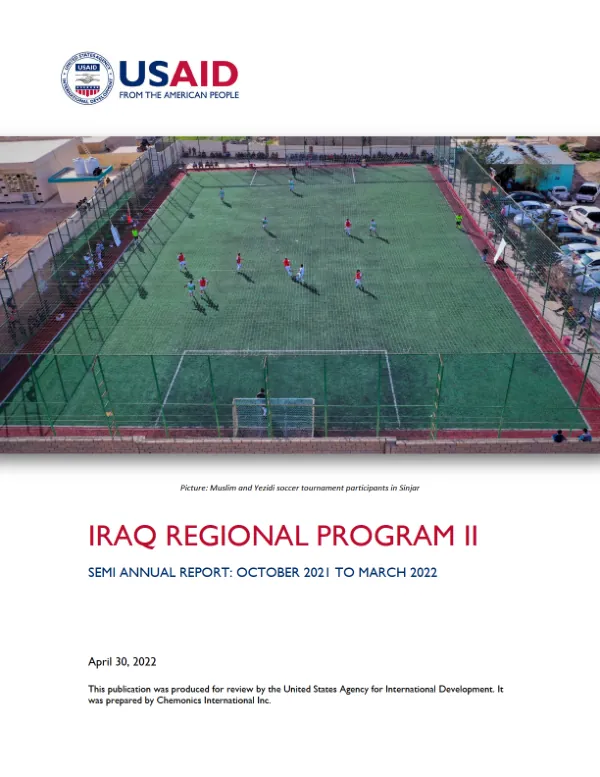
Semi-Annual Report: October 1, 2019 – March 31, 2020
The Iraq Regional Program (IRP) is a program launched by USAID's Office of Transition Initiatives (OTI) in September 2018 to accelerate recovery in conflict-affected areas and strengthen the social fabric of Iraqi communities.
2020 · 19 pages
Sign in to readA free account is required to download.
Abstract
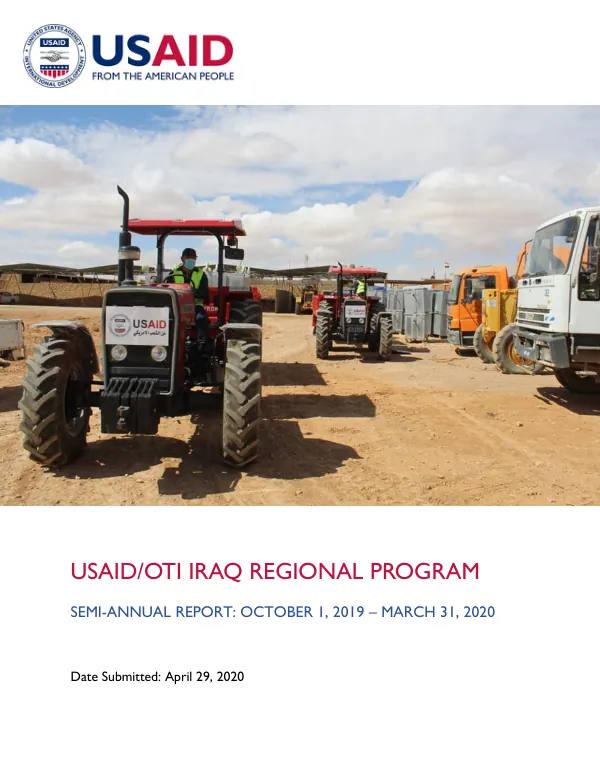
IRP uses a quick-response mechanism to implement activities in Western Anbar, Mosul, the Ninewa Plain, and Sinjar, leveraging ongoing stabilization and recovery efforts and seizing windows of opportunity. During the reporting period, IRP took the results of its September 2019 strategy review session and revised its strategic framework to focus on two program objectives: accelerating recovery in liberated areas and strengthening the social fabric of Iraqi communities. IRP launched 52 new activities worth an estimated $9 million with 43 partners during the reporting period, primarily across two conflict-affected Iraqi provinces. These activities included providing specialized equipment and vehicles to the Water Directorate in Mosul, rehabilitating the Mosul Cardiac Surgery Center, and enhancing critical service provision in the Ninewa Plain by allocating heavy machinery and equipment to public providers. The country context in Iraq remains challenging, with citizens continuing to suffer from limited basic services and worsening economic conditions. Two and a half years after the defeat of the Islamic State of Iraq and Syria (ISIS), infrastructure reconstruction and improvements to basic service delivery have progressed slowly, particularly in areas suffering from neglect prior to the ISIS invasion. The lack of economic opportunities and a paucity in resources have created unfavorable circumstances for encouraging the return of the estimated 1.4 million internally displaced persons (IDPs). Recent attempts by the Government of Iraq (GoI) to consolidate or close IDP camps have forced thousands to return to destroyed homes that lack basic services. The beginning of the reporting period marks a year of the tenure of Adil Abd al-Mahdi as a prime minister. His nomination in October 2018 was seen as a compromise, reached by Iraq's most influential political parties, to elect a weak candidate that would not oppose their political agendas. AAM subsequently struggled to form a full cabinet, and his first six months in power were shaped by political and armed factions' attempts to buy and sell ministerial positions. AAM had promised to tackle the presence of security actors outside state control, for the most part operating under the Popular Mobilization Forces (PMF) umbrella, formed in 2014 in response to Grand Ayatollah Ali al-Sistani's fatwa calling all able-bodied men to join the fight against ISIS. IRP continued working with the Iraqi Civil Defense to improve emergency response services, notably in response to fires and floods. IRP also supported small business owners in Mosul, the Ninewa Plain, and Sinjar by restoring shops and markets and delivering trainings. In Anbar, IRP equipped water stations with generators to improve potable water supply in remote villages. Across Ninewa and Western Anbar, IRP's assistance addressed issues challenging Iraq's social fabric in the post-ISIS era, including the return of IDPs and the social stigma associated with it.