ABT ASSOCIATES
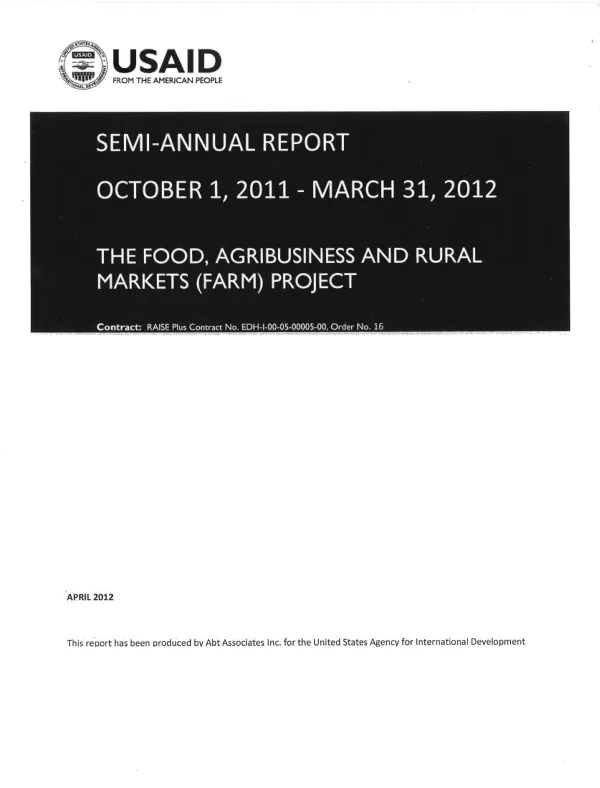
Semi-Annual Report: October 2011 - March 2012
The FARM Project, a USAID-funded initiative, has made significant progress in its technical components.
2012 · 63 pages
Sign in to readA free account is required to download.
Abstract
The project has expanded its beneficiary base to 310 farmer-based organizations (FBOs), comprising 6,795 members across the three Equatoria states. This expansion has been achieved through the successful implementation of the project's activities, including the training of farmers and the establishment of FBOs. The project has also shifted its operations from Budi County to Torit County in Eastern Equatoria State, due to security concerns in the former location. This shift has enabled the project to continue its activities without interruption. Additionally, the project has expanded its focus to include beans as one of its key crops, in addition to maize and other staple crops. In Component 1, Agricultural Productivity, the project has made notable progress in improving crop yields. The first and second yield assessments have been completed, and the results show that farmers who received improved maize seed varieties have achieved higher yields than in the baseline. However, there is still potential to expand yields, and the project is using the current cropping season to conduct on-farm demonstration trials to further improve yields. The project has also implemented various activities to improve agricultural productivity, including soil analysis, mechanized land preparation, and integrated pest management. These activities have been implemented in collaboration with local stakeholders, including farmers, extension agents, and government officials. In Component 2, Trade and Marketing, the project has made progress in linking commodity buyers to farmers' based organizations (FBOs). The project has also conducted market assessments and facilitated the participation of FBOs in the first agricultural trade fair in South Sudan. These activities have helped to improve market access for farmers and increase their incomes. In Component 3, Capacity Building, the project has implemented various training programs for farmers, extension agents, and government officials. These training programs have focused on improving agricultural productivity, trade and marketing, and capacity building. The project has also established a training of trainer model to ensure the sustainability of the training programs. The project has also made progress in policy, legislation, and regulatory framework, and has established synergies with donor and RSS partners. The project has also implemented grants to support farmers in improving their agricultural productivity and market access. Overall, the FARM Project has made significant progress in its technical components and has expanded its beneficiary base to 310 FBOs. The project has also shifted its operations to Torit County and has expanded its focus to include beans as one of its key crops. The project continues to implement various activities to improve agricultural productivity, trade and marketing, and capacity building, and has established synergies with local stakeholders to ensure the sustainability of its activities.
Related documents