USAID DEC
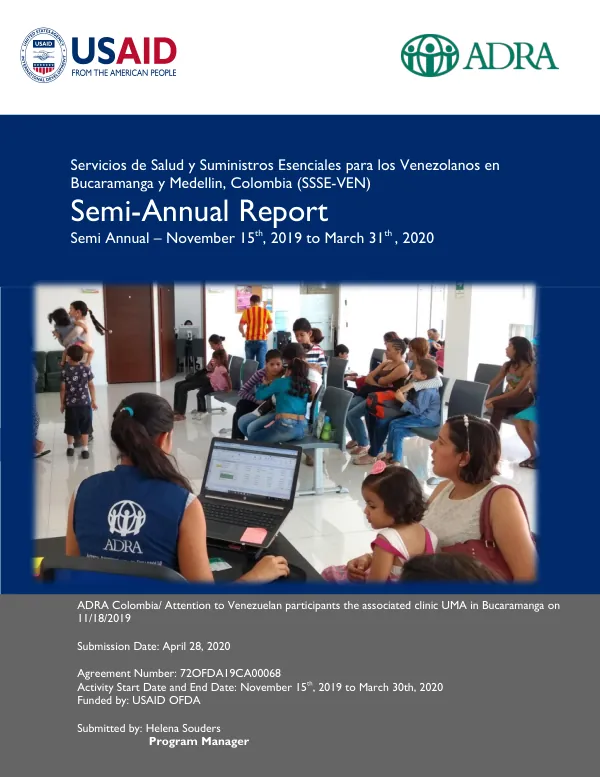
Servicios de Salud y Suministros Esenciales para los Venezolanos en Bucaramanga y Medellin, Colombia (SSSE-VEN) Semi-Annual Report
Sign inINTERNATIONAL ORGANIZATION FOR MIGRATION
Servicios de Salud y Suministros Esenciales para los Venezolanos en Bucaramanga y Medellin, Colombia (SSSE-VEN) Semi-Annual Report
The SSSE-VEN project, implemented by ADRA Colombia, aims to provide health services and essential supplies to Venezuelan migrants in Bucaramanga and Medellín, Colombia.
2020 · 20 pages
Sign in to readA free account is required to download.
Abstract
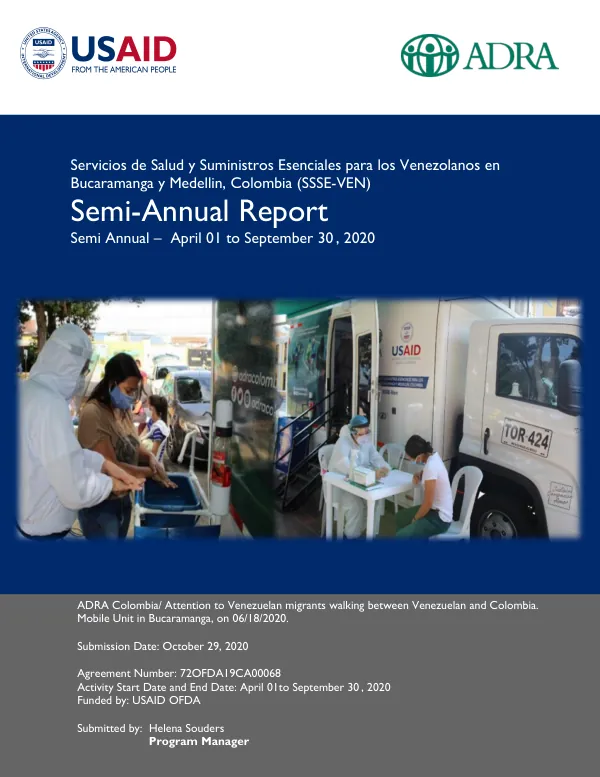
The project began on November 15, 2019, and is expected to benefit 45,780 people. The project's two sectors are Health and Water, Sanitation, and Hygiene (WASH). In the Health sector, project participants benefited from free primary care medical consultations, basic laboratory testing services, and essential medicines. A total of 5,724 consultations were realized through partner clinics, with 2,538 in Medellín and 3,186 in Bucaramanga. The age group that attended most of the visits were between 19 to 49 years old, followed by those between 5 to 14 years old. A total of 1,846 patients were diagnosed with contagious diseases, with 49% suffering from acute respiratory infection. Additionally, 2,624 patients with non-communicable diseases were treated, and 204 pregnant women received prenatal counseling. The WASH sector focused on providing essential relief items, including vouchers for beneficiaries to purchase WASH NFIs. A total of 3,200 vouchers were distributed, complemented by hand hygiene promotion to 12,800 people. The aim of the promotion was to reinforce good habits among the migrant population to avoid infectious diseases. During the first semester, 3,250 households representing 12,480 people were registered, with 54% women and 46% men. The program is expected to benefit 45,780 people, with 12,473 participants having benefited as of March 30. The benefits include 5,724 medical consultations, 4,965 individuals receiving medicines, 1,627 laboratory tests, 5,228 transportation assistance, and educational sessions on sexual and reproductive health. The ADRA MEAL team performed monitoring activities, surveying 505 patients and 461 households that received hygiene kits. The results showed that 99.8% of patients were completely satisfied with the care received, and 100% of households used the purchased items daily. The supplementary baby kit was also distributed to households with children between 0 and 5 years old, with 99.5% of recipients being satisfied with its quality and 99.3% with its contents. The project also worked in coordination with other entities to improve the quality of life of participants. Key activities included the donation of baby items by the Colombian Methodist Church, referral of beneficiaries to Profamilia for access to contraceptives, and coordination with IOM for breastfeeding workshops and delivery of kits. ADRA also participated in sectoral tables and national clusters to coordinate routes of care for migrants. The project's implementation was affected by the COVID-19 pandemic, which led to restrictions on the number of people allowed in places at a time and the isolation of the entire population. To mitigate the impact, the ADRA team continued to work from home, designing strategies to continue benefiting the migrant population while complying with regulations and health measures. The project's mobile unit was acquired to provide first response attention to Venezuelan migrants walking the route between Berlin and La Corcova. However, due to the COVID-19 pandemic, the border between Colombia and Venezuela is closed, and there is no transit for walkers. ADRA is analyzing the possibility of placing the mobile unit along other routes where there are still substantial numbers of Venezuelan migrants traveling by foot. The project's overall goal is to support the displaced Venezuelan migrants in Bucaramanga and Medellín through primary health care, health and hygiene messages, and the provision of essential relief items. The project's implementation is expected to continue until November 14, 2020, with the aim of benefiting 45,780 people.