GOVERNMENT OF COLOMBIA
Venezuela Regional Crisis - Complex Emergency Fact Sheet #1, FY 2018
Deteriorating conditions in Venezuela have triggered a significant influx of Venezuelans into neighboring countries, including Brazil, Colombia, and Ecuador.
2018 · 5 pages
Sign in to readA free account is required to download.
Abstract
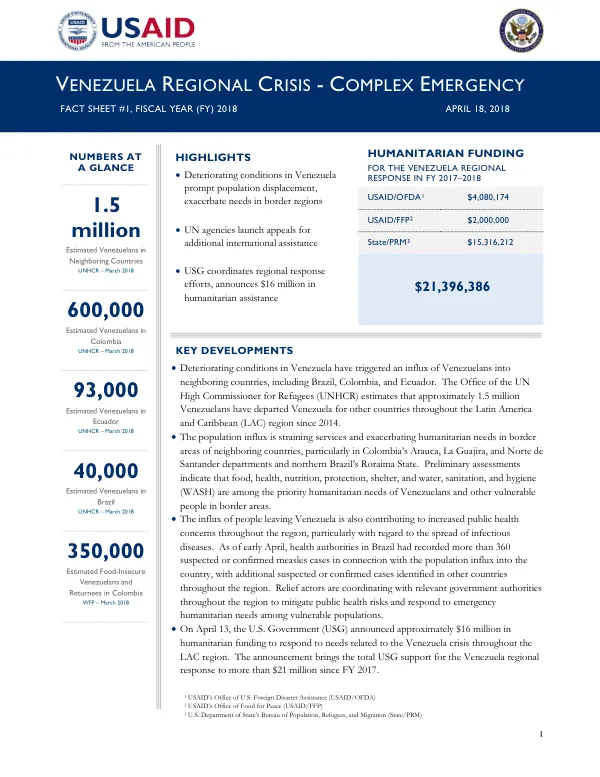
The Office of the UN High Commissioner for Refugees (UNHCR) estimates that approximately 1.5 million Venezuelans have departed Venezuela for other countries throughout the Latin America and Caribbean (LAC) region since 2014. The population influx is straining services and exacerbating humanitarian needs in border areas of neighboring countries, particularly in Colombia's Arauca, La Guajira, and Norte de Santander departments and northern Brazil's Roraima State. Preliminary assessments indicate that food, health, nutrition, protection, shelter, and water, sanitation, and hygiene (WASH) are among the priority humanitarian needs of Venezuelans and other vulnerable people in border areas. The influx of people leaving Venezuela is also contributing to increased public health concerns throughout the region, particularly with regard to the spread of infectious diseases. As of early April, health authorities in Brazil had recorded more than 360 suspected or confirmed measles cases in connection with the population influx into the country. The U.S. Government (USG) has announced approximately $16 million in humanitarian funding to respond to needs related to the Venezuela crisis throughout the LAC region. The assistance includes a $12 million contribution toward the recently released UNHCR supplementary budget appeal, which requests $46 million to support vulnerable Venezuelans throughout the LAC region. The newly announced funding supplements an initial $2.5 million in USAID funding announced in mid-March by USAID Administrator Mark Green. Colombia has been particularly affected by the influx of Venezuelans, with at least 600,000 people departing Venezuela and seeking shelter in Colombia as of mid-March, according to UNHCR. Relief actors report that population estimates remain difficult to verify given fluid cross-border migration and the likely use of informal border crossings. The influx of Venezuelans and returning Colombians continues to strain services, including health care and WASH infrastructure, in host communities receiving populations from Venezuela. In late 2017, UNHCR surveyed more than 8,100 people in Colombia, of which the majority were populations originating from Venezuela. Survey results indicated that inadequate access to food and employment opportunities, as well as insecurity and inadequate access to health care services and medicines, in Venezuela were among the primary drivers of population displacement from the country. Additionally, respondents originating from Venezuela identified general insecurity and insufficient income to meet basic needs as the primary protection risks preventing them from returning to areas of origin in Venezuela. The Government of Colombia (GoC) commenced nationwide registration activities to identify Venezuelan populations in Colombia on April 6. Colombian authorities are conducting the registration campaign across 22 departments and the capital city of Bogotá to identify vulnerable Venezuelans and inform humanitarian assistance efforts. Recent USAID/OFDA rapid needs assessments indicate vulnerable Venezuelans and Colombian returnees in Arauca, La Guajira, and Norte de Santander lack access to health care and other essential services and sufficient income to meet basic household needs. In Brazil, the influx of people from Venezuela into Roraima is straining existing services, particularly in Boa Vista and Pacaraima municipalities, prompting the Government of Brazil (GoB) to declare a situation of vulnerability in the state. According to UNHCR, approximately 40,000 Venezuelans were sheltering in Brazil as of mid-March; the UN agency estimates that approximately 800 Venezuelans are entering Roraima on average each day, reporting that new arrivals appear vulnerable and in need of urgent humanitarian assistance. The GoB has commenced efforts to relocate Venezuelans sheltering in Roraima to more centralized areas of the country, citing the need to alleviate overcrowded conditions in the state and increase vulnerable populations' access to basic services and livelihoods opportunities. In close coordination with UNHCR and the International Organization for Migration (IOM), the GoB has facilitated the voluntary relocation of approximately 600 Venezuelans from Roraima to other areas of Brazil, including Mato Grosso and São Paulo states, as of early April.
Related documents