INSTITUTO COLOMBIANO PARA EL BIENESTAR FAMILIAR
Quarterly Technical Report: April – June 2020
The Regional Governance Activity (RGA) in Colombia began on June 22, 2015, with an initial period of performance of four and a half years.
2020 · 60 pages
Sign in to readA free account is required to download.
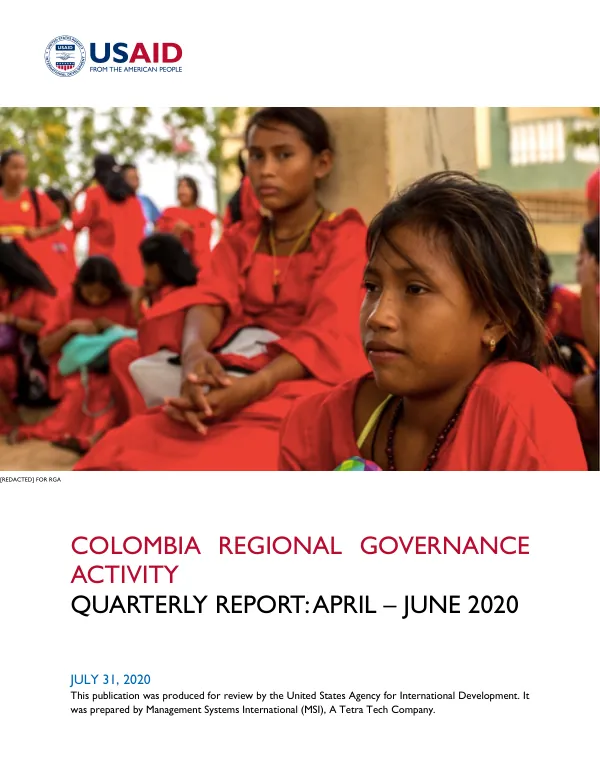
Abstract
The program's original objective was to improve governance in 40 Colombian municipalities affected by the nation's armed conflict through five program components: decentralization, public financial management, tertiary roads, citizen participation, and electoral reform. On April 23, 2019, RGA was awarded a six-month cost extension to June 21, 2020, which added a sixth component and adjusted RGA's territorial focus to concentrate on 10 subnational governments (SNGs) in three border departments—Arauca, La Guajira, and Norte de Santander—to help them cope with the challenges created by the influx of Venezuelan migrants and Colombian returnees in host communities. RGA's focus shifted to COVID-19 prevention, containment, and recovery, and broadened the project's geographic focus, following a second cost extension on June 17, 2020, through June 21, 2021. This amendment increased the Total Estimated Cost (TEC) by USD$10 million. The program's quarterly report covers RGA activities between April and June 2020, corresponding to the third quarter of the 2020 fiscal year. The report highlights RGA's support to SNGs to improve health service provision. Following assistance to the Ministry of Health to draft and issue Decree 064, RGA focused on increasing migrant and returnee access to Colombia's health system. To do so, the program focused on census list creation and database maintenance, achieving the registration in census lists of more than 8,000 people, including nearly 6,000 migrants, who now have access to the health system. RGA also provided support to SNGs to improve education service provision. Recognizing the challenges of delivering education services remotely, the program provided assistance to train public school teachers from Arauca, La Guajira, and Norte de Santander in online and remote methodologies. Through online forums, workshops, and radio programs, RGA provided support to develop teachers' skills in psychological support, radio production, the creation of online educational content, and methodologies to detect cyber-bullying and other cyber risks. The program's progress is reflected in the registration of more than 8,000 people, including nearly 6,000 migrants, in census lists, providing them access to the health system. RGA's support to SNGs to improve education service provision has also contributed to the development of teachers' skills in online and remote methodologies. RGA's coordination with USAID implementing partners and international donors has been crucial in achieving the program's objectives. The program has worked closely with the Ministry of Health, the Ministry of Education, and other stakeholders to implement its activities. RGA has also collaborated with international donors, such as the United Nations High Commissioner for Refugees (UNHCR) and the United Nations Children's Fund (UNICEF), to leverage resources and expertise. RGA's success story, "Working Together toward Progress," highlights the program's achievements in improving health and education services in the target areas. The story showcases the collaboration between RGA, SNGs, and other stakeholders in implementing the program's activities and achieving its objectives. The program's progress is reflected in the