USAID DEC
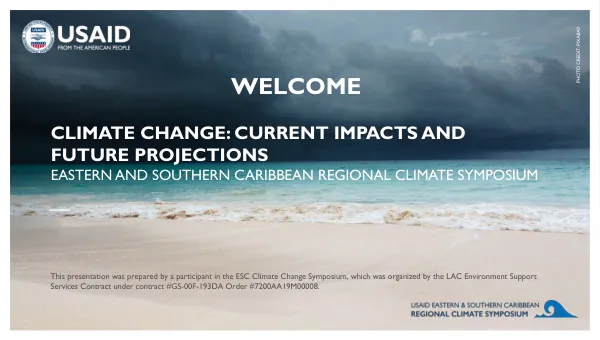
Session 2. Climate Change: Current Impacts and Future Projections
Climate change poses significant threats to the Eastern and Southern Caribbean region.
2021 · 64 pages
Sign in to readA free account is required to download.
Abstract
Rising temperatures and altered precipitation patterns are projected to exacerbate existing climate-related hazards. The region's vulnerability to climate change is compounded by its small island geography and limited economic resources. Climate models indicate a warming trend of +1°C to 5°C by 2100, accompanied by a drying trend of 25-30% less rainfall. Sea level rise is also expected, with projections suggesting a +1m increase in the future. These changes will have far-reaching impacts on the region's ecosystems, economies, and human populations. The Caribbean Institute for Meteorology and Hydrology plays a crucial role in monitoring and predicting climate-related hazards. As a WMO Regional Climate Centre, the institute collects, stores, and disseminates climate data, providing critical information for decision-makers. The institute's research focus includes climate extremes, such as heatwaves, droughts, and storms, which are expected to increase in frequency and severity. Climate risk is a function of hazard severity, probability, vulnerability, and exposure. The IPCC defines climate risk as the product of hazard impact potential, vulnerability, and exposure. In the context of the OECS region, climate risk is projected to increase due to rising temperatures, altered precipitation patterns, and sea level rise. Adaptation strategies, such as early warning systems and climate-resilient infrastructure, are essential for mitigating the impacts of climate change. The region's small island states are particularly vulnerable to climate change. Dr. Mark Bynoe, Assistant Executive Director at the Caribbean Community Climate Change Centre, has highlighted the need for innovative adaptation and mitigation strategies. These strategies must take into account the unique challenges and opportunities presented by the region's geography, economy, and culture. By working together, regional governments, international organizations, and local communities can develop effective climate change adaptation and mitigation plans.
Related documents