INTERNATIONAL ORGANIZATION FOR MIGRATION
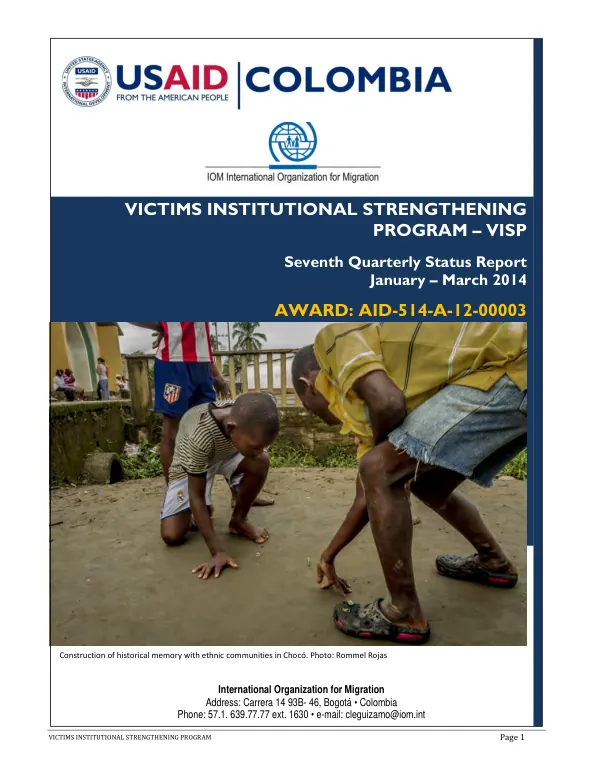
Seventh Quarterly Status Report: Victims Institutional Strengthening Program
The Victims Institutional Strengthening Program (VISP) is a three-year initiative aimed at strengthening the capacity of the Government of Colombia (GoC) institutions to implement the Victims Law.
2014 · 50 pages
Sign in to readA free account is required to download.
Abstract
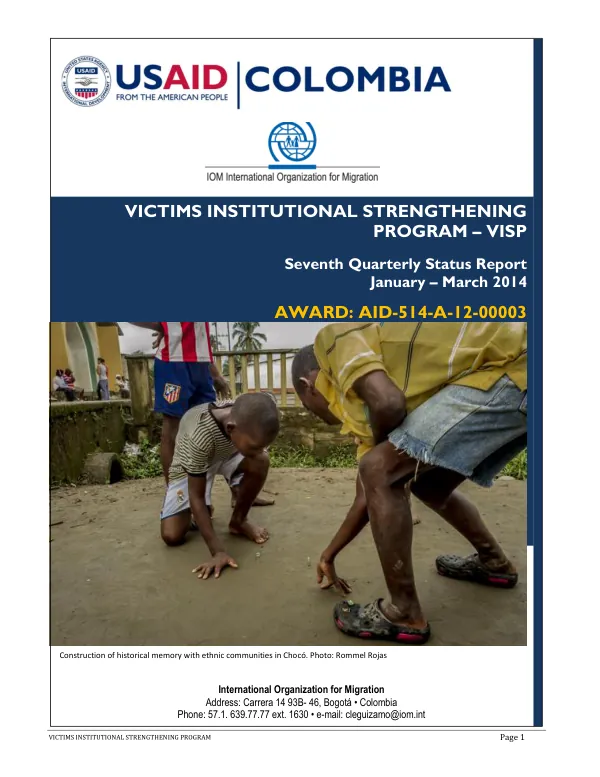
The program is implemented by the International Organization for Migration (IOM) and has a total confirmed funding of $40,870,000. The program's objective is to ensure that GoC institutions, policies, and systems at the national, departmental, and municipal levels are effectively implemented for the effective implementation of the Victims Law. During the first quarter of 2014, the program made significant progress in each of its four intermediate results. In Intermediate Result 1, the Temporary Victims Single Registry (RUV) was completed and transferred to the Victims Unit, and support was provided to renovate and improve Regional Assistance Centers for Victims in seven municipalities. In Intermediate Result 2, training was provided to 48 psychosocial professionals from the ERE strategy, and an encounter was held with the Ministry of Health, PAICMA, and the Victims Unit on landmines, physical rehabilitation, and community interventions. In Intermediate Result 3, support was provided to the Victims Unit to implement the collective reparation route with five collective groups, and initial steps were taken for six historical memory projects that will be carried out in 2014. In Intermediate Result 4, support was provided to two Afro-Descendant organizations in Chocó to carry out historical memory processes with diversity mainstreaming. The program faced challenges during this period, including the need to rapidly carry out actions at the local level and address gaps and obstacles in the assistance, attention, and reparation routes. The program will prioritize the completion of the development of the ten information system modules and their transfer to the Victims Unit in the upcoming period, as well as the development of resistance strategies for changes and the adoption of new tools. The program's work was affected by two aspects of the Colombian political and social context during the first quarter of 2014. Firstly, calls to accelerate the implementation of the Victims Law and land restitution processes increased in the electoral period, and the program was required to provide support in identifying bottlenecks and contributing to comprehensive reparation at the local level. Secondly, the end of the unilateral ceasefire announced by FARC-EP led to an increase in displacements and attacks against the civil population, particularly against ethnic groups and women. The program has seen an increase in its participation in alliances with the Government of Colombia and other civil society actors, focusing on promoting participatory processes and participation strategies for victims, as well as increasing societal consciousness and visibility of the current challenges presented by landmines, sexual violence against women, and the situation of children, adolescents, and youth in post-conflict settings.