INTERNATIONAL ORGANIZATION FOR MIGRATION
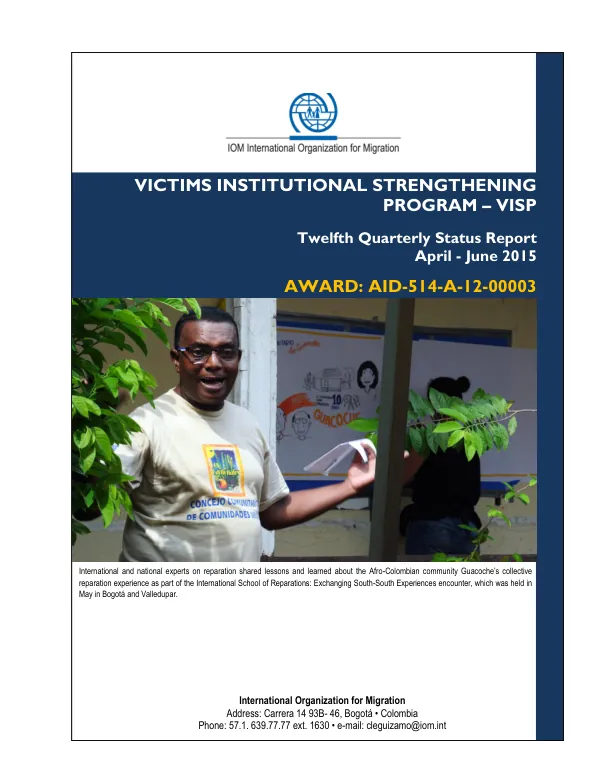
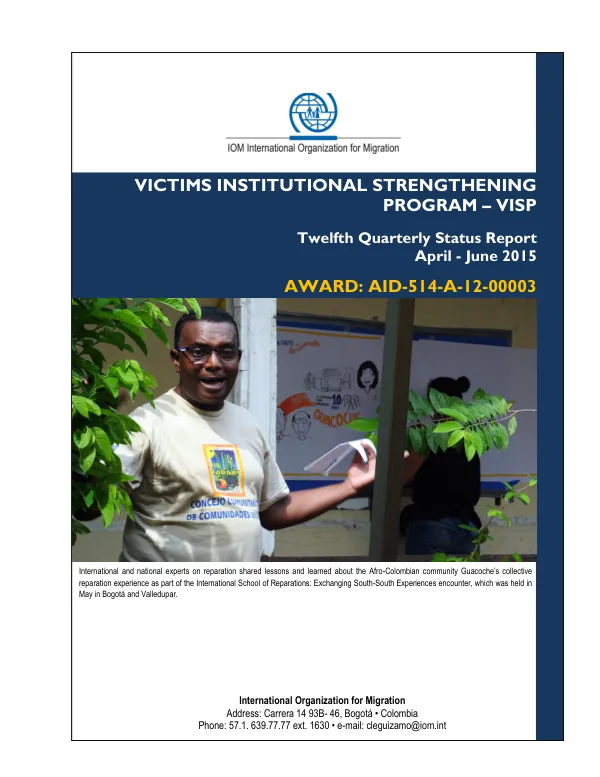
Twelfth Quarterly Status Report: Victims Institutional Strengthening Program
The Victims Institutional Strengthening Program (VISP) is a strategic initiative aimed at providing accompaniment and technical support for the Government of Colombia's (GoC) policies, systems, and institutions at the national, departmental, and municipal levels.
2015 · 57 pages
Sign in to readA free account is required to download.
Abstract
The program's objective is to strengthen capacities and build necessary competencies for the timely and effective execution and implementation of the Victims Law. During the twelfth quarter, from April 1 to June 30, 2015, VISP made significant progress in each of its four intermediate results. Intermediate Result 1 focused on supporting the Victims Unit's implementation of the Comprehensive Route, which involved the election of municipal, departmental, and national victims participation roundtables for 2015-17. VISP also supported the renovation and inauguration of Victims Attention Points in three communities. Intermediate Result 2 aimed to improve rehabilitation services for the wellbeing of citizens. During this quarter, self-care policies were included within the Victims Unit's and the Ministry of Health's institutional and human resources structures, ensuring sustainability long-term. Regional trainings for the Victims Psychosocial and Comprehensive Health Program (PAPSIVI) Phase III were held, and teams from the Victims Unit, the Attorney General's Office, and other GoC entities were qualified. Intermediate Result 3 focused on transitional justice processes. VISP supported sessions with the Victims Unit to hand over the first financial compensations of 2015 to victims, and provided guidance on how victims can invest said compensations. The International School of Reparations network was launched, and the Human Rights Archive Toolbox for Memory Managers was publicly launched. Intermediate Result 4 aimed to strengthen the capacity of GoC institutions and systems to accommodate the specific needs of ethnic groups and women. During this quarter, VISP supported the training of more than 200 public servants from governor's offices and mayor's offices of capital cities in 10 departments on ethnic decree-laws and the special rights of ethnic groups. VISP also coordinated efforts between the Victims Unit and the National Historical Memory Center to hold sessions with 64 LGBT victims from four cities to validate the first version of the historical memory report for this community. The implementation of the Comprehensive Victims Attention and Reparation Route had implications for the program's implementation, requiring additional labor to support the integration of information systems and existing applications, the re-training of public servants, and the implementation of the strategy to clear more than 300,000 rights of petition and writs of protection. The program's financial report for the quarter shows a total confirmed fund of USD 65,452,500, with total federal funds authorized at USD 56,322,579, total cash receipts at USD 35,870,000, and total cash disbursements at USD 38,184,528.