INTERNATIONAL ORGANIZATION FOR MIGRATION
Tenth Quarterly Status Report: Victims Institutional Strengthening Program
The Victims Institutional Strengthening Program (VISP) is a strategic initiative aimed at providing accompaniment and technical support for the Government of Colombia's (GoC) policies, systems, and institutions at the national, departmental, and municipal levels.
2014 · 57 pages
Sign in to readA free account is required to download.
Abstract
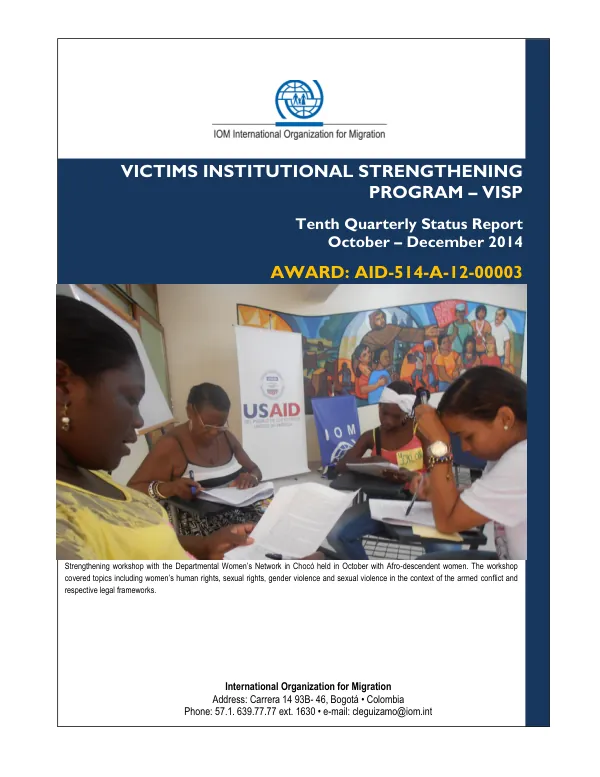
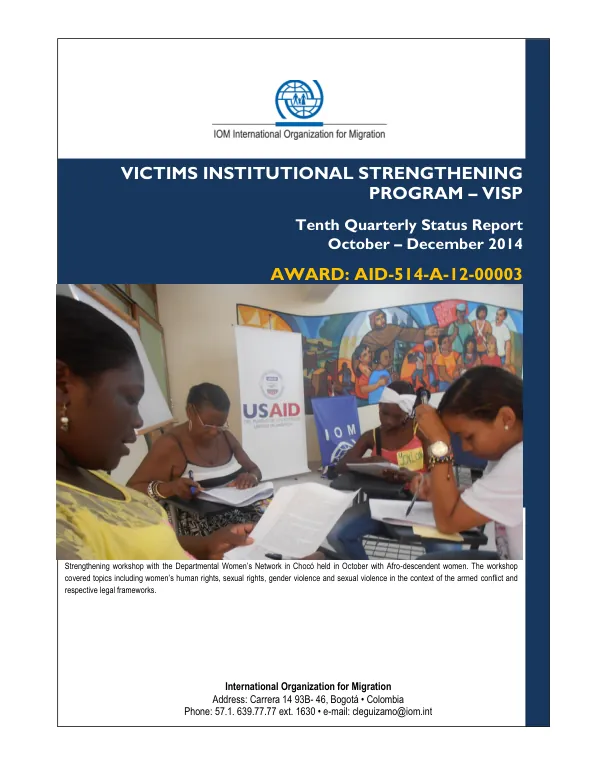
The program's objective is to strengthen capacities and build necessary competencies for the timely and effective execution and implementation of the Victims Law. During the period from October 1 to December 31, 2014, VISP made significant progress in each of its four intermediate results. Intermediate Result 1 focused on improving the victims' attention points in Cartagena and Fundación, resulting in victims having access to inter-institutional teams and services for assistance, attention, and comprehensive reparation in dignified conditions. Intermediate Result 2 involved the institutionalization of the self-care strategy for the Victims Unit through the Human Talent Office as part of psychosocial welfare for persons attending to victims. Additionally, a methodological proposal to incorporate a differential approach for children and adolescents and victims of the armed conflict in the Registry to Locate and Characterize Persons with Disabilities (RLCPD) was completed. Intermediate Result 3 saw the issuance of Decree 2569 of 2014, which establishes procedures to deliver emergency humanitarian attention and transitional aid for victims of forced displacement, as well as criteria to evaluate overcoming vulnerability. This decree modifies politics for humanitarian attention to displaced populations in Colombia and was technically assisted by VISP. Intermediate Result 4 involved the design of 27 projects for communities of ethnic victims, with 2 projects approved. A proposal was constructed for the organizational strengthening of indigenous communities, and four prototypes were completed, including the design of life plans, ethnic-development plans, production of cacao, and financing victims' return plans. Furthermore, 19 learning circles directed at 194 female victims of sexual violence were held in various cities, resulting in the development of an applied methodology to strengthen the participation and protection of female victims of sexual violence. The increased visibility of victims in the public agenda, given discussions at the negotiating table in Havana and the presence of victims' delegations, has increased the prominence of the advances and challenges of the Victims Law, particularly its implementation at the local level. As a result, the Victims Unit has concentrated its efforts on finding political and opinion-based support to respond to victims' demands, issuing the decree to modify humanitarian assistance for victims of displacement and the Ministry of the Interior's initiative to territorialize the Victims Law. The program has responded to emerging requests from the Victims Unit, including the dissemination of evaluations on the reparation model and changes in humanitarian assistance to displaced persons. Additionally, the program is actively involved in supporting the implementation of the Victims Law, particularly in the areas of humanitarian assistance and attention measures. The program's financial report for the quarter shows a total confirmed fund of $65,452,500, with total federal funds authorized at $56,322,579 and total cash disbursements at $29,993,317. The program's activities and achievements during this quarter demonstrate its commitment to supporting the implementation of the Victims Law and improving the lives of victims in Colombia.