INTERNATIONAL ORGANIZATION FOR MIGRATION
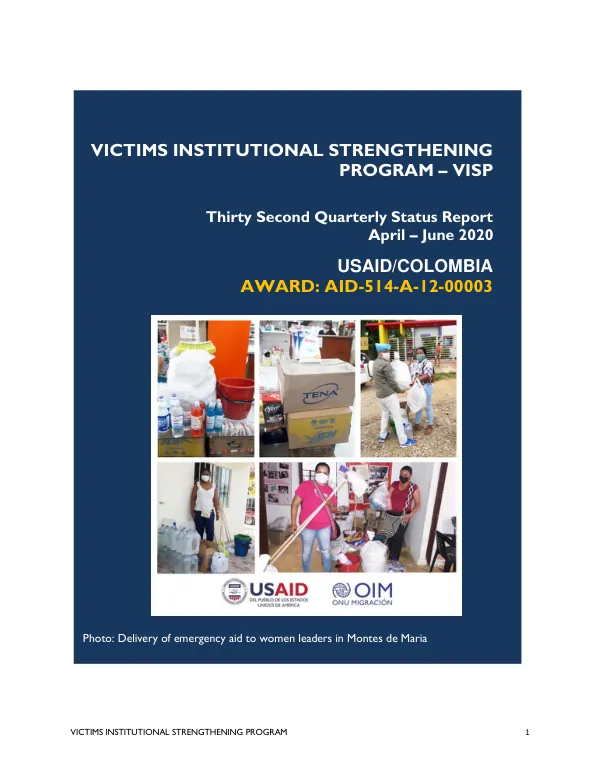
Thirty Second Quarterly Status Report: Victims Institutional Strengthening Program
The Victims Institutional Strengthening Program (VISP) is a USAID-funded initiative aimed at providing accompaniment and technical support to the Government of Colombia (GOC) in implementing the Victims Law (Law 1448 of 2011).
2020 · 55 pages
Sign in to readA free account is required to download.
Abstract
The program's strategic objective is to strengthen capacities and build necessary competencies for the timely and effective execution and implementation of the Victims Law at the national, departmental, and municipal levels. During the reporting period from April 1st to June 30th, 2020, VISP made significant progress in each of its five intermediate results. In Intermediate Result 1, VISP finalized and delivered the Integrated Information System for Post-Conflict (SIIPO) to the National Planning Department (DNP) and supported the adjustment of the victims' and land restitution policy financing plan. The program also concluded Phase 7 of the Strengthening Model for Territorial Entities (EETT) and initiated Phase 8, which aims to target 15 territorial entities. In addition, VISP supported territorial entities in Caquetá, Cauca, and Nariño to include the victims' comprehensive attention, care, and reparation public policy in Territorial Development Plans drafts. The program also delivered the Victims' Public Policy Balance to the Victims Unit and shared it with other national-level entities, including the DNP and the Ministry of Finance. Intermediate Result 2 focused on supporting the Ministry of Health's (MOH) rehabilitation measures' territorializing process by implementing the Psychosocial Attention and Comprehensive Health Care for Victims Program (PAPSIVI). VISP also adjusted and validated the Psychosocial Rehabilitation Program, which aims to provide comprehensive care and support to victims of conflict. In Intermediate Result 3, VISP advanced transitional justice processes by supporting the GOC in implementing reparations for conflict victims. The program also worked with the Truth Commission to strengthen the National Victims' Effective Participation Board (MNPEV) and improve the victims' participation in the transitional justice process. Intermediate Result 4 aimed to select GOC institutions and systems that accommodate the specific needs of ethnic groups and women. VISP supported the strengthening of select ethnic communities in their design, implementation, monitoring, and evaluation roles under victim legislation. The program also improved support and care services for victims of sexual violence in target municipalities. Finally, Intermediate Result 5 focused on peace for victims, with VISP supporting the GOC in implementing peace accords on victims and reparation. The program worked with the Special Jurisdiction for Peace (JEP) to strengthen the Integral System for Truth, Justice, Reparation, and non-Repetition (SIVJRNR) and improve the victims' access to justice and reparations. Overall, VISP's progress during the reporting period demonstrates the program's commitment to supporting the GOC in implementing the Victims Law and strengthening capacities and competencies at the national, departmental, and municipal levels.