USAID DEC
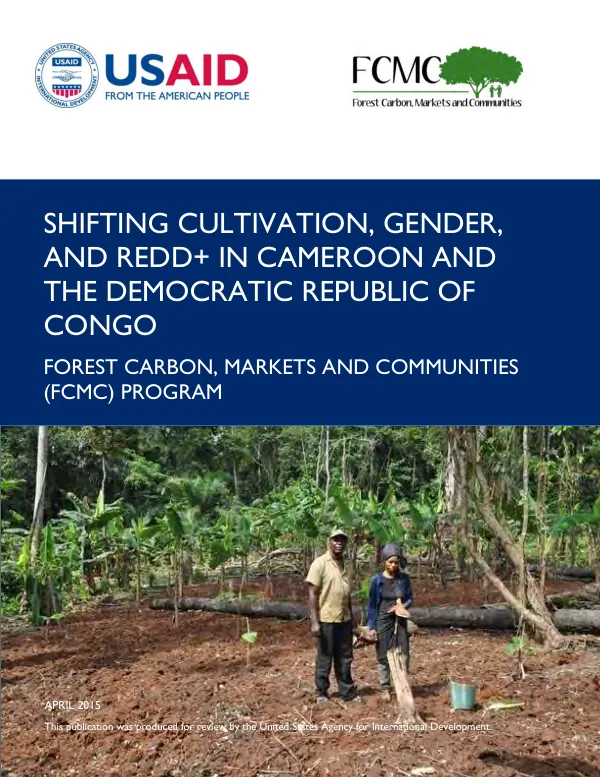
Shifting Cultivation, Gender, and REDD+ in Cameroon and the Democratic Republic of Congo
Sign inTETRA TECH
Shifting Cultivation, Gender, and REDD+ in Cameroon and the Democratic Republic of Congo
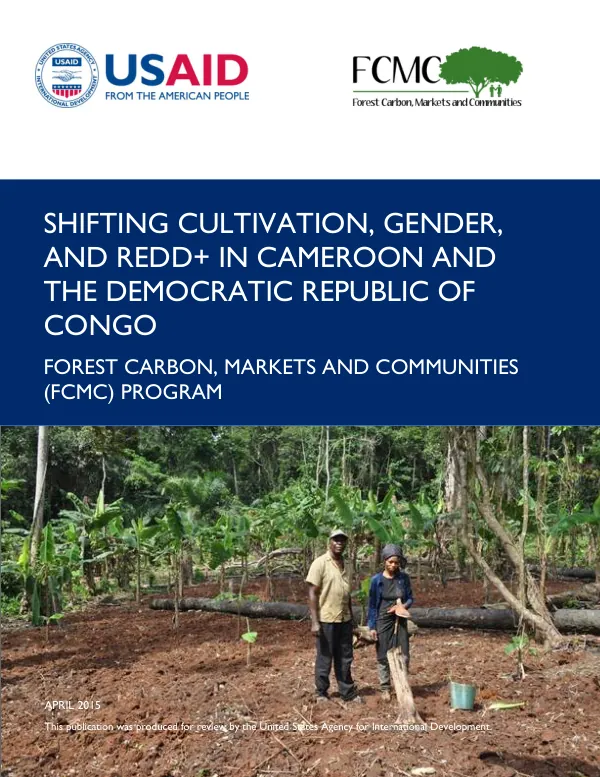
Shifting cultivation, a common agricultural practice in the Congo Basin, involves clearing land through burning and cultivating crops for a short period before abandoning the field and moving to a new location.
2015 · 48 pages
Sign in to readA free account is required to download.
Abstract
This practice is widespread in the Democratic Republic of Congo (DRC) and Cameroon, where it is often associated with deforestation and forest degradation. The Congo Basin forests are of great importance, covering an area of approximately 2 million square kilometers and accounting for 18% of the world's tropical forests. These forests are home to a diverse array of plant and animal species, and play a crucial role in regulating the global climate. However, the forests are under threat from deforestation and forest degradation, primarily driven by the expansion of agriculture, urbanization, and logging. In the DRC and Cameroon, REDD+ (Reducing Emissions from Deforestation and Forest Degradation) strategies aim to reduce greenhouse gas emissions from deforestation and forest degradation. However, the effectiveness of these strategies is often hindered by the complex social and economic factors driving deforestation and forest degradation. Shifting cultivation is a key driver of deforestation and forest degradation in the region, and its impact on gender roles and relationships is a critical consideration in REDD+ policy and implementation. Field studies conducted in the DRC and Cameroon between November 2012 and March 2013 found that shifting cultivation is a complex and multifaceted practice that is deeply embedded in local cultures and economies. The studies identified several key drivers of shifting cultivation, including poverty, lack of access to land and resources, and limited market opportunities. The studies also highlighted the importance of considering the social and economic context in which shifting cultivation takes place, including the role of women and other vulnerable groups. The studies found that women play a critical role in shifting cultivation, often responsible for clearing land, planting and harvesting crops, and managing household resources. However, women's participation in shifting cultivation is often limited by lack of access to land, credit, and other resources. The studies also highlighted the need to consider the impact of REDD+ policies on women's livelihoods and well-being, and to ensure that women's voices and perspectives are included in decision-making processes. The field studies identified several key policy suggestions for addressing the complex social and economic factors driving deforestation and forest degradation in the DRC and Cameroon. These include developing new and/or sharing and enhancing existing analytical tools to study deforestation drivers and the environmental impact of shifting cultivation, valuing farmers' knowledge, choices, and innovation, and widening the range of options available to local farmers. The studies also emphasized the need to secure land tenure rights, question the REDD+ process in depth as a function of adaptive learning and management, and provide the right incentive framework through REDD+ policies. In conclusion, the field studies conducted in the DRC and Cameroon highlight the complex social and economic factors driving deforestation and forest degradation in the region. The studies emphasize the need to consider the impact of REDD+ policies on women's livelihoods and well-being, and to ensure that women's voices and perspectives are included in decision-making processes. The policy suggestions identified in the studies provide a framework for addressing the complex social and economic factors driving deforestation and forest degradation in the DRC and Cameroon, and for promoting sustainable forest management and conservation in the region.