USAID DEC
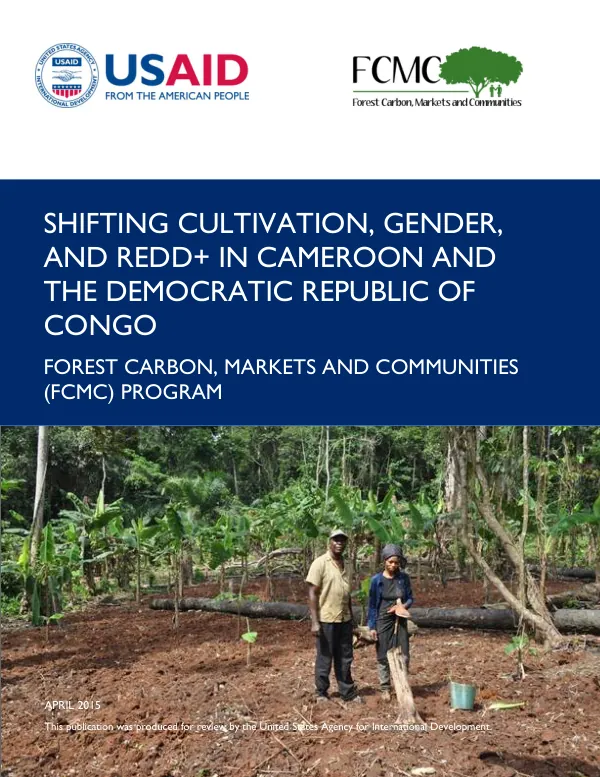
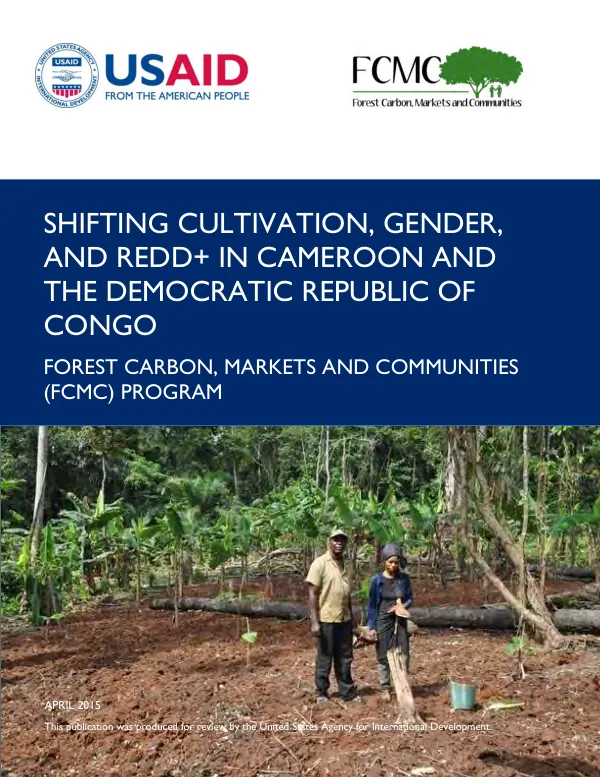
Shifting Cultivation, Gender, and REDD+ in Cameroon and the Democratic Republic of Congo
Sign inUSAID
Shifting Cultivation, Gender, and REDD+ in Cameroon and the Democratic Republic of Congo
Shifting cultivation is a natural resource management system that underpins food production and livelihoods in the forest zones of Central Africa and many other countries.
2015 · 4 pages
Sign in to readA free account is required to download.
Abstract
It has been identified as a key driver of deforestation in Central Africa and is the focus of many international initiatives and projects that come under the rubric of REDD+ (Reducing Emissions from Deforestation and Forest Degradation and the role of conservation, sustainable management of forests and enhancements of forest carbon stocks). In the Democratic Republic of Congo (DRC) and Cameroon, shifting cultivation is the primary form of agriculture practiced in primary and secondary forests. The shifting cultivation systems discussed here largely produce subsistence crops, although households also produce crops for sale and grow perennial cash crops such as cocoa and coffee. Women carry out the bulk of agricultural labor, although in some areas men clear and burn the sites in preparation for planting. Women play a critical role in agriculture in these regions, but their role in REDD+ has been limited. In Cameroon, cocoa agroforestry provides significant incomes, but plantations are distinct from food-crop fields and are typically controlled by men. The success of smallholder cocoa cultivation attracts people to the forest frontier, leading to the establishment of new cocoa plantations in forests. With the development of road networks, larger investors are also attracted to forest areas to establish large-scale oil palm and rubber tree plantations. This trend of large-scale plantations is already developing in Cameroon, although not at the sites visited. In the DRC, cultivation of perennial cash crops such as coffee, cocoa, and plantains has been declining since the 1990s. This trend has decreased household cash income and placed household food security at risk. Household vulnerability has been exacerbated further by weak markets, increased crop damage from disease, and declining returns from hunting and fishing. The DRC is currently considered the most food-insecure country in the world according to the Global Food Security Index. In many areas, security of tenure for smallholders is weak, and large-scale agricultural, forestry, and mining concessions predominate as land uses. Given this situation, securing tenure rights and supporting smallholder farmers and other forest dwellers practicing shifting cultivation and other small-scale economic activities may help reduce the risk of larger-scale deforestation carried out by outside loggers and large-scale plantation or other investors. It could also contribute to the reduction of poverty. However, there is no guarantee that this course of action will reduce deforestation if other key constraints remain in place. REDD+ and Payment for Ecosystem Services (PES) projects have considered shifting cultivation an unsustainable land use. This perception has been widespread since the colonial era. Some projects propose alternatives such as crop rotation, fire suppression, plowing, agroforestry, conservation agriculture, perennial crops, and income-generating activities. While some farmers appreciate these interventions, many expressed concerns to the study team. Women in particular noted that many proposed techniques required additional labor, which the women were unwilling or unable to provide. Support for the commercialization of non-timber forest products was a positive exception. The unpopularity of shifting cultivation alternatives with some intended project beneficiaries, and the failure of certain of the proposed alternatives to meet local needs, may generate anti-conservation and/or anti-nongovernmental organization (NGO) resentments among farmers. Overall poor relations between local and state actors likely exacerbate these negative perceptions. For example, according to some farmers interviewed, forest rangers, or eco-guards, often do not respect the civil rights of the villagers and make no distinction between subsistence and commercial hunting. Financial transfers to local communities are promoted through community forestry operations, PES schemes, and conventional rural development activities. In all visited sites, local associations or committees channel and manage the money. Most of these are newly created with support from an NGO or project proponent. Many of the villagers interviewed criticized these local institutions for favoring the relatives and friends of their leaders (elite capture), for their lack of transparency, and for spending money on activities that had limited or no positive impact. Based on these and other findings, the field team offers the following observations to stimulate reflection and guide support for REDD+ programming: Policymakers need to recognize and take into account farmers' capacity to make decisions based on their own means, interests, and experiences. Rather than planning the activities of farmers in a top-down way, REDD+ promoters and managers should work with target beneficiaries to jointly develop appropriate options and incentives to reconcile farmers' objectives (sustainable livelihoods) with the global agenda (conservation and greenhouse gas emission reductions). The "committee-based natural resources management" approach should be more thoroughly assessed, and its promoters should analyze it as a management strategy. To balance the "committee-based" approach, alternative strategies need to be explored and possibly developed in which individual farmers or families could participate and receive direct benefits from forest conservation, which in turn would have to be reconciled with notions of common property regimes. They could become shareholders in a carbon or mixed carbon-commodity enterprise. History has shown that