USAID DEC
Shifting Cultivation, Gender, and REDD+ in Cameroon and the Democratic Republic of Congo
Sign inTETRA TECH
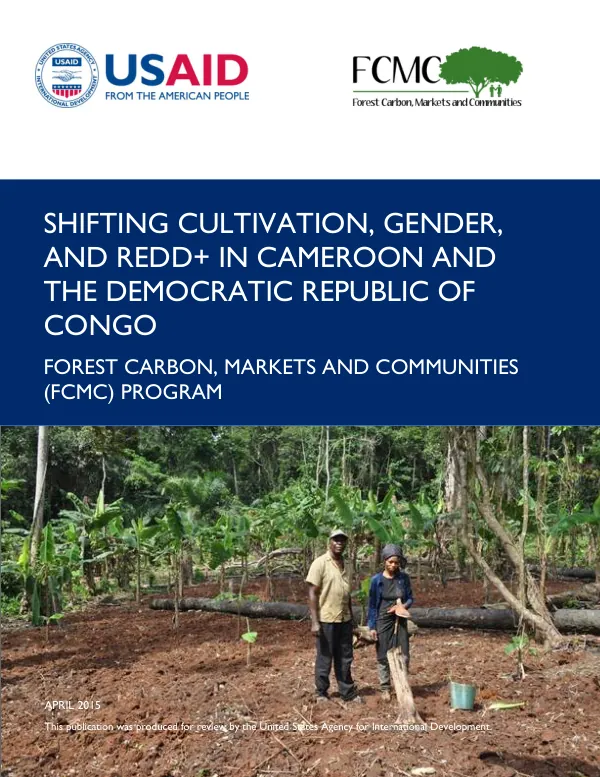
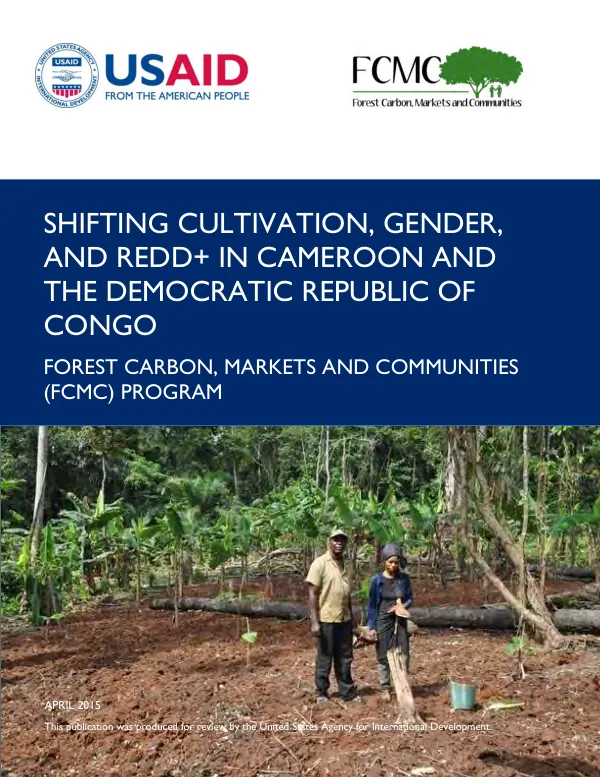
Shifting Cultivation, Gender, and REDD+ in Cameroon and the Democratic Republic of Congo
Shifting cultivation, a farming practice characterized by the clearing of land through burning, is a widespread phenomenon in the Congo Basin forests of Cameroon and the Democratic Republic of Congo (DRC).
2015 · 48 pages
Sign in to readA free account is required to download.
Abstract
This practice has significant implications for forest conservation and the livelihoods of local communities. The Forest Carbon, Markets and Communities (FCMC) Program, supported by the United States Agency for International Development (USAID), conducted field studies in 2012-2013 to explore the dynamics of shifting cultivation in these countries. The Congo Basin forests are of great importance, covering an area of approximately 2 million square kilometers and accounting for 18% of the world's tropical forests. However, these forests are under threat due to deforestation and forest degradation, primarily driven by agricultural expansion, urbanization, and logging. Shifting cultivation is a key driver of deforestation in the region, with an estimated 70% of forest loss attributed to this practice. The FCMC Program's field studies were conducted in several locations in the DRC and Cameroon, including Kesenge, Yalungu, Bossonongo, Mampu, and Tsumba-Kituti in the DRC, and Nkolényeng, Mintom, Akom, Belleville, Lélé, Lomié, Kongo, Nomedjoh, and Ebebda in Cameroon. The studies aimed to understand the causes and consequences of shifting cultivation, as well as the role of gender in this practice. The research found that shifting cultivation is a complex phenomenon, with both positive and negative impacts on the environment and local communities. On the one hand, shifting cultivation can provide a means of livelihood for local farmers, particularly in areas where other economic opportunities are limited. On the other hand, the practice can lead to soil degradation, loss of biodiversity, and increased greenhouse gas emissions. The study also highlighted the importance of gender in shifting cultivation, with women playing a crucial role in the practice. Women are often responsible for preparing the land, planting crops, and managing household resources. However, they also face significant challenges, including limited access to land, credit, and markets. The FCMC Program's findings have important implications for REDD+ (Reducing Emissions from Deforestation and Forest Degradation) initiatives in the DRC and Cameroon. REDD+ aims to reduce greenhouse gas emissions from deforestation and forest degradation by providing financial incentives to countries and communities that conserve and sustainably manage their forests. However, the program's effectiveness depends on a range of factors, including the design of the program, the level of community engagement, and the availability of resources. Based on the study's findings, the FCMC Program recommends several policy suggestions to address the challenges associated with shifting cultivation and REDD+ in the DRC and Cameroon. These include: 1. Developing new and/or sharing and enhancing existing analytical tools to study deforestation drivers and the environmental impact of shifting cultivation. 2. Valuing farmers' knowledge, choices, and innovation in shifting cultivation practices. 3. Widening the range of options available to local farmers, including alternative livelihoods and agricultural practices. 4. Securing land tenure rights for local communities. 5. Questioning the REDD+ process in depth as a function of adaptive learning and management, and modifying activities as appropriate. 6. Providing the right incentive framework through REDD+ policies. 7. Emphasizing women and other vulnerable groups in REDD+ initiatives. Overall, the FCMC Program's study highlights the complex dynamics of shifting cultivation in the Congo Basin forests and the need for a nuanced approach to addressing the challenges associated with this practice. By engaging with local communities, valuing their knowledge and experiences, and providing the right incentives and support, it may be possible to reduce the negative impacts of shifting cultivation and promote more sustainable forest management practices.