USAID DEC
Shifting the Locus of Learning: Catalyzing Private Sector Learning for Systemic Change
Sign inDAI
Shifting the Locus of Learning: Catalyzing Private Sector Learning for Systemic Change
Economic development programs can stimulate systemic change by focusing on facilitating stronger learning processes within local actors and systems.
2023 · 16 pages
Sign in to readA free account is required to download.
Abstract
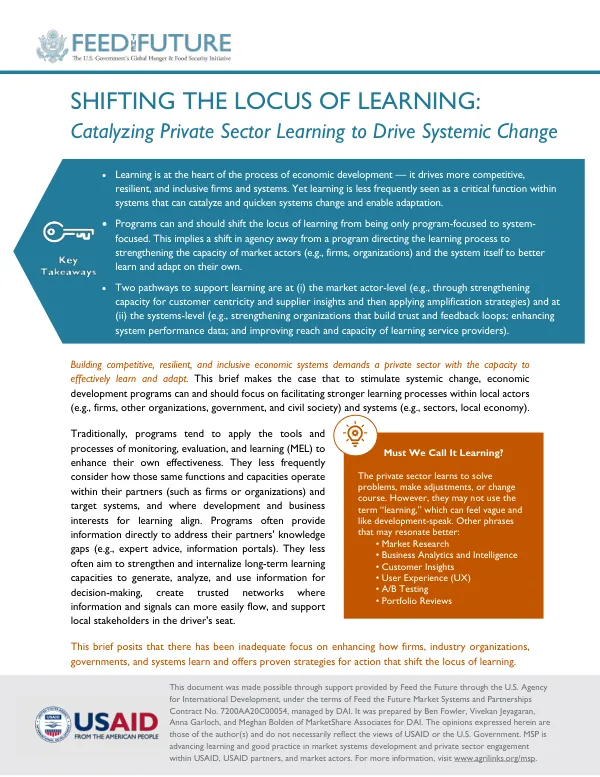
Traditionally, programs apply monitoring, evaluation, and learning (MEL) tools to enhance their own effectiveness, but less frequently consider how these functions operate within their partners and target systems. Programs often provide information directly to address knowledge gaps, but less often aim to strengthen and internalize long-term learning capacities to generate, analyze, and use information for decision-making. Learning is at the heart of the process of economic development, driving more competitive, resilient, and inclusive firms and systems. However, learning is less frequently seen as a critical function within systems that can catalyze and quicken systems change and enable adaptation. Programs can shift the locus of learning from being only program-focused to system-focused, implying a shift in agency away from a program directing the learning process to strengthening the capacity of market actors and the system itself to better learn and adapt on their own. Two pathways to support learning are at the market actor-level and the systems-level. At the market actor-level, strengthening capacity for customer centricity and supplier insights, and applying amplification strategies can support learning. At the systems-level, strengthening organizations that build trust and feedback loops, enhancing system performance data, and improving the reach and capacity of learning service providers can support learning. The private sector learns to solve problems, make adjustments, or change course, but may not use the term "learning," which can feel vague and like development-speak. Other phrases that may resonate better include market research, business analytics and intelligence, customer insights, user experience (UX), A/B testing, and portfolio reviews. Examples of successful learning processes abound, such as the Bangladeshi garment sector, which has greatly enhanced its competitiveness since the early 1970s through foreign direct investment and knowledge transfer. This has led to the sector's exports growing by 1,374 times from 1983 to 2022, making it the sixth largest textile and garment exporter in the world. Learning is challenging and happens unevenly, and there are challenges that impede knowledge acquisition at the individual, organizational, and system levels. These challenges include learning being a social activity that is hindered by low trust and uncollaborative relationships between market actors, as well as cognitive frames that influence how we interpret and value information, and organizational context that shapes the capacity for learning. Economic development programs can focus on enhancing systems-oriented learning by supporting effective learning systems in which market actors within and across systems have the mechanisms, supports, and capacities to generate, access, and apply knowledge that improves their decision-making and outcomes. This can be achieved through practical intervention strategies, such as strengthening capacity for customer centricity and supplier insights, and applying amplification strategies at the market actor-level, and strengthening organizations that build trust and feedback loops, enhancing system performance data, and improving the reach and capacity of learning service providers at the systems-level.
Related documents