USAID DEC
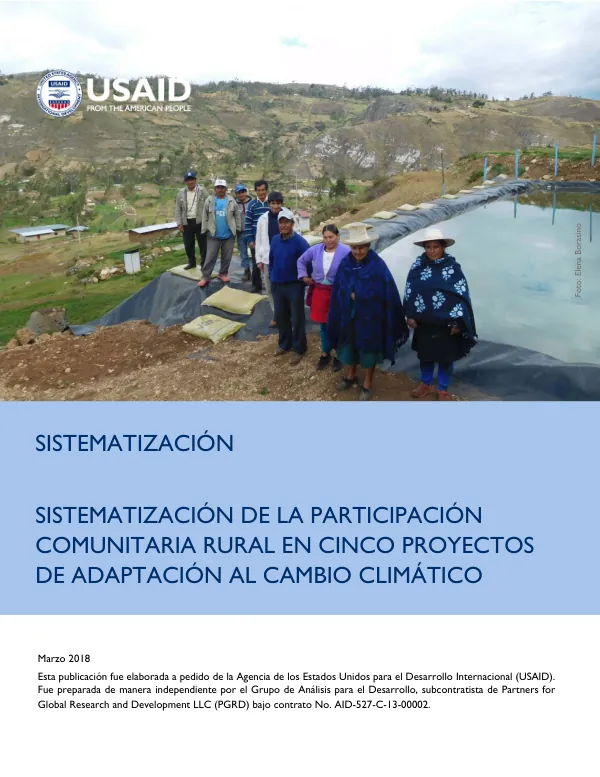
Sistematización de la participación comunitaria rural en cinco proyectos de adaptación al cambio climático
Sign inLUTHERAN WORLD RELIEF
Sistematización de la participación comunitaria rural en cinco proyectos de adaptación al cambio climático
The systematization of community engagement in five projects of adaptation to climate change, supported by USAID, identifies challenges, best practices, and lessons learned.
2018 · 120 pages
Sign in to readA free account is required to download.
Abstract
The analysis used the USAID's Local Systems Framework principles and the Best Practices in stakeholder participation for environmental management. Positive lessons highlighted include the use of the implementor's previous knowledge and experience to select and approach communities, formal mechanisms for establishing initial links, and participatory processes towards community empowerment, equity, trust, and learning. Challenges facing interventions include the complexity of the basin approach at the ecosystem and socioeconomic level, scaling up of the "on demand" approach, real empowerment of women still facing limitations, community participation from the design to monitoring and evaluation of the project, and communities recognized and receiving direct benefits of green infrastructure initiatives. Main recommendations include implementing adaptation measures under a basin approach, facilitating community participation in research, design of measures, preparation of public investment projects (PIP), contests, and exchanges, encouraging the articulation of actors for sustainability, providing evidence to local governments about the benefits of working with the basin approach and developing green PIP, raising men's awareness on gender equality, and promoting women's local and political participation to scale it up to the regional level. The study focuses on the relationship and community participation. The points of view of the authors, expressed in this publication, do not necessarily reflect the points of view of the United States Agency for International Development (USAID) or the Government of the United States. The systematization of community engagement in five projects of adaptation to climate change, supported by USAID, identifies challenges, best practices, and lessons learned. The projects analyzed include Fortaleciendo la Capacidad Adaptativa Frente al Cambio Climático de los Gobiernos Municipales y Organizaciones Locales - AEDES, Territorios Climáticamente Inteligentes para el diseño, implementación, monitoreo y evaluación de proyectos de inversión pública, considerando la variabilidad y el cambio climático en Perú - CATIE, Asegurando el agua y los medios de vida en la montaña – TMI, Adaptando Juntos - LWR, and Adaptación al cambio climático para las comunidades de las cuencas de Lima - TNC. The analysis used the USAID's Local Systems Framework principles and the Best Practices in stakeholder participation for environmental management. Positive lessons highlighted include the use of the implementor's previous knowledge and experience to select and approach communities, formal mechanisms for establishing initial links, and participatory processes towards community empowerment, equity, trust, and learning. Main recommendations include implementing adaptation measures under a basin approach, facilitating community participation in research, design of measures, preparation of public investment projects (