AIDER
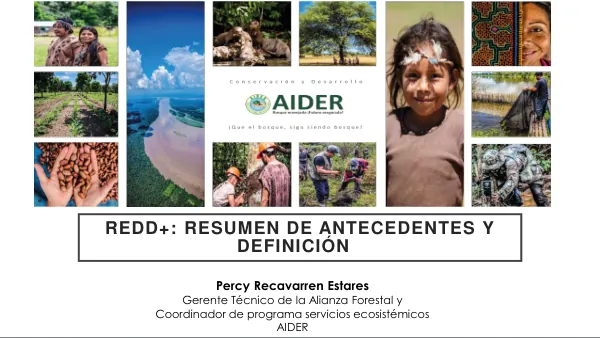
REDD+: RESUMEN DE ANTECEDENTES Y DEFINICIÓN
The REDD+ initiative has been present in the United Nations Framework Convention on Climate Change (UNFCCC) negotiations since 2005.
2020 · 20 pages
Sign in to readA free account is required to download.
Abstract
Initially, it gained interest and weight in the negotiations over the years. The concept of REDD+ was officially adopted at the 13th Conference of the Parties (COP13) in Bali in 2007, and a complete decision was made at COP16 in Cancun in 2010. REDD+ is also part of the Paris Agreement (2015). REDD+ is an acronym that stands for Reducción de Emisiones por Evitar Deforestación y Degradación del Bosque, which translates to Reduction of Emissions from Deforestation and Forest Degradation. The "+" sign indicates that REDD+ also includes the role of conservation, sustainable forest management, and the increase of carbon stocks. This includes activities such as reforestation, enrichment of forests, protected areas, and others. The main sources of CO2 emissions causing global warming and climate change are the automotive sector, industry, and land-use change, including deforestation. Solutions to mitigate these emissions include reducing or offsetting CO2 emissions through technological changes, such as switching from fossil fuels to biomass or natural gas, and through natural solutions, such as conserving, restoring, or improving natural ecosystems. Carbon sequestration or capture refers to the process of capturing CO2 from the atmosphere through the growth of plants, such as in SAF (sustainable agriculture and forestry) plantations and forest restoration. Carbon storage or avoidance refers to preventing mature natural forests from being cut down, burned, or otherwise disturbed, thereby avoiding the release of stored CO2 into the atmosphere. REDD+ or "deforestation avoided" is a solution that involves preventing deforestation and forest degradation in areas where forests are under threat. This can be achieved through the implementation of sustainable forest management practices, reforestation, and the establishment of protected areas. The implementation of REDD+ projects can be categorized into three levels: early-stage REDD+ initiatives, local REDD+ activities, and national REDD+ programs or systems. Early-stage REDD+ initiatives are known as "initiatives tempranas REDD+" and are typically led by non-governmental organizations (NGOs), local agencies, and other organizations. These projects are often financed by the private sector and are not necessarily linked to a country's national REDD+ program. National REDD+ programs or systems, on the other hand, have a subnational or national territorial scope and are led by government entities that follow the REDD+ decisions of the UNFCCC and other international initiatives. These programs can consider payment for results (PbR) and/or carbon market mechanisms, depending on the definition of the responsible authority.
Related documents
Documents in this collection
 2018
2018USAID DEC
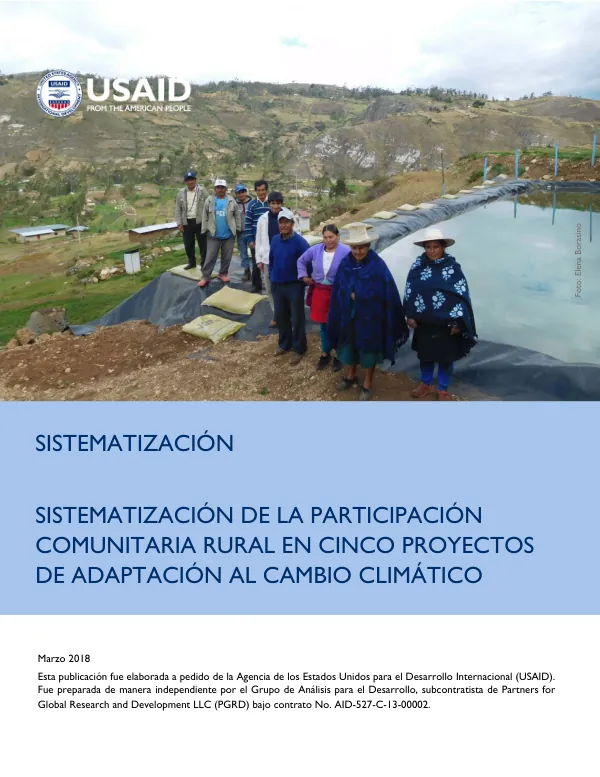
Sistematización de la participación comunitaria rural en cinco proyectos de adaptación al cambio climático
Open record 2014
2014USAID DEC