FHI 360
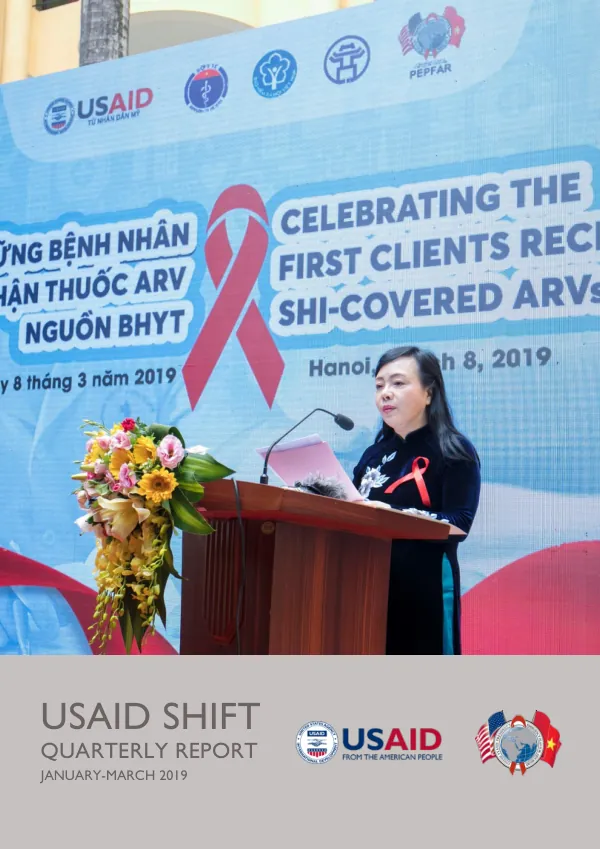
USAID SHIFT Y3 Q2 Quarterly Progress Report
The USAID SHIFT project is a five-year contract managed by FHI 360 to help local stakeholders achieve epidemic control and transition sustainable HIV services.
2019 · 67 pages
Sign in to readA free account is required to download.
Abstract
The project is organized into three major areas: scaling up services to achieve epidemic control targets, transitioning a sustainable HIV response and services, and providing demand-driven technical assistance. In its third year, USAID SHIFT is fulfilling priorities in PEPFAR's 2018 Country Operational Plan to accelerate epidemic control in two regions: the Northern Economic Zone and Ho Chi Minh City metropolitan area. During the second quarter of the third year, the project supported HIV outreach, prevention, case-finding, testing, and treatment services in five provinces: Hanoi, Ho Chi Minh City, Dong Nai, Tay Ninh, and Tien Giang. The project also provided HIV care and treatment services in Quang Ninh province, located in the Northern Economic Zone. Case finding and new antiretroviral therapy treatment results for Hanoi lagged behind targets for the past three quarters. To address this, the project is launching an intensive case finding strategy in the third quarter, aimed at reaching new networks of high-risk individuals, improving structural processes, and building on existing enhanced outreach approaches. The project's CLIN 1, Task 1.1, focuses on scaling up services to achieve epidemic control targets. This task is divided into four components: REACH, TEST, TREAT, and M&E. REACH aims to increase access to HIV testing and counseling services, while TEST focuses on improving testing and diagnosis rates. TREAT targets the expansion of antiretroviral therapy treatment services, and M&E is responsible for monitoring and evaluating project progress. The project's CLIN 1, Task 1.2, focuses on transitioning a sustainable HIV response and services, including transitioning services to local stakeholders and ensuring sustainability. The project's CLIN 2 provides demand-driven technical assistance to local stakeholders. This includes establishing a demand-driven mechanism for technical assistance provision and providing technical assistance to meet the needs of local stakeholders. The project also engages with stakeholders, including community-based supporters, to improve HIV services and outcomes. The project's quarterly progress report highlights achievements and challenges, and outlines plans for future quarters.