FHI 360
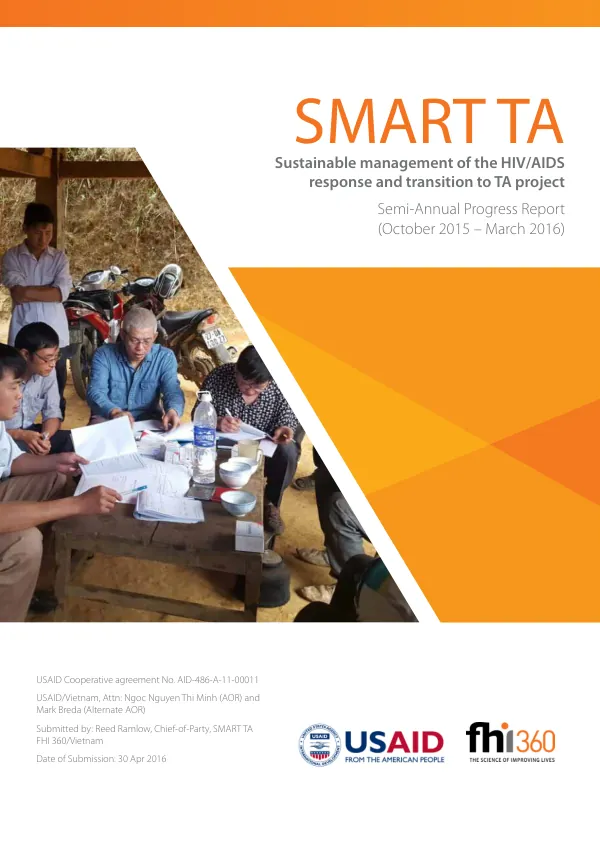
USAID/SMART Y5 Semiannual Report (October 2015-March 2016)
The USAID Sustainable Management of the HIV/AIDS Response and Transition to Technical Assistance Project, also known as SMART TA, is a five-year initiative managed by FHI 360 to ensure a comprehensive, high-quality, and sustainable local response to HIV in Vietnam.
2016 · 75 pages
Sign in to readA free account is required to download.
Abstract
The project is designed to contribute directly to targets identified in the National Strategy on HIV/AIDS Prevention and Control in Vietnam and the Partnership Framework between the Government of the United States of America and the Government of the Socialist Republic of Vietnam for HIV/AIDS Prevention and Control. SMART TA prioritizes programming that aligns to PEPFAR 3.0's five key agendas - impact, efficiency, sustainability, partnership, and human rights - to accelerate progress towards 90-90-90 targets and an AIDS-free generation. The project focuses on three objectives: delivering quality HIV services within the Continuum of HIV Prevention to Care (CoPC), transitioning financial, administrative, and technical ownership of CoPC services, and strengthening the Government of Vietnam's technical capacity to sustain quality CoPC services. In the semiannual period from October 2015 to March 2016, SMART TA achieved significant results in its assigned priority provinces, Nghe An, Dien Bien, and Ho Chi Minh City. The project expanded the availability, quality, and impact of essential HIV services, including the development and implementation of an improved Mountainous Outreach Model and MSM-friendly services. The project also doubled the pace of ART enrollment in Dien Bien, which had been severely lagging against an ambitious FY16 treatment target. In addition to scale-up efforts in priority provinces, SMART TA has focused on transitioning in eight remaining "maintenance" provinces, which are An Giang, Bac Giang, Can Tho, Hai Phong, Hanoi, Lao Cai, Quang Ninh, Thai Binh, and Ninh Binh. The project has reduced recurring operating costs for direct service delivery sites supported by the project, with overall DSD site recurring operating costs falling to $710,548, reflecting a cumulative reduction of 54% since the start of SMART TA. SMART TA also aims to guide the technical transition of HIV service sites it supports, conducting "SMART technical monitoring" to assess the technical state of readiness of sites to transition from direct service delivery to TA-SDI, where they would receive only limited technical assistance and support for discrete service delivery interventions. Over the first half of FY16, SMART TA observed a remarkable move in terms of transition, with the graduation of twelve DSD sites to TA-SDI status. The project's efforts in the semiannual period culminated with a highly successful rapid ART enrollment campaign in Dien Bien, which amplified the SMART TA Mountainous Model meant to bring HIV services closer to those in remote mountainous areas. The campaign doubled the pace of ART enrollment that had been severely lagging in the province against an ambitious FY16 treatment target for the "second 90" among the fast track "90-90-90" targets the province must achieve by 2018. SMART TA's results show the project is on track to either meet or surpass its fiscal year/project-end objectives across the reach-test-treat (start)-retain spectrum in the priority provinces, as well as achieve its transitioning targets in the maintenance provinces while helping to ensure transitioning sites maintain high-quality service standards. With a productive first half behind it, SMART TA looks forward to intensifying production of results in the second half of the fiscal year to maintain strong momentum toward achieving 90-90-90, transitioning, and technical transfer in line with its goals.
Related documents