FEWS NET
Somalia Rain Watch October 22, 2012
Rainfall in southern, central, and northeastern Somalia has been moderate to heavy in many areas.
2012 · 2 pages
Sign in to readA free account is required to download.
Abstract
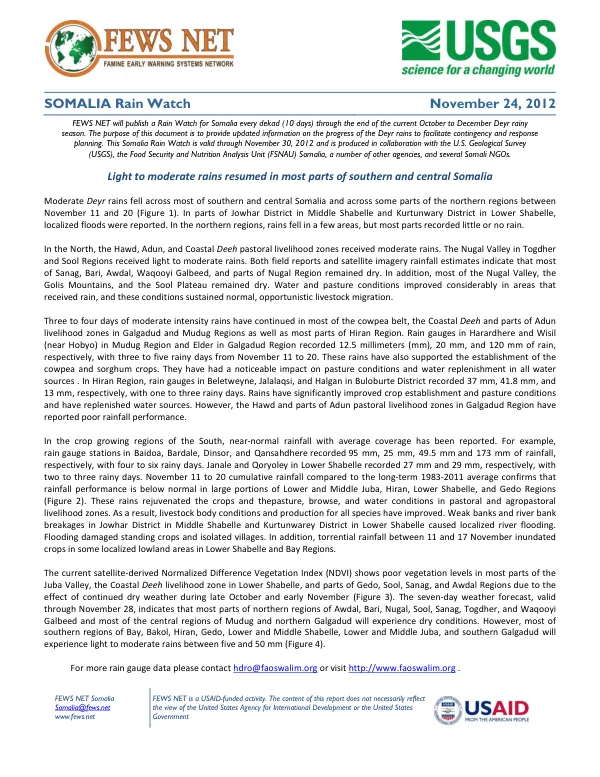
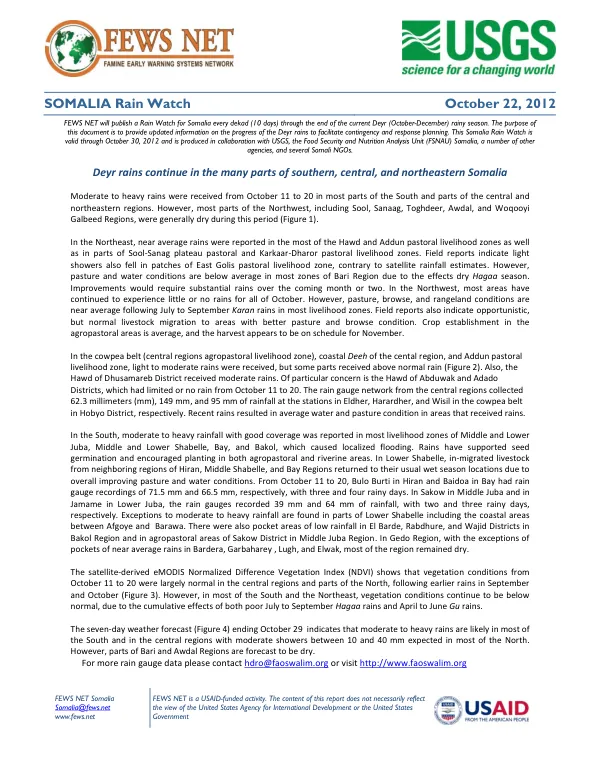
From October 11 to 20, most parts of the South and parts of the central and northeastern regions received moderate to heavy rains. However, the Northwest, including Sool, Sanaag, Toghdeer, Awdal, and Woqoyi Galbeed Regions, was generally dry during this period. In the Northeast, near-average rains were reported in most of the Hawad and Addun pastoral livelihood areas, as well as in parts of the Sool-Sanag plateau pastoral and Karkar-Dharor pastoral livelihood zones. Field reports indicate light showers also fell in parts of the East Golis pastoral zone, contrary to satellite estimates. However, pasture and water conditions are below average in most zones of the Bari Region due to the dry Hagaa season. Improvements would require substantial rains over the coming month or two. In the Northwest, most areas have continued to experience little or no rains for the entire month of October. However, field reports indicate opportunistic but normal livestock migration to areas with better pasture and browse conditions. Crop establishment in the agropastoral areas is average, and the harvest appears to be on track for November. In the cowpea belt, coastal Deeh, and Addun pastoral zones, light to moderate rains were received, with some areas receiving above-normal rain. The Hawad of Dhusamareb District received moderate rains, while the Hawad of Adduwak and Adi Ad Districts received limited or no rain from October 11 to 20. The rain gauge network in the central regions collected 62.3 mm, 149 mm, and 95 mm of rainfall at stations in Eldher, Harardher, and Wisil in Hobyo District, respectively. In the South, moderate to heavy rainfall with good coverage was reported in most livelihood zones of Middle and Lower Juba, Middle and Lower Shabelle, Bay, and Bakol, causing localized flooding. Rains have supported seed germination and encouraged planting in both agropastoral and riverine areas. In Lower Shabelle, in-migrated livestock from neighboring regions of Hiran, Middle Shabelle, and Bay Regions returned to their usual wet-season locations due to improving pasture and water conditions. From October 11 to 20, Bulo Burti in Hiran and Baidoa in Bay had rain gauge recordings of 71.5 mm and 66.6 mm, respectively, with five and four rainy days. Exceptions to moderate to heavy rainfall were found in parts of Lower Shabelle, including the coastal areas between Afgoy and Barawa. There were also pocket areas of low rainfall in El Barde, Rabdhure, and Wajid Districts in Bakol Region and in agropastoral areas of Sakow District in Middle Juba Region. In Gedo Region, with the exceptions of pockets of near-average rains in Bardera, Bardera, Lashah, and Elwak, most of the region remained dry. The satellite-derived EMODIS Normalized Difference Vegetation Index (NDVI) shows that vegetation conditions from October 11 to 20 were largely normal in the central regions and parts of the North, following earlier rains in June and July. However, in most of the South and the Northeast, vegetation conditions continue to be below normal, due to the cumulative effects of both the dry Hagaa season and the Gu rains. The seven-day weather forecast ending October 29 indicates that moderate to heavy rainfall is likely in most of the South and in the central regions, with moderate showers between 10 and 40 mm expected in most of the North. However, parts of Bari and Awdal are forecast to be dry.