FEWS NET
Tanzania Food Security Outlook October 2009 to March 2010
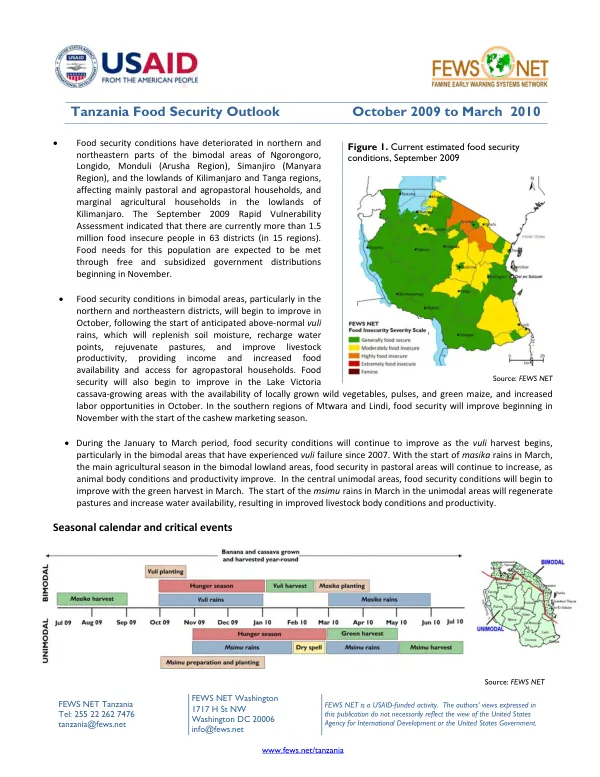
Food security conditions in Tanzania have deteriorated in northern and northeastern parts of the bimodal areas, as well as in the Lake Victoria zone.
2009 · 10 pages
Sign in to readA free account is required to download.
Abstract
The deterioration is mainly affecting pastoralists and agropastoralists, as well as households in the marginal crop agricultural zone in the lowlands of these areas. Food security conditions have also deteriorated in some parts of the unimodal areas that received below-normal msimu rains, including the central zone, particularly Dodoma and Singida regions, some parts of the lowland areas of the southern highlands (Iringa and Mbeya regions), and the southern regions of Mtwara and Lindi. The affected population is expected to need food assistance amounting to 56,740 MT, with 5,674 MT recommended for free distribution to 156,989 poor people and the remaining 51,066 MT recommended for subsidized sales beginning in November 2009 to 1,412,901 people who cannot buy food at market prices. Food needs are expected to be met through these food distributions. The deterioration of food security in bimodal areas is due to extended dryness following consecutive failed vuli and masika rain seasons since 2007 in the pastoral and agropastoral areas of Ngorongoro, Longido, Monduli (Arusha Region), Simanjiro (Manyara Region), and the lowlands of Kilimanjaro region. Extended dryness in pastoral rangelands has led to deterioration of pasture and browse, resulting in poor livestock body conditions, decreased milk production, and increasing vulnerability to disease. In the marginal agricultural lowland areas of Rombo, Same, Mwanga, Hai (Kilimanjaro region), Meru, and Arusha (Arusha region), Babati, Hanang, and Mbulu (Manyara region), Korogwe, Lushoto, and Mkinga (Tanga region), poor rains have led to crop failure, which has reduced local food availability and increased pressure on food prices. The affected population is experiencing reduced access to food due to high prices, which have limited the purchasing power of poor households. The high prices are attributed to above-five-year average prices for all monitored commodities, including maize, rice, beans, millet, sorghum, and potatoes. The poor market-dependent households in both urban and rural areas are generally spending a large proportion of their cash income on food, forcing them to reduce the quality of food consumed. The nutritional status of sedentary household members who do not migrate with animals is negatively impacted by decreased milk production. The major contributing factors to poor nutrition are the lack of safe water and sanitation facilities and constrained access to protein-rich food that is not affordable to poor households. Abnormal migrations of pastoralists in search of pasture and water for livestock have resulted in long trekking distances, further deteriorating body conditions and increasing mortality.
Related documents