CATHOLIC RELIEF SERVICES ORGANIZATION
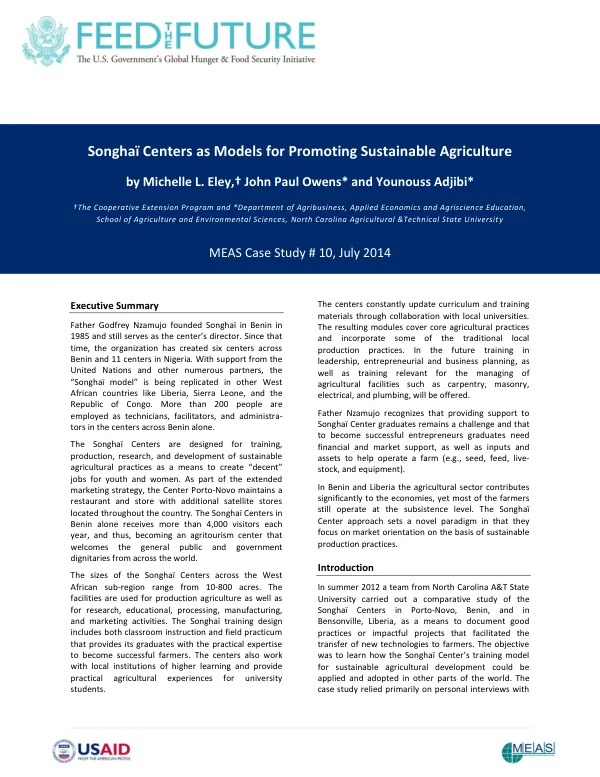
Songhaï Centers as Models for Promoting Sustainable Agriculture
The Songhaï Centers were founded by Father Godfrey Nzamujo in 1985 in Benin, with the goal of promoting sustainable agriculture and creating decent jobs for youth and women.
2014 · 9 pages
Sign in to readA free account is required to download.
Abstract
The centers are designed for training, production, research, and development of sustainable agricultural practices. As of 2014, there were six centers in Benin and 11 centers in Nigeria, with plans to replicate the model in other West African countries. The Songhaï Centers focus on market orientation based on sustainable production practices, which sets them apart from traditional agricultural approaches. The centers provide training in sustainable agriculture techniques, including classroom instruction and field practicum, and offer practical agricultural experiences for university students. The training design is constantly updated through collaboration with local universities, incorporating core agricultural practices and traditional local production methods. The centers also work with local institutions of higher learning and provide practical agricultural experiences for university students. In the future, training in leadership, entrepreneurial, and business planning, as well as training relevant for managing agricultural facilities, will be offered. Father Nzamujo recognizes that providing support to Songhaï Center graduates remains a challenge, and that financial and market support, as well as inputs and assets, are necessary for graduates to become successful entrepreneurs. The agricultural sector contributes significantly to the economies of Benin and Liberia, but most farmers operate at the subsistence level. The Songhaï Center approach addresses this issue by focusing on market orientation based on sustainable production practices. The centers have received support from various partners, including the United Nations Development Program (UNDP), USAID, and the International Development Research Centre (IRDC). The Songhaï Center in Porto-Novo, Benin, was founded in 1985 and has become a model for sustainable agriculture in the region. The center has received support from various partners, including the UNDP, USAID, and the IRDC. The center's innovative design includes a restaurant and store, as well as satellite stores located throughout the country, which serves as an agritourism center that welcomes the general public and government dignitaries from across the world. The centers have also established Community Networking Service Centers (CNSCs), which provide networking, computer training, and internet access to rural communities. This allows them to provide distance education to farmers, young entrepreneurs, and other residents in rural communities. The CNSCs also enable rural communities to communicate and exchange information with each other. The Songhaï Centers have received support from various partners, including the UNDP, USAID, and the IRDC. The centers have also received funding from the Government of Benin, which has signed a funding agreement with the UNDP for the amount of $51 million (US) to strengthen and create new centers throughout the country. Other partners that have contributed to the development of Songhaï include Songhaï France, the UN Refugee Agency, Cooperation Francaise, Rabobank Foundation, and local and regional governmental, non-governmental institutions, and international agencies and groups. The research design for this paper includes a case study approach to explain how the center works as a sustainable agriculture model and the feasibility of using this model in other West African countries. The project team developed a formal protocol that included standard questions for personal interviews. Secondary data on the economic structure of the area from the World Bank and other sources were also used to support the case study.
Related documents