USAID DEC
Sources of Family Planning: Pakistan
The modern contraceptive prevalence rate (mCPR) in Pakistan is 25%, with one-fourth of married women of reproductive age using modern contraception.
2018 · 4 pages
Sign in to readA free account is required to download.
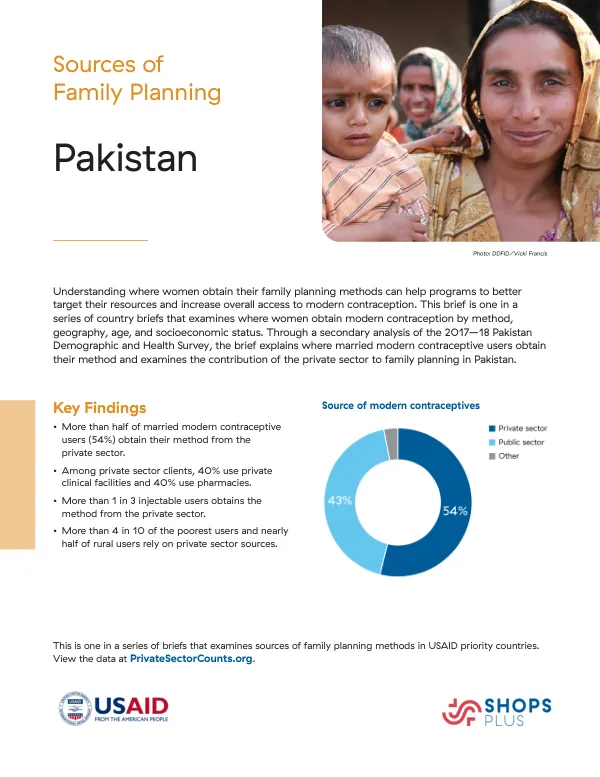
Abstract
The mCPR did not change significantly between 2012-13 and 2017-18. Short-acting methods (SAMs) and long-acting reversible contraceptives and permanent methods (LARCs and PMs) are both important in Pakistan, with condoms being the dominant SAM and sterilization being the dominant LARC. Among married modern contraceptive users in Pakistan, the private sector is the primary source, accounting for 54% of users. The public sector is the second most common source, used by 43% of users, while 3% of users rely on other sources. The private sector is the dominant source for SAMs, with 61% of condom users and 64% of injectable users obtaining their methods from private sector sources. Geographic variations in contraceptive source and method mix are observed in Pakistan. Urban areas have a higher mCPR (29%) than rural areas (23%), with a higher proportion of users relying on the private sector (61% in urban areas versus 49% in rural areas). Condoms are more popular among urban users, while injectables are more common among rural users. Age and socioeconomic status also influence contraceptive source and method mix. Married contraceptive users aged 15-24 are more likely to rely on the private sector than users aged 25 or older, with condoms being the dominant method among the youngest users. The poorest modern contraceptive users are more likely to rely on private sources, primarily for condoms and sterilization, while the wealthiest users are more likely to use private sector sources, particularly for condoms. The public and private sectors are both important sources of contraception in Pakistan, with the government committed to increasing the country's contraceptive prevalence rate through public-private partnerships. Social marketing and social franchising organizations are the primary private sector providers of contraceptive services, with the majority of pill and condom users relying on socially marketed brands. However, use of hormonal contraceptives is low in Pakistan, and discontinuation rates are high due to fear of side effects and bodily harm. Improved education, counseling, and quality of care are necessary to increase contraceptive access and choice, particularly among traditional method and condom users.