RTI INTERNATIONAL
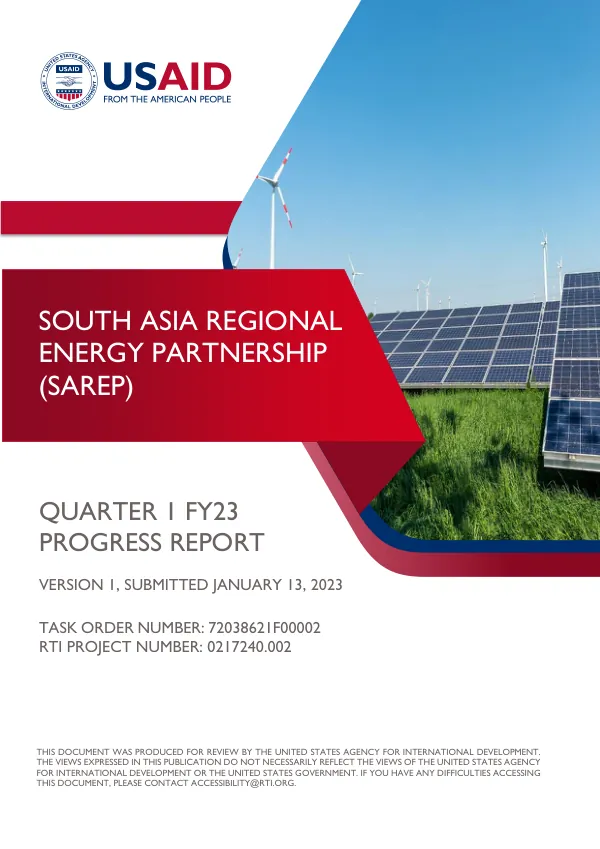
SOUTH ASIA REGIONAL ENERGY PARTNERSHIP (SAREP) FY 2023 ANNUAL REPORT
The South Asia Regional Energy Partnership (SAREP) initiative began in 2022 with funding from USAID's Food Security Program.
2023 · 114 pages
Sign in to readA free account is required to download.
Abstract
The primary objective of SAREP is to enhance regional energy markets and integration in South Asia. The initiative focuses on three key objectives: enhanced regional energy markets and integration, increased deployment of advanced energy solutions and systems, and high-performing modern utilities. Implementation of SAREP involved the establishment of a program steering committee to accelerate regional energy integration and energy markets in South Asia. The committee consisted of representatives from various countries, including India, Bangladesh, Nepal, Bhutan, and Sri Lanka. The committee aimed to facilitate market-based cross-border energy trade (CBET) in the region. One of the key interventions under SAREP was the institutionalization of the South Asia Forum of Transmission Utilities (SAFTU) and the implementation of activities under SAFTU to facilitate CBET in South Asia. Additionally, the initiative focused on increasing the deployment of advanced energy solutions and systems, including utility-scale renewable energy capacity deployment, grid integration, balancing, and resilience, and the promotion of fuel-switching in transport, industries, and the domestic sector. SAREP also aimed to establish high-performing modern utilities through the establishment of the South Asia Distribution Utilities Network (DUN) and the enhancement of cybersecurity capacity at the central and state level. Furthermore, the initiative focused on transparent, best-value procurement and private sector investment mobilized through the development of financing strategies for large corporates/PSUs, infrastructure investment trusts (INVITS) for renewable energy projects, and the enhancement of the use of green bonds through a programmatic approach. The SAREP initiative involved various stakeholders, including government agencies, private sector companies, and civil society organizations. The initiative also involved the development of various work products, including reports, white papers, and conference proceedings. The SAREP partnership fund was established to support the implementation of the initiative and to mobilize private sector investment in the energy sector. The SAREP initiative made significant progress in 2023, with various achievements reported in the annual report. The report highlights the progress made in the implementation of the initiative's objectives, including the establishment of the SAFTU and the implementation of activities under SAFTU to facilitate CBET in South Asia. The report also highlights the progress made in the deployment of advanced energy solutions and systems, including utility-scale renewable energy capacity deployment and grid integration. The SAREP initiative has the potential to make a significant impact in the energy sector in South Asia, particularly in the areas of regional energy markets and integration, advanced energy solutions and systems, and high-performing modern utilities. The initiative's focus on transparent, best-value procurement and private sector investment mobilized is also expected to contribute to the development of the energy sector in the region. The SAREP initiative has also established partnerships with various stakeholders, including government agencies, private sector companies, and civil society organizations. The initiative's partnership fund has been established to support the implementation of the initiative and to mobilize private sector investment in the energy sector.