USAID DEC
South Central Somalia and Puntland Emergency Response Program (SCAPE) Quarterly Report (July – September 2012)
Sign inMERCY CORPS INTERNATIONAL
South Central Somalia and Puntland Emergency Response Program (SCAPE) Quarterly Report (July – September 2012)
The South Central Somalia and Puntland Emergency Response Program (SCAPE) is a humanitarian initiative implemented by Mercy Corps in response to the 2011 famine and ongoing conflict in Somalia.
2012 · 14 pages
Sign in to readA free account is required to download.
Abstract
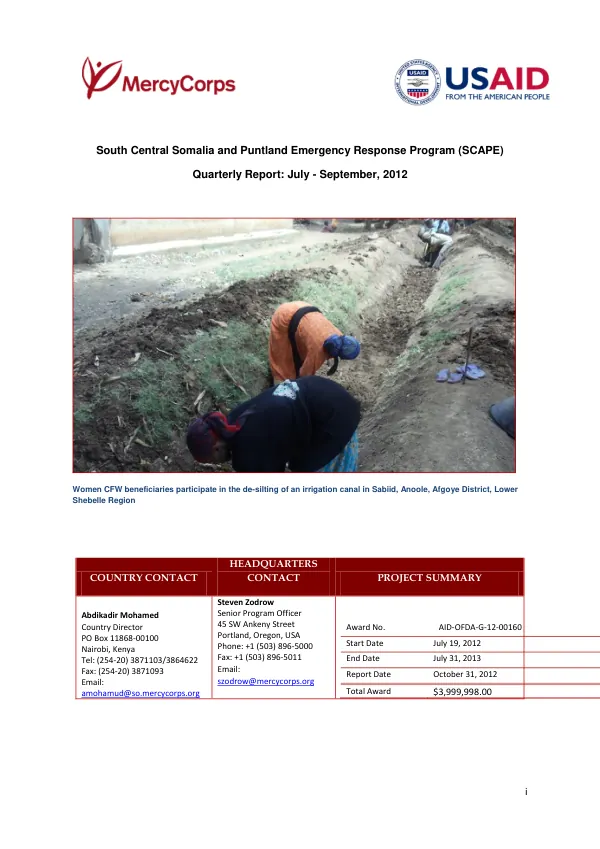
The program aims to provide emergency assistance to internally displaced persons (IDPs) and host communities in South Central Somalia and Puntland. The program's objectives are to increase the asset base of targeted households through short-term employment and improved community infrastructure, provide access to clean water, sanitation, and hygiene, and enhance community capacity to respond to the care and protection of children and adolescents. The program is being implemented in 11 regions, including Banadir, Lower Shabelle, Middle Shabelle, Lower Juba, Middle Juba, Bay, Bakool, Galgadud, Mudug, Bari, and Karkaar. The program has engaged 2,091 individuals through cash for work (CFW) projects, which have included the rehabilitation of surface dams, irrigation canals, and river embankments. A total of 2,091 cash transfers, totaling USD $187,000, were made to participating households. The program has also distributed 11,200 CFW tools to beneficiaries, including shovels, pick axes, wheelbarrows, and gloves. The program has made significant progress in providing access to clean drinking water, with 23 water sources rehabilitated, including 18 shallow wells and five berkads. Over 3,000 households in ten IDP camps in Mogadishu and Bosaso are receiving a supply of safe drinking water, with each household receiving 60 liters of water per day for 45 days. The program has also procured and installed six water tanks in Bosaso to ease water storage and tracking. In the protection sector, the program has conducted 16 awareness and sensitization meetings and trained 140 persons on Sexual Gender-Based Violence (SGBV) and Strategies for Trauma Awareness and Resilience (STAR). Group counseling sessions were held for 14 victims of SGBV, all of whom were women from various IDP camps in Bosaso. The program has also conducted a baseline survey in the program operation areas, which revealed that households were surviving on less than a dollar a day and were dependent on casual labor, crop production, livestock rearing, self-employment, and humanitarian assistance as the main sources of income. The survey also found that only 32% of households had access to safe water, and water available was of poor quality due to salinity or pollution. The security situation in Somalia has made access to some areas difficult, and the program team has faced extreme dangers to ensure the implementation of program activities. However, the program has taken advantage of the high need in the areas of operation to respond to the needs of the populations in crisis. The program will continue to focus on attending to the needs of IDP camps while working with host communities to foster recovery and improve resilience. The program has made significant progress in achieving its objectives, with 43,746 beneficiaries reached, including 22,890 female and 20,856 male IDPs. The program has also rehabilitated 10 kilometers of irrigation canals, 15 kilometers of river embankments, and 11 surface dams. The program has also provided cash grants to 20 small and micro-enterprises (SMEs), totaling USD $35,000. The program has also employed 2,091 individuals through CFW activities, with an average USD amount per person earned through the activities being USD $75.
Related documents