USAID DEC
Somalia Emergency and Livelihood Intervention Program (SELIP) Report for October – December, 2015
Sign inMERCY CORPS INTERNATIONAL
Somalia Emergency and Livelihood Intervention Program (SELIP) Report for October – December, 2015
The Somalia Emergency and Livelihood Intervention Program (SELIP) is a project aimed at restoring sustainable livelihoods through the rehabilitation of local community infrastructure.
2016 · 12 pages
Sign in to readA free account is required to download.
Abstract
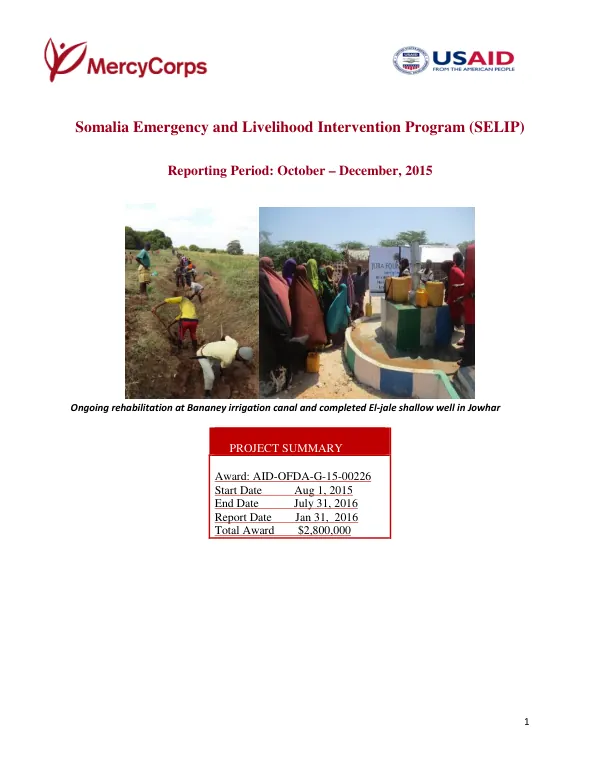
Implemented in the Banadir, Lower Juba, Lower/Middle Shabelle, Galmudug, and Gedo regions of Somalia, the project is working to build the capacities of targeted communities to withstand and cope with natural and man-made shocks. During the reporting period of October to December 2015, Mercy Corps continued to implement project activities without major hindrances. The security situation in the regions remained stable, with no incidents impeding implementation of the interventions. However, the unexpected deyr/El-Niño onset rains affected the targeted asset restoration activity areas, including irrigation canals, river embankments, feeder roads, and market restorations. This led to a slight delay in the implementation plan. The economic recovery and market systems (ERMS) interventions were implemented as planned. A total of 402 beneficiary households participated in the activities completed during the reporting quarter, benefiting 2,412 indirect beneficiaries. Furthermore, 651 Cash for Work (CfW) beneficiaries were registered for other CfW activities started during this quarter, which will be completed during the next reporting quarter. These activities will benefit a total of 3,906 individuals. Community infrastructure rehabilitation activities included markets, irrigation canals, river embankments, and feeder road clearance in the target project regions. Beneficiaries contributed to the development of their community infrastructure, and the income they received from CfW activities enhanced their purchasing power and ensured they could afford their basic needs. These activities also helped to stimulate the economy by injecting cash into local markets. Under the WASH activities, Mercy Corps facilitated the construction of 40 single-stance pit latrines in four internally displaced person (IDP) settlements in Mogadishu. One hundred twenty CfW beneficiaries participated in the latrine installations over a two-day period each. The program also facilitated the formation of 18 hygiene committees composed of 130 members trained on using key messages to sensitize the respective communities. The Agriculture & Food Security (AFS) Livestock Subsector implemented training of Community Animal Health Workers (CAHWs) during this reporting period. RIO, through community consultation and participation, identified and selected 40 local community members for the CAHW course conducted by an accredited veterinary professional association. The program injected a total of USD $31,600 through CfW activities in the project implementation areas. Implementation progress on project activities was initiated and implemented according to schedule within the quarter. The ERMS sector activities included market system rehabilitation and temporary employment. The program completed the rehabilitation of two feeder roads and two markets, and initiated the rehabilitation of three irrigation canals and four river embankment sites. A total of 12,065 CfW tools were distributed during this reporting quarter, including shovels, axes, hoes, buckets, and sacks. The CfW interventions were applied to improve market systems through rehabilitation, while creating short-term employment for vulnerable families targeted. A total of 1,053 CfW beneficiaries were identified, selected, and registered to participate in the various planned CfW activities. The beneficiaries were selected by Village Relief Committees and verified by Mercy Corps based on documented selection criteria.
Related documents