INTERNATIONAL CHILDREN'S FUND, INC.
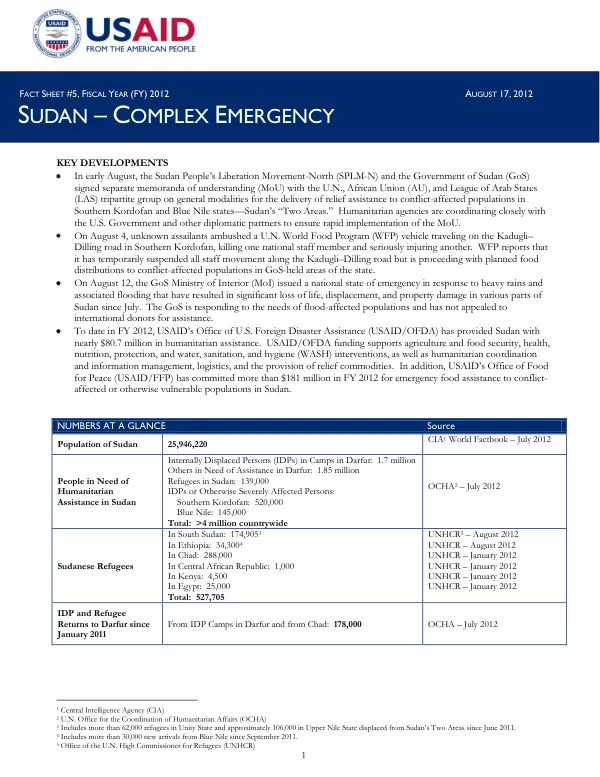
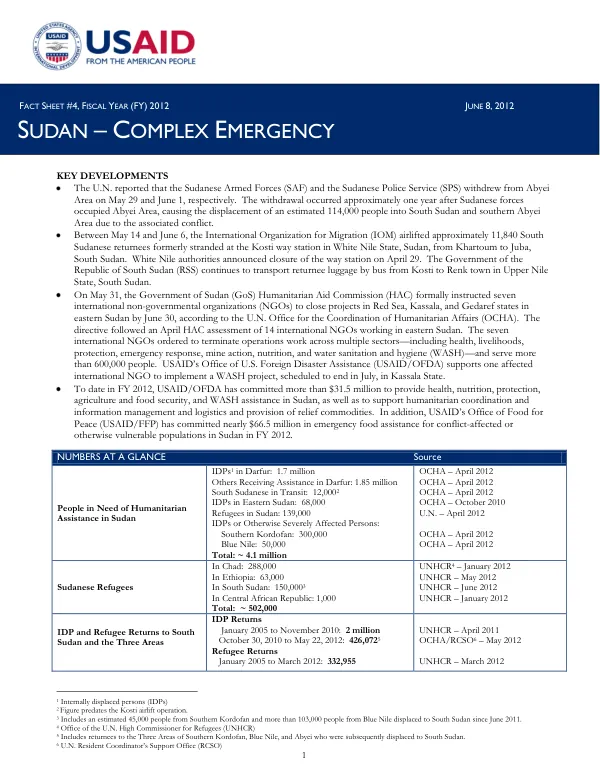
USAID-DCHA Sudan Complex Emergency Fact Sheet #4
The Sudanese Armed Forces (SAF) and the Sudanese Police Service (SPS) withdrew from Abyei Area on May 29 and June 1, respectively.
2012 · 7 pages
Sign in to readA free account is required to download.
Abstract
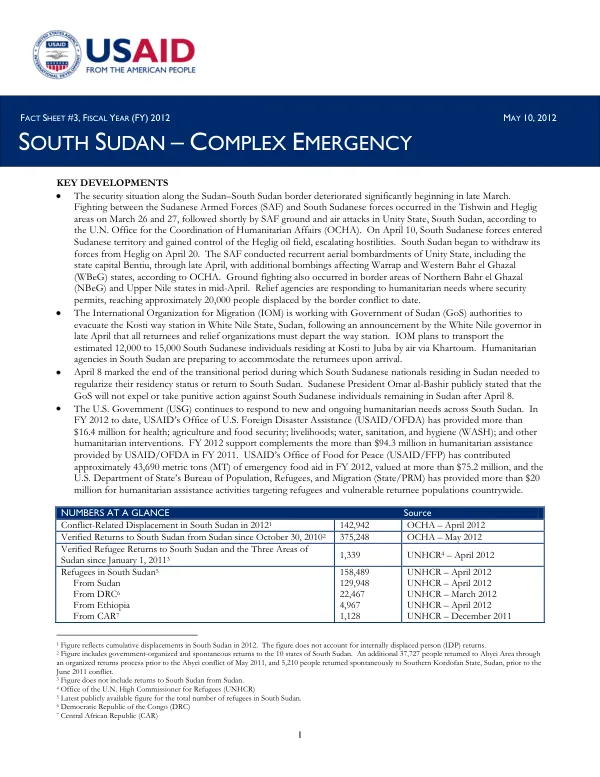
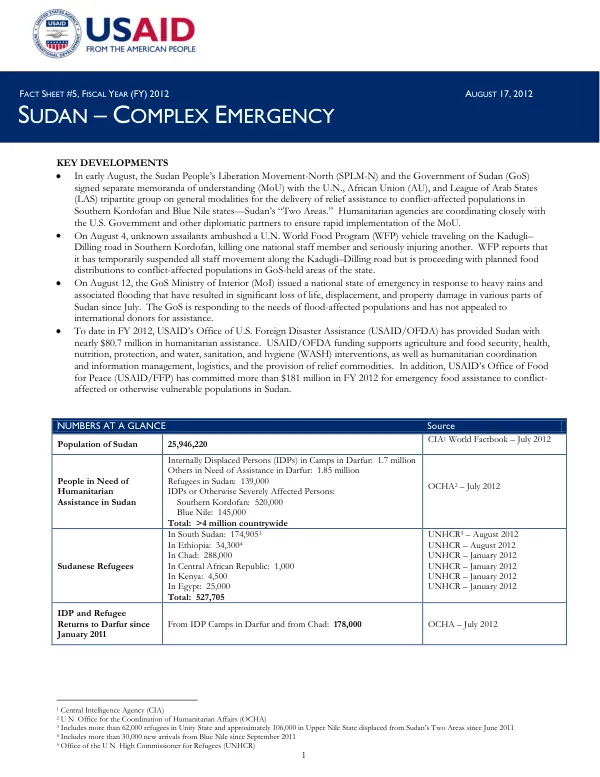
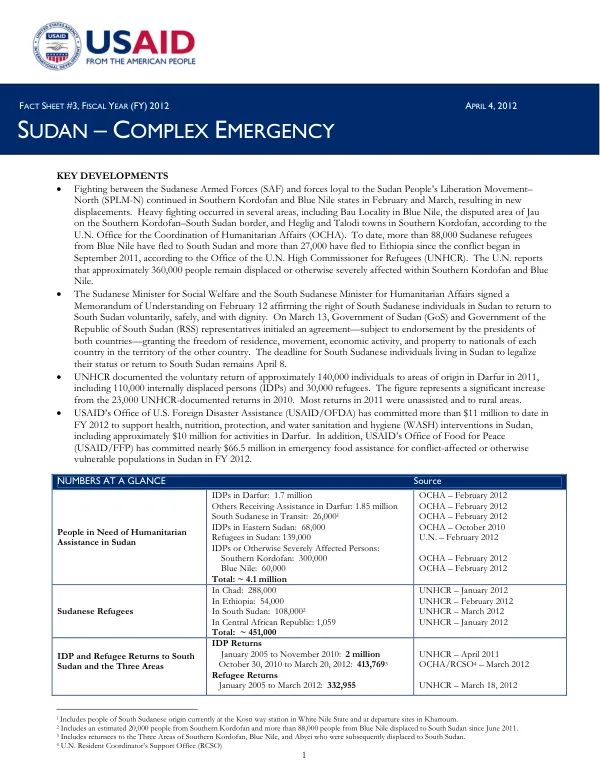
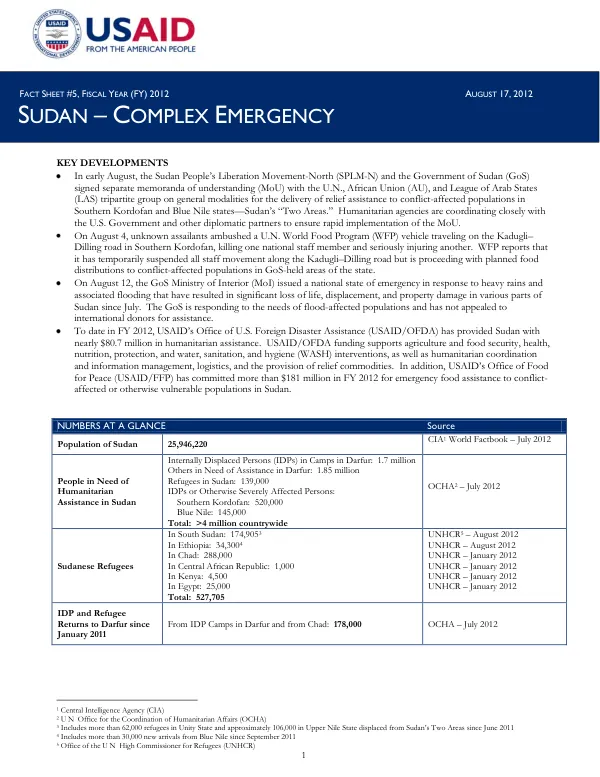
This withdrawal occurred approximately one year after Sudanese forces occupied Abyei Area, causing the displacement of an estimated 114,000 people into South Sudan and southern Abyei Area due to the associated conflict. Between May 14 and June 6, the International Organization for Migration (IOM) airlifted approximately 11,840 South Sudanese returnees formerly stranded at the Kosti way station in White Nile State, Sudan, from Khartoum to Juba, South Sudan. White Nile authorities announced closure of the way station on April 29. The Government of the Republic of South Sudan (RSS) continues to transport returnee luggage by bus from Kosti to Renk town in Upper Nile State, South Sudan. The Government of Sudan (GoS) Humanitarian Aid Commission (HAC) formally instructed seven international non-governmental organizations (NGOs) to close projects in Red Sea, Kassala, and Gedaref states in eastern Sudan by June 30, according to the U.N. Office for the Coordination of Humanitarian Affairs (OCHA). The directive followed an April HAC assessment of 14 international NGOs working in eastern Sudan. The seven international NGOs ordered to terminate operations work across multiple sectors, including health, livelihoods, protection, emergency response, mine action, nutrition, and water sanitation and hygiene (WASH), and serve more than 600,000 people. To date in FY 2012, USAID's Office of U.S. Foreign Disaster Assistance (USAID/OFDA) has committed more than $31.5 million to provide health, nutrition, protection, agriculture and food security, and WASH assistance in Sudan, as well as to support humanitarian coordination and information management and logistics and provision of relief commodities. In addition, USAID's Office of Food for Peace (USAID/FFP) has committed nearly $66.5 million in emergency food assistance for conflict-affected or otherwise vulnerable populations in Sudan in FY 2012. Sudan continues to cope with the effects of conflict, displacement, economic challenges, and perennial environmental shocks, such as drought. Since 2003, a complex emergency in Darfur has affected more than 4.7 million people, including up to 2.7 million internally displaced persons (IDPs), of whom an estimated 1.7 million remain in camps, according to U.N. agencies. Conflict continues among SAF, armed opposition groups, militias, and ethnic groups. Insecurity, access restrictions, and bureaucratic impediments limit the ability of relief agencies to respond to humanitarian and recovery needs. The January 2005 signing of the Comprehensive Peace Agreement (CPA) between the GoS and the southern-based Sudan People's Liberation Movement officially ended more than two decades of North-South conflict during which famine, fighting, and disease killed an estimated 2 million people and displaced at least 4.5 million others. In accordance with the CPA, the 10 states of Southern Sudan conducted a referendum on self-determination on January 9, 2011, which resulted in the independence of the Republic of South Sudan on July 9, 2011. Between the signing of the CPA and the independence of South Sudan, more than 2 million IDPs and 331,000 refugees returned to South Sudan and the Three Areas of Abyei, Southern Kordofan, and Blue Nile, according to UNHCR. Fighting between the SAF and forces loyal to the Sudan People's Liberation Movement-North (SPLM-N) erupted in Southern Kordofan and Blue Nile states on June 5 and September 1, 2011, respectively. Conflict and GoS-imposed restrictions continue to limit humanitarian access to populations in need. The founding organizations of the Sudan Revolutionary Front—comprising the SPLM-N and Darfur armed opposition groups the Justice and Equality Movement (JEM) and the Abdul Wahid and Minni Minawi factions of the Sudanese Liberation Army—released a communiqué on November 11, 2011, affirming the alliance's commitment to overthrow the ruling National Congress Party and establish a democratic state in Sudan. As of May 19, HAC reported that approximately 83,400 IDPs remained in SAF-controlled areas of Southern Kordofan, including an estimated 35,000 IDPs who have taken refuge in abandoned buildings, with relatives, or with host families in the state capital Kadugli. In addition, approximately 17,000 IDPs are residing in Abu Jubaiha locality, HAC reports. With U.N. Children's Fund (UNICEF) support, the GoS Office of Water and Environmental Sanitation (WES) is providing water and sanitation services in Abu Jubaiha, according to OCHA. Civil society organizations estimated that, as of May 27, approximately 20 percent
Related documents