USAID FAMINE EARLY WARNING SYSTEMS NETWORK
SOUTH SUDAN Food Security Outlook April - September 2009
Food insecurity remains concentrated in the northwest, eastern, and southeastern parts of South Sudan.
2009 · 7 pages
Sign in to readA free account is required to download.
Abstract
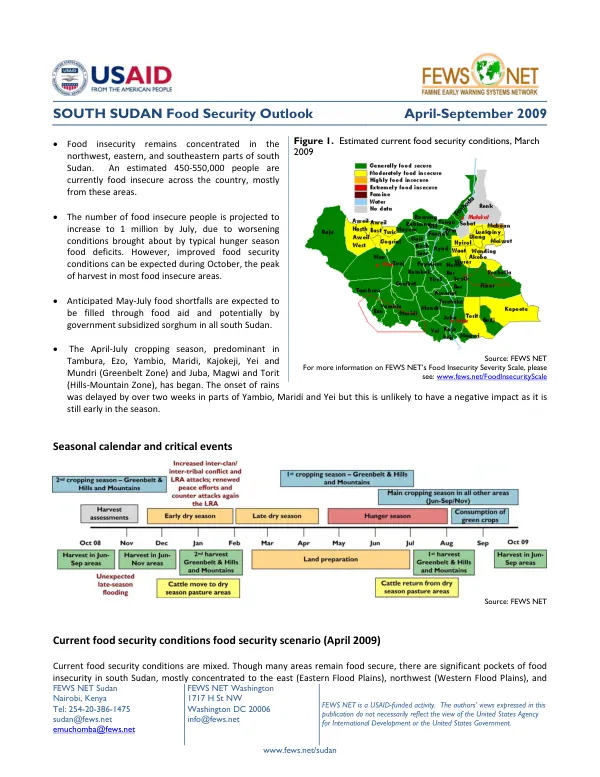
An estimated 450-550,000 people are currently food insecure across the country, mostly from these areas. The number of food-insecure people is projected to increase to 1 million by July, due to worsening conditions brought about by typical hunger season food deficits. The April-July cropping season has begun in the Greenbelt and Hills-Mountains zones, with rains starting in February-March and becoming more established in early April. However, planting began about 20 days later than normal in some pockets, with affected areas receiving 50-80 percent of normal rains during that time. Crop water conditions, especially for maize, were satisfactory and even above average in the Hills and Mountains zone. Food insecurity persists in area 1 (Aweil East, West, South, North Twic, and Gogrial) as the hunger season peaks during May-July. Conditions will slightly worsen in area 2 (northern parts of Tonj and Wau) due to earlier-than-normal exhaustion of last year's harvest. Access to potential local surpluses might be constrained by inter-clan tensions, especially in Tonj. Food shortages will also persist in area 3 (Longuchok, Maiwut, Luakping, and Ulang), but still remain within the typical hunger season limits. Conditions will likely worsen in area 4 (Waat, Wuror, and Akobo) due to a combination of last year's crop shortfalls, compounded by hunger season food deficits and above-normal cattle raiding conflicts with pastoralists in area 5 (Pibor County). In general, area 4 remains inaccessible to humanitarian agencies due to repeated conflicts. Area 5 has been stable until an unprecedented level of cattle raiding took place with the neighboring Nuer tribe in March, displacing close to 5,000 people. Deterioration in food security conditions is also anticipated in area 6 due to the progressing of the hunger season and increased inaccessibility caused by June-September rains. The negative impact of 2008 crop shortfalls and the hunger season will be more evident especially in May-June in area 6. Torit might experience improvements with the onset of harvest of early crops in July-August. Shortages in area 7 (Kapoeta) are partially due to limitations on grain and livestock market access, more than crop production, as the area is predominantly pastoral. Here, improvements can be expected as a result of the April-July rains but unpredictability of performance of often erratic rainfall could sustain current moderately food-insecure conditions until September. Concerns over the presence of refugees from the Democratic Republic of Congo and recent insecurity persist over area 8. The refugees affect food insecurity in that they are reliant on food aid, and the host population. Apart from refugees, most households affected by insecurity here are likely to recover, especially after July harvests. Overall, slightly improvements can be expected towards September in some areas due to improved food access following the "green harvest" at this time. However, in areas highlighted in Figure 7, the situation is expected to worsen due to the progressing hunger season and increased inaccessibility caused by June-September rains.