ACTED
South Sudan-Wide Humanitarian Assistance to South Sudan
South Sudan is a landlocked country located in East Africa, bordered by Sudan to the north, Ethiopia to the east, Kenya to the southeast, Uganda to the south, Democratic Republic of the Congo to the southwest, and Central African Republic to the west.
2012 · 1 pages
Sign in to readA free account is required to download.
Abstract
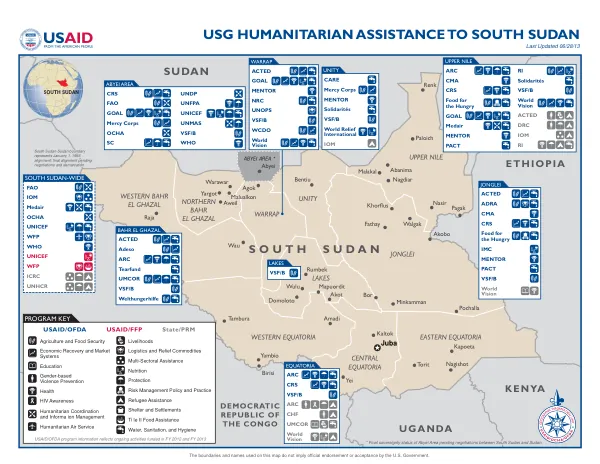
The country's geography is characterized by vast savannas, grasslands, and tropical rainforests, with numerous rivers and lakes, including the Nile River, which flows through the country. The South Sudan-Sudan boundary represents the January 1, 1956, alignment, with final alignment pending negotiations and demarcation. The final sovereignty status of the Abyei Area is also pending negotiations between South Sudan and Sudan. The country is divided into 10 states: Central Equatoria, Eastern Equatoria, Western Equatoria, Jonglei, Lakes, Upper Nile, Unity, Warrap, Bahr el Ghazal, and Northern Bahr el Ghazal. The United Nations has a significant presence in South Sudan, with various agencies and organizations providing humanitarian assistance. These include the Food and Agriculture Organization (FAO), International Organization for Migration (IOM), Medair, Office for the Coordination of Humanitarian Affairs (OCHA), UNICEF, World Food Programme (WFP), and World Health Organization (WHO). Other organizations, such as ACTED, Adeso, ARC, Tearfund, and VSF/B, are also involved in humanitarian activities in the country. The USAID/OFDA program in South Sudan focuses on agriculture and food security, economic recovery and market systems, education, gender-based violence prevention, health, HIV awareness, humanitarian coordination and information management, humanitarian air service, livelihoods, logistics and relief commodities, multi-sectoral assistance, nutrition, protection, risk management policy and practice, refugee assistance, shelter and settlements, title II food assistance, and water, sanitation, and hygiene. The program reflects ongoing activities funded in FY 2012 and FY 2013. The humanitarian situation in South Sudan is complex, with ongoing conflicts, displacement, and food insecurity affecting millions of people. The country's fragile infrastructure and limited access to basic services exacerbate the challenges faced by the population. Humanitarian assistance is critical to addressing the needs of vulnerable populations, including refugees, internally displaced persons, and host communities.