DELOITTE CONSULTING, LLP
Southern Africa Energy Program: MEGA Solar White Paper – Draft
The Southern Africa Energy Program (SAEP) is a USAID initiative aimed at promoting energy development in the region.
2019 · 92 pages
Sign in to readA free account is required to download.
Abstract
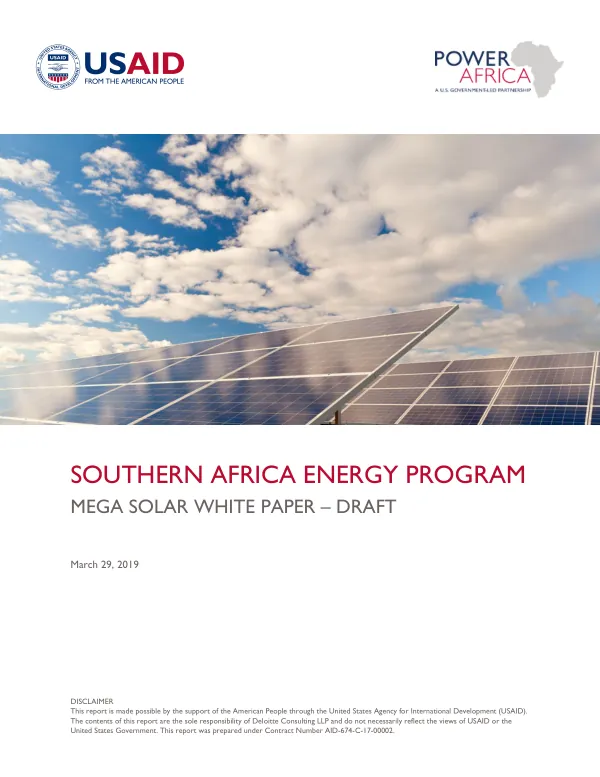
The program focuses on increasing access to reliable and affordable energy, with a particular emphasis on renewable energy sources. One of the key components of the SAEP is the MEGA Solar White Paper, which provides a comprehensive analysis of the potential for large-scale solar energy development in Southern Africa. The MEGA Solar concept involves the development of large-scale solar power plants, which can provide a significant portion of the region's energy needs. The concept is based on the idea of creating a network of solar power plants that can be connected to the existing grid, providing a reliable and dispatchable source of energy. The MEGA Solar concept has the potential to address the region's energy challenges, including the need for increased energy access, reduced greenhouse gas emissions, and improved energy security. The SAEP has conducted a detailed analysis of the potential for MEGA Solar development in Botswana and Namibia, two of the countries in the region that have the most favorable conditions for solar energy development. The analysis includes a review of the current energy landscape in both countries, including the existing energy infrastructure, energy demand, and renewable energy policies. The study also examines the potential for MEGA Solar development in both countries, including the availability of suitable land, the potential for energy storage, and the feasibility of connecting the solar power plants to the existing grid. The economic analysis of the MEGA Solar concept in Botswana and Namibia reveals that the levelized cost of energy (LCOE) for solar power is competitive with other forms of energy generation in the region. The study estimates that the LCOE for solar power in Botswana is around $0.15 per kilowatt-hour, while in Namibia it is around $0.18 per kilowatt-hour. These estimates are based on a range of assumptions, including the cost of land, the cost of equipment, and the cost of labor. The demand analysis for MEGA Solar development in Botswana and Namibia reveals that there is a significant potential for solar energy development in both countries. The study estimates that the addressable demand for solar energy in Botswana is around 1,000 megawatts, while in Namibia it is around 500 megawatts. The study also examines the potential for scaling up MEGA Solar development to meet the addressable demand, including the need for additional transmission infrastructure and the potential for energy storage. The success conditions analysis for MEGA Solar development in Botswana and Namibia reveals that there are several key factors that will determine the success of the program. These include the availability of suitable land, the potential for energy storage, the feasibility of connecting the solar power plants to the existing grid, and the level of support from the government and other stakeholders. The study also examines the potential for meeting local content requirements in both countries, including the need for local manufacturing and the potential for job creation. The SAEP has also conducted a review of several case studies of MEGA Solar development projects around the world, including the Upington Solar Park in South Africa, the Cerro Dominador project in Chile, and the Solar Start projects in the United States. The case studies provide valuable insights into the leading practices and financial analysis of MEGA Solar development projects, and highlight the potential for MEGA Solar development in Southern Africa. Overall, the MEGA Solar White Paper provides a comprehensive analysis of the potential for large-scale solar energy development in Southern Africa. The study reveals that the region has the potential to become a major player in the global solar energy market, and that MEGA Solar development can play a key role in addressing the region's energy challenges.