HEALTH ALLIANCE INTERNATIONAL
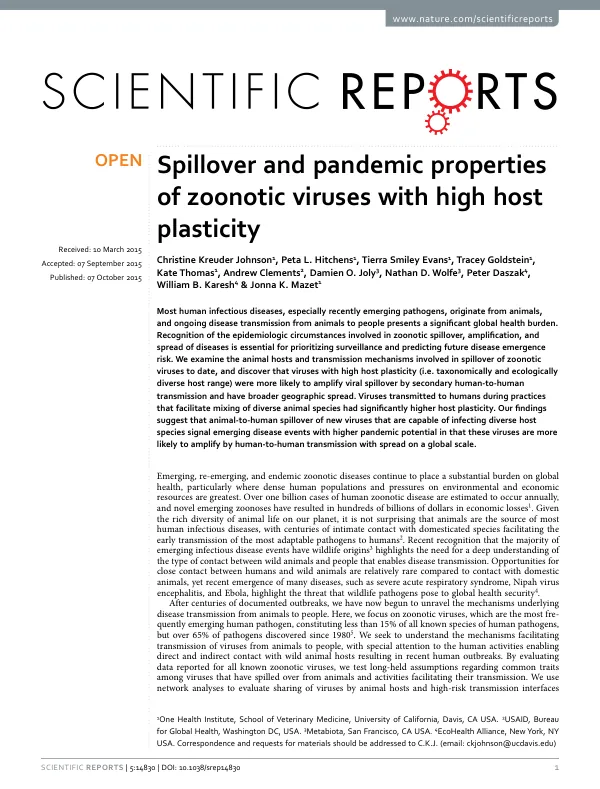
Spillover and pandemic properties of zoonotic viruses with high host plasticity
Zoonotic viruses, which are the most frequently emerging human pathogens, originate from animals and present a significant global health burden.
2015 · 8 pages
Sign in to readA free account is required to download.
Abstract
The majority of human infectious diseases, especially recently emerging pathogens, originate from animals. Recognition of the epidemiologic circumstances involved in zoonotic spillover, amplification, and spread of diseases is essential for prioritizing surveillance and predicting future disease emergence risk. The animal hosts and transmission mechanisms involved in zoonotic virus spillover have been examined, and it has been discovered that viruses with high host plasticity, or the ability to infect a wide range of taxonomically diverse hosts, are more likely to amplify viral spillover by secondary human-to-human transmission and have broader geographic spread. Viruses transmitted to humans during practices that facilitate mixing of diverse animal species have significantly higher host plasticity. These findings suggest that animal-to-human spillover of new viruses that are capable of infecting diverse host species signal emerging disease events with higher pandemic potential. Emerging, re-emerging, and endemic zoonotic diseases continue to place a substantial burden on global health, particularly where dense human populations and pressures on environmental and economic resources are greatest. Over one billion cases of human zoonotic disease are estimated to occur annually, and novel emerging zoonoses have resulted in hundreds of billions of dollars in economic losses. The majority of emerging infectious disease events have wildlife origins, highlighting the need for a deep understanding of the type of contact between wild animals and people that enables disease transmission. The mechanisms underlying disease transmission from animals to people have been unraveled, and it has been found that RNA viruses are far more likely to be zoonotic than DNA viruses. Wild animals were suggested as the source of zoonotic transmission for 91% of zoonotic viruses compared to 34% of viruses transmitted from domestic animals. Wild rodents were implicated as a source of spillover for 58% of zoonotic viruses, particularly for zoonotic arenaviruses and bunyaviruses. Primates were implicated as a source of zoonotic retroviruses, while bats were more implicated for zoonotic paramyxoviruses and most zoonotic rhabdoviruses. The virus-host unipartite network illustrates high connectivity among host groups sharing zoonotic viruses and the central role domestic animals play in cross-species transmission. Viruses with domestic animal hosts occurred in twice as many host orders than other viruses, indicating that domestic animals play a key role in cross-species transmission of zoonotic viruses. Among viruses from wildlife, higher host plasticity was found in viruses transmitted at high-risk interfaces involving wild animals kept as pets, maintained in sanctuaries or zoos, and sold at markets. Vector-borne viruses were reported in three times the number of host taxonomic groups than non-vector-borne viruses, indicating that vector-borne pathogens have significantly broader host range than non-vector-borne viruses. Transmission of zoonotic viruses to humans occurs by direct or indirect contact with wildlife in a diverse array of interconnected animal-to-human interfaces, with little overlap with viruses transmitted primarily by vectors. Zoonotic virus spillover from wildlife was most frequent in and around human dwellings and in agricultural fields, as well as at interfaces with occupational exposure to animals. Primate hosts were most frequently cited as the source of viruses transmitted by direct contact during hunting and in laboratories, while rodent hosts were more likely to be implicated in transmission by indirect contact in and around human dwellings and in agricultural fields. Approximately 40% of zoonotic viruses involving wild animals required arthropod vectors for transmission to humans.
Related documents
Documents in this collection
 2017
2017USAID DEC
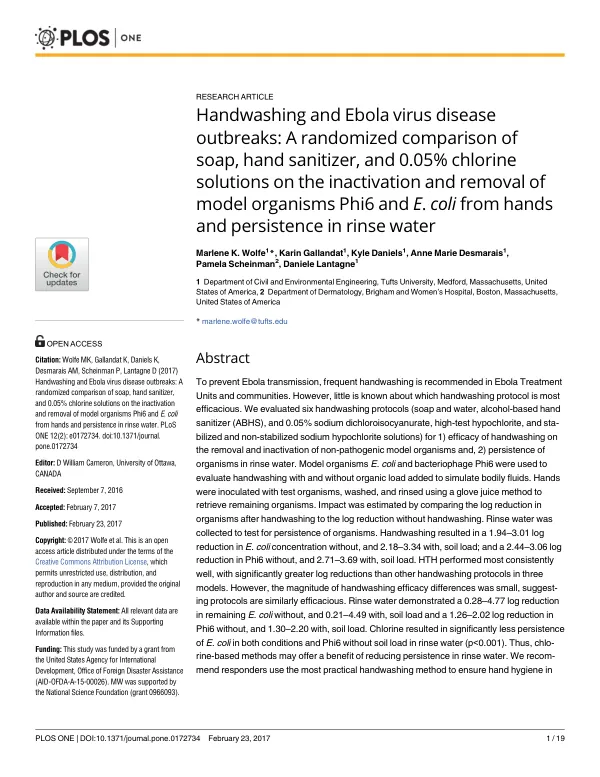
Handwashing and Ebola virus disease outbreaks: A randomized comparison of soap, hand sanitizer, and 0.05% chlorine solutions on the inactivation and removal of model organisms Phi6 and E. coli from hands and persistence in rinse water
Open record 2019
2019USAID DEC