USAID DEC
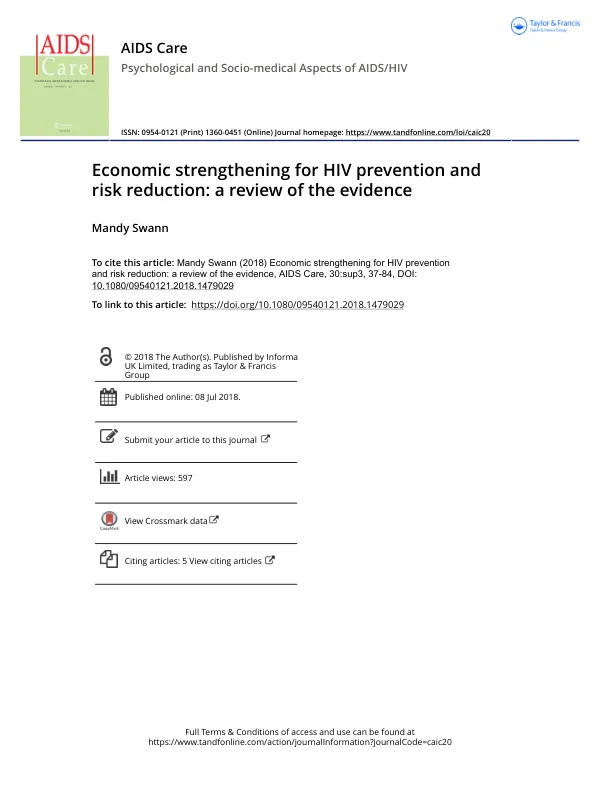
Economic strengthening for HIV prevention and risk reduction: a review of the evidence
Sign inFHI 360
Economic strengthening for HIV prevention and risk reduction: a review of the evidence
Household economic strengthening (HES) initiatives are increasingly being implemented in coordination with biomedical and behavioral approaches to HIV prevention, treatment, and care.
2018 · 49 pages
Sign in to readA free account is required to download.
Abstract
Economic status has long been recognized as an important structural driver of the HIV epidemic. Poverty and economic insecurity can affect HIV risk by reducing negotiating power within sexual relationships, increasing reliance on transactional sex and sex work, or limiting access to HIV prevention knowledge and services. The relationship between poverty and HIV is not linear, but economic factors are linked to HIV risk behaviors, as well as outcomes at all stages of the HIV care and treatment cascade. Poverty and economic insecurity can also pose barriers to HIV testing services and routine access to care and treatment services for those who are positive, compromising the health and survival of people living with HIV. Transportation costs, time away from productive economic activities, and the costs of medical services are known barriers to care and treatment. A growing body of evidence links HES interventions to HIV outcomes. This literature review aimed to comprehensively document the published and gray literature on a broad set of HES intervention types and their effects on a range of HIV outcomes. The review consisted of an academic database search, citation tracking of relevant articles, examination of existing evidence reviews for relevant primary articles, and a gray literature search. The search methodology included nine academic databases, and four consistent search strings were entered into each database using a list of HES interventions, plus terms associated with different HIV outcomes. The literature search was conducted in November 2015 without restrictions on publication dates. Included evidence had to meet the following criteria: evaluated one or more HES intervention of interest, reported on at least one HIV outcome of interest, available in English, and relevant to low-income contexts or vulnerable populations. Two reviewers screened titles and abstracts for inclusion, and selected records then underwent a full-text review by the study author. Data on study characteristics were extracted by two reviewers using a standard template. Using a citation tracking approach, the reference sections of all selected papers were screened for additional pertinent research. An additional thirty-eight evidence reviews and policy papers identified in the initial screening were also reviewed for relevant source studies. For all primary studies identified through citation tracking, the same inclusion criteria were applied. In July 2016, recommendations for additional evidence were solicited from experts in this field through a half-day consultative meeting. These recommendations were subsequently reviewed for inclusion. The review found that conditional and unconditional cash transfers, and educational support were each associated with reductions in self-reported risk behaviors, particularly among adolescents. Food assistance in combination with other support also shows a positive trend for adolescent risk reduction. Most studies relied on self-reported behavioral data, and clinical outcomes such as HIV or other sexually transmitted infection (STI) incidence or prevalence were mostly null or underpowered, calling into question the true effectiveness of these interventions in preventing HIV. Limited evidence also supports the effectiveness of financial incentives in increasing voluntary medical male circumcision. Well-designed vocational/entrepreneurial training and savings interventions could bolster HIV prevention efforts for female sex workers, while findings are less conclusive for adolescents.