THE CLOUDBURST GROUP
Stakeholder Perceptions of Electoral Integrity in Nigeria: 2007-2019
Improvements in Electoral Process Credibility in Nigeria were observed from 2007 to 2019, with stakeholders positively assessing the work of the Independent National Electoral Commission (INEC) in managing Nigeria's federal and state elections.
2021 · 2 pages
Sign in to readA free account is required to download.
Abstract
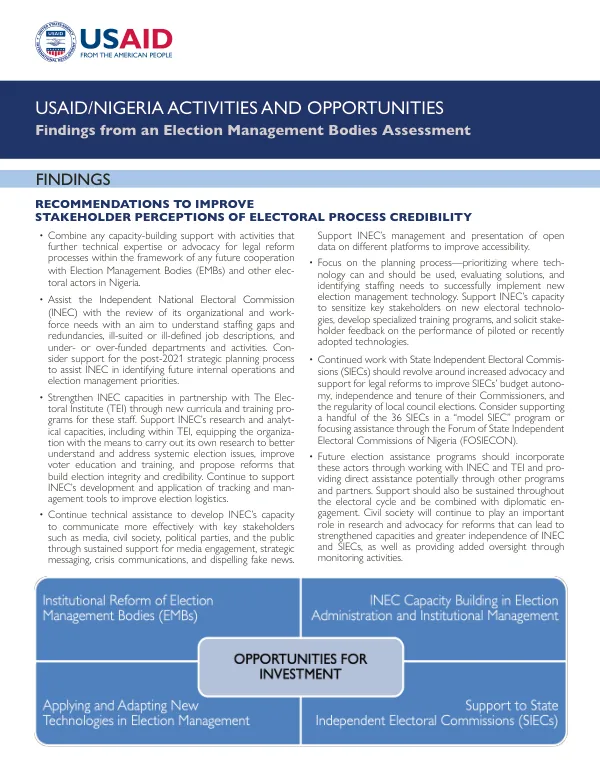
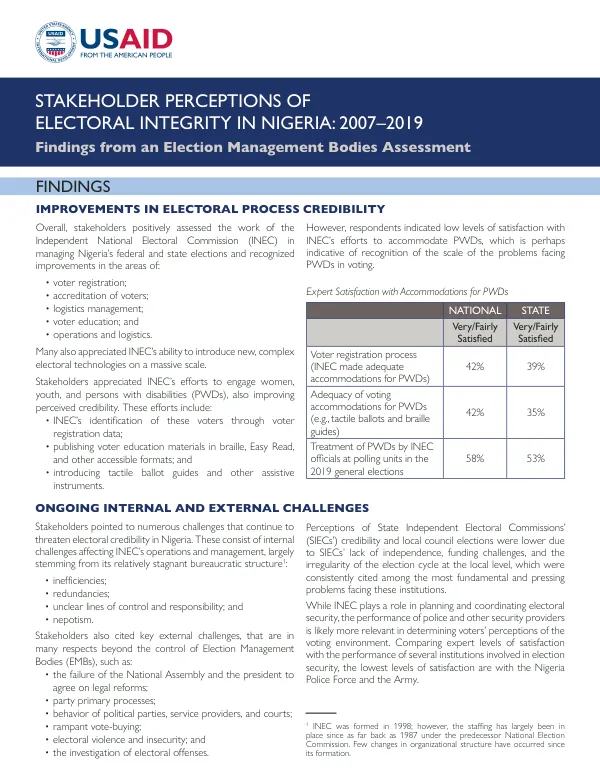
Recognized improvements included voter registration, accreditation of voters, logistics management, voter education, and operations and logistics. Many stakeholders appreciated INEC's ability to introduce new, complex electoral technologies on a massive scale. Stakeholders also appreciated INEC's efforts to engage women, youth, and persons with disabilities (PWDs), which improved perceived credibility. These efforts included identifying these voters through voter registration data, publishing voter education materials in accessible formats, and introducing tactile ballot guides and other assistive instruments. However, respondents indicated low levels of satisfaction with INEC's efforts to accommodate PWDs, which may be indicative of the scale of problems facing PWDs in voting. Despite these improvements, stakeholders pointed to numerous challenges that continue to threaten electoral credibility in Nigeria. Internal challenges affecting INEC's operations and management include inefficiencies, redundancies, unclear lines of control and responsibility, and nepotism. External challenges include the failure of the National Assembly and the president to agree on legal reforms, party primary processes, behavior of political parties, service providers, and courts, rampant vote-buying, electoral violence and insecurity, and the investigation of electoral offenses. Perceptions of State Independent Electoral Commissions' (SIECs') credibility and local council elections were lower due to SIECs' lack of independence, funding challenges, and the irregularity of the election cycle at the local level. While INEC plays a role in planning and coordinating electoral security, the performance of police and other security providers is likely more relevant in determining voters' perceptions of the voting environment. Comparing expert levels of satisfaction with the performance of several institutions involved in election security, the lowest levels of satisfaction are with the Nigeria Police Force and the Army. INEC is effectively managing relationships with external institutions that support election processes and continuing to improve its responsiveness to operations and logistics problems. Experts believed relationships with other institutions were effective, with the exception of the National Orientation Agency. Relationships with National Youth Service Corps and the Academic Staff Union of Universities (ASUU) ranked highest. The assessment conducted by The Cloudburst Group for USAID/Nigeria aimed to understand and assess the performance of INEC in Nigeria over the past decade, with a focus on the period corresponding to USAID's Support for Electoral Reforms Project (SERP).