THE CLOUDBURST GROUP
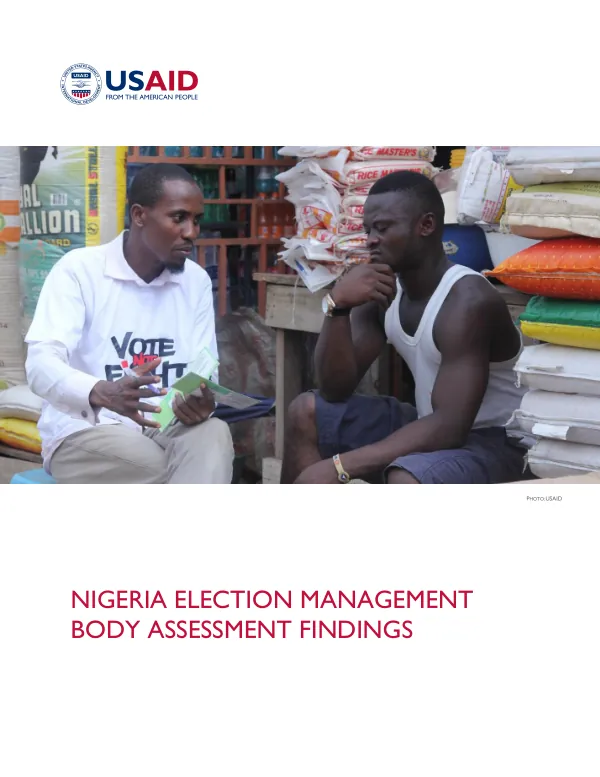
Nigeria Election Management Body Assessment
The assessment of Election Management Bodies (EMBs) in Nigeria was conducted by a team of international and local consultants, led by Gavin Weise, to evaluate the performance of the Independent National Electoral Commission (INEC) and State Independent Electoral Commissions (SIECs) over the past decade.
2021 · 112 pages
Sign in to readA free account is required to download.
Abstract
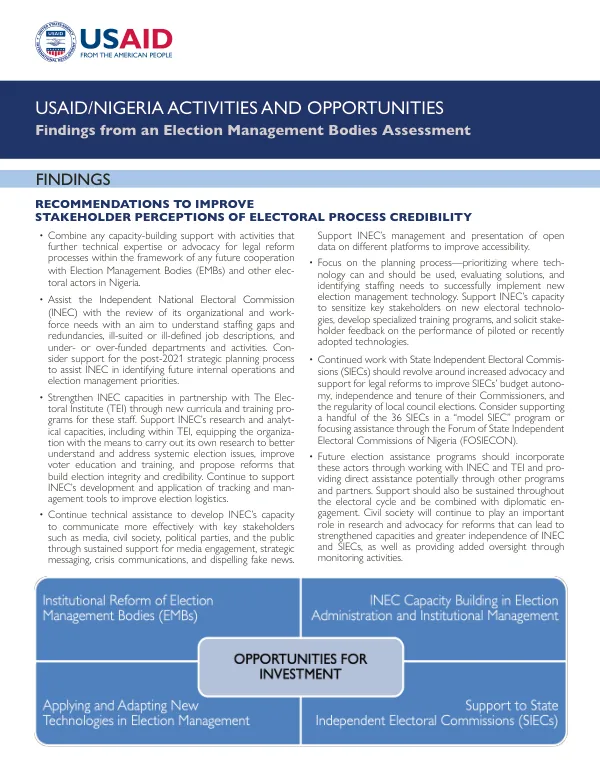
The study aimed to understand how stakeholder perceptions of the electoral process in Nigeria have changed since the 2007 general elections, and to identify opportunities for the United States Agency for International Development (USAID) to invest strategically in election management and administration moving forward. The assessment explored how INEC's and SIECs' management and administration of elections since 2007 have impacted electoral integrity. The study found that the 2011 elections saw improvements in election administration and the overall credibility of the electoral process, due in part to the government's commitment to electoral reforms. Reforms continued in the post-election period, including the completion of new systems for voter registration and voter identification through biometrics. However, several lingering deficiencies in election administration remained, including an uneven distribution of permanent voters cards (PVCs), malfunctioning card readers, inefficient counting procedures, and the lack of transparent results collation and announcement processes. These issues persisted during the 2019 general elections, further undermining stakeholder confidence in INEC's ability to manage elections. The assessment identified several key areas for improvement, including the need for INEC to strengthen its internal operations, improve its management of relationships with other institutions essential to electoral management and administration, and address key internal and external challenges in addressing electoral integrity issues. The study also highlighted the importance of USAID's continued support for INEC and SIECs, and identified opportunities for strategic investment in election management and administration moving forward. The assessment was guided by four key research questions, which were further divided into 15 sub-questions. The study used a range of data sources, including surveys, interviews, and analysis of election data, to investigate changes in trust levels and credibility of Nigerian EMBs and election processes, and the specific USAID interventions that contributed to improved electoral management. The study found that stakeholder perceptions of the electoral process in Nigeria have changed significantly since the 2007 general elections. Trust in INEC and SIECs has increased, and perceptions of the credibility of the electoral process have improved. However, there are still significant challenges to be addressed, including the need for INEC to strengthen its internal operations, improve its management of relationships with other institutions, and address key internal and external challenges in addressing electoral integrity issues. The study's findings have significant implications for USAID's continued support for INEC and SIECs, and for the future of election management and administration in Nigeria. The assessment provides a comprehensive analysis of the current state of election management in Nigeria, and identifies key areas for improvement and opportunities for strategic investment.