USAID DEC
Stakeholders’ partnerships in collaborative policymaking: Fostering transboundary cooperation on small watersheds in Central Asia
Sign inUSAID
Stakeholders’ partnerships in collaborative policymaking: Fostering transboundary cooperation on small watersheds in Central Asia
The project focuses on fostering transboundary cooperation on small watersheds in Central Asia.
2015 · 1 pages
Sign in to readA free account is required to download.
Abstract
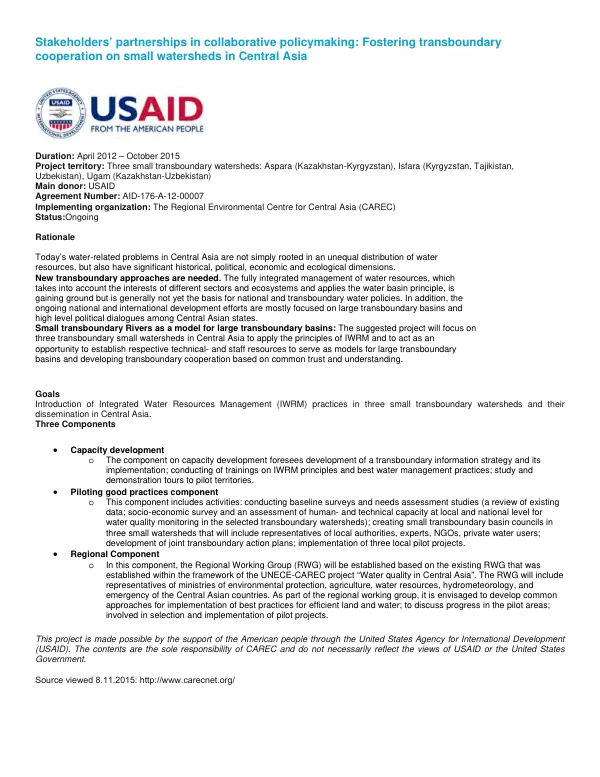
The project territory includes three small transboundary watersheds: Espara (Kazakhstan-Kyrgyzstan), Iskermes (Kyrgyzstan, Tajikistan, Uzbekistan), and Ugam (Kazakhstan-Uzbekistan). The main donor is USAID, and the agreement number is AID-176-A-12-00007. The implementing organization is the Regional Centre for Central Asia (CAREC). The project aims to address the complex water-related problems in Central Asia, which are not solely caused by unequal distribution of water resources but also by historical, political, ecological, and ecological factors. The project seeks to introduce Integrated Water Resources Management (IWRM) principles in three small transboundary watersheds and disseminate them in Central Asia. IWRM takes into account the interests of different stakeholders and ecosystems and applies the water basin principle. The project has three components: capacity development, piloting good practices, and regional. The capacity development component involves developing a transboundary information strategy, conducting trainings on IWRM principles, and study tours to pilot territories. The piloting good practices component includes conducting baseline surveys, establishing small transboundary basin councils, and implementing joint transboundary action plans. The regional component involves establishing a Regional Working Group to develop approaches for efficient land and water management, discuss progress in pilot areas, and select and implement projects. The project is ongoing, and its status is supported by the support of the American people through USAID. The project's contents are the sole responsibility of CAREC and do not necessarily reflect the views of USAID or the United States Government. The project's goals include introducing IWRM principles in three small transboundary watersheds and disseminating them in Central Asia. The project's implementation involves developing a transboundary information strategy, conducting trainings on IWRM principles, and study tours to pilot territories. The project also involves conducting baseline surveys, establishing small transboundary basin councils, and implementing joint transboundary action plans. The Regional Working Group will be established to develop approaches for efficient land and water management, discuss progress in pilot areas, and select and implement projects. The project's focus on small transboundary watersheds serves as a model for large transboundary basins and developing transboundary cooperation based on common understanding and trust. The project's goals and objectives are aligned with the principles of IWRM, which take into account the interests of different stakeholders and ecosystems and apply the water basin principle. The project's implementation will contribute to the development of transboundary cooperation and the introduction of IWRM principles in Central Asia.