USAID DEC
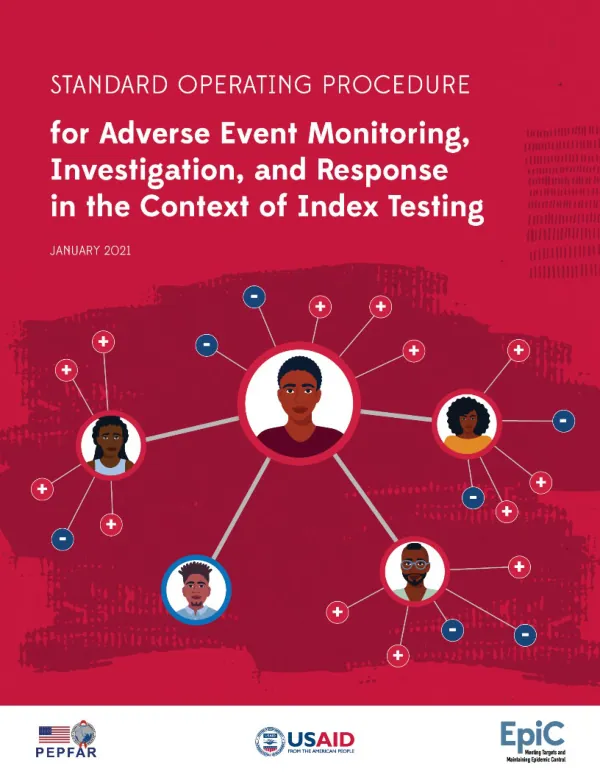
Standard Operating Procedure for Adverse Event Monitoring, Investigation, and Response in the Context of Index Testing
Sign inFHI 360
Standard Operating Procedure for Adverse Event Monitoring, Investigation, and Response in the Context of Index Testing
Adverse Event Monitoring, Investigation, and Response in the Context of Index Testing is a standard operating procedure (SOP) intended to help facility managers and health care workers involved in index testing to prevent adverse events, encourage clients to report adverse events, and support providers to respond to and document adverse events.
2021 · 34 pages
Sign in to readA free account is required to download.
Abstract
This SOP is designed to meet the requirements of the President's Emergency Plan for AIDS Relief (PEPFAR) and adhere to the 5 Cs (consent, confidentiality, counseling, correct test results, and connection to prevention/treatment). The SOP outlines procedures for ensuring a safe and ethical environment for index testing, including training staff on adherence to the 5 Cs and conducting intimate partner violence (IPV) screenings. Staff conducting index testing must be trained on the use of a script to ensure that essential messages are covered, and they must be aware of the importance of confidentiality and informed consent. The SOP also emphasizes the need for a site-level adverse event monitoring and reporting system, which includes forms for documenting and monitoring consent, IPV, and frequency of adverse events. Sites with unusually high acceptance of index testing services are flagged for supportive supervision monitoring visits to ensure that index testing is being offered as a voluntary service. The SOP categorizes adverse events into severe and serious categories, including threats of physical, sexual, or emotional harm, occurrences of physical, sexual, or emotional harm, economic harm, withholding HIV treatment or services, forced or unauthorized disclosure of client information, abandonment or forced removal of children, and stigma perpetrated by health site staff. The procedures outlined in the SOP include responding immediately to adverse events, documenting, investigating, reporting, and remediating adverse events. The SOP also emphasizes the importance of data review and analysis to identify trends and areas for improvement. The SOP is intended to be integrated into a larger SOP covering index testing and does not need to be a standalone document. It is designed to be used by facility managers and health care workers involved in index testing to ensure a safe and ethical environment for clients. The SOP is adapted from PEPFAR guidance on implementing safe and ethical index testing services and is intended to help sites meet the requirements of PEPFAR. The SOP is designed to be used in conjunction with other SOPs, including those on identifying violence in the context of index testing and violence response. The SOP includes several appendices, including content recommendations for SOPs describing clinical violence response services, an index testing script, an adverse event report form, an adverse event investigation form, a beneficiary abuse disclosure and response form, a patient rights poster, a customer complaint form, and an implementer security incident log. Overall, the SOP provides a comprehensive framework for adverse event monitoring, investigation, and response in the context of index testing, and is designed to ensure a safe and ethical environment for clients.
Related documents