AMERICAN NATIONAL STANDARDS INSTITUTE
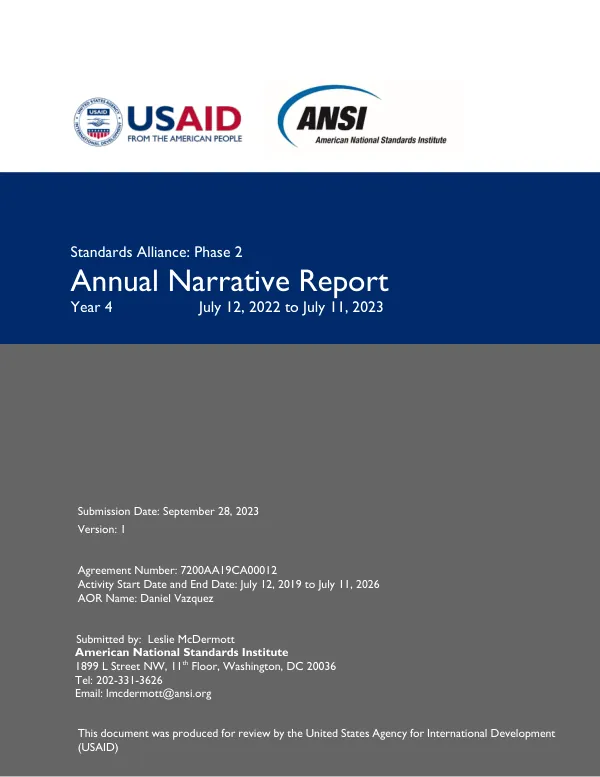
Standards Alliance: Phase 2 Annual Narrative Report Year 4
The Standards Alliance: Phase 2 is a program aimed at promoting the adoption of international standards and conformity assessment principles in developing countries.
2023 · 40 pages
Sign in to readA free account is required to download.
Abstract
The program is implemented by the American National Standards Institute (ANSI) and is funded by the United States Agency for International Development (USAID). The program's objective is to build the capacity of developing countries in the areas of legal and regulatory framework, standards development, conformity assessment procedures, and private sector engagement. The program engages target populations including foreign government officials, ministries responsible for standards, trade, and consumer protection, foreign private sector, industry groups, civil society, consumer interest groups, business professionals, trade policy experts, and academia. The program's activities are focused on various geographical regions and levels of economic development, subject to the agreement of USAID. During the first year of the project, the COVID-19 pandemic created new challenges for the implementation of the Standards Alliance Phase 2. Most of the work during the first year focused on finalizing and creating a strong Monitoring and Evaluation framework that would facilitate the tracking of the impact that the different activities are having on the partner countries' National Quality Infrastructure. In Year 2 of the SA2, significant progress was made in the launch and implementation of the COVID-19 Medical Device and Regulatory Convergence (MDRC) project and the finalization of all sub-award agreements with USAID approval. The MDRC launched the Inter-American Coalition for Regulatory Convergence, solidifying international partnerships with relevant government and private sectors organizations, and executing medical device and good regulatory practice trainings and high-level meetings. In Year 3, the Standards Alliance Phase 2 reached full implementation with training and other workshops being carried out across all activities. One of the MDRC's key accomplishments during Year 3 was the publication of the Tier One Gap Analysis on Good Regulatory Practices, which is intended to be a live document that will help guide policy priorities and increase transparency on areas to focus to further develop the National Quality Infrastructure of the partner countries. During the current reporting year (Year 4), ANSI and USAID secured an extension and ceiling increase for the overall program for two additional years, allowing for new activities to be implemented in Year 5 and Year 6 of the program. The SA2 program will focus on new activities in the critical minerals, agribusiness, automotive, digital infrastructure, water and sanitation, and medical devices sectors. In Year 4, the program carried out successful culminating events for activities with ASTM and Pivot. ASTM held an in-person workshop in Dakar, Senegal, and a Study Tour in Denver, CO in conjunction with ASTM Committee D02 on Petroleum Products, Liquid Fuels, and Lubricants. Pivot concluded a 5-part webinar series with ARSO over Year 4 focused on bioethanol as an alternative to toxic fuels like wood and charcoal. In the water and sanitation sectors, CWSC furthered their research into legal, policy, and institutional frameworks governing National Quality Infrastructure related to the WASH sector in Ghana, Uganda, and Zambia. IAPMO achieved success for the development and adoption of a new national standard related to faucets and continues to provide technical assistance to relevant ministries on its adoption and enforcement. Meanwhile, NSF and AWWA finalized their workshops in Brazil, Morocco, India, and the African continent focusing on different aspects of drinking water systems.