JOHNS HOPKINS UNIVERSITY
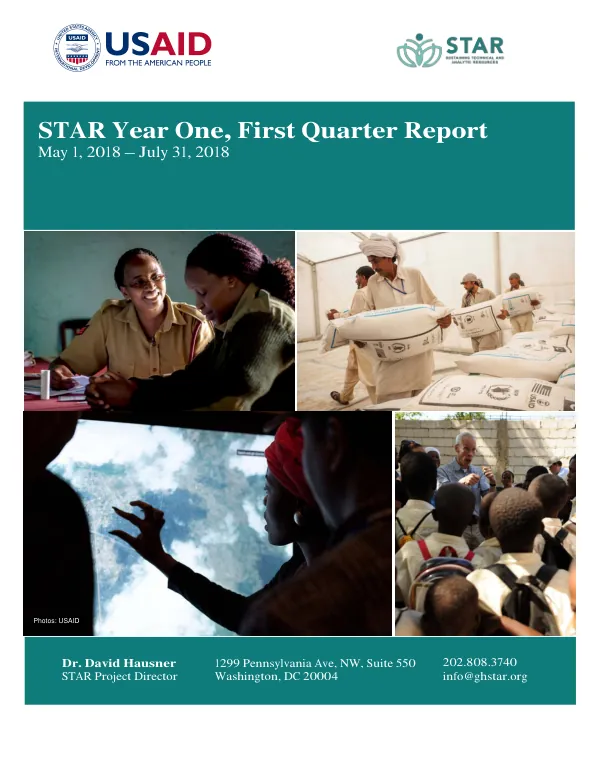
STAR Year One, First Quarter Report
The STAR project, a USAID-funded initiative, began its first quarter in May 2018 with a focus on start-up activities.
2018 · 6 pages
Sign in to readA free account is required to download.
Abstract
A facilitated work planning retreat was held, where directors and managers participated in a day and a half of initial project design. The development of required deliverables, including a draft project year 1 work plan and budget, and branding and marking plan, took place and were submitted during the reporting period. The project was able to hire its first Fellow, Dr. William Weiss, Senior M and E Advisor for MNCH, who is currently awaiting his security clearance to begin his Fellowship. Recruitment and Outreach, Performance Management, Learning, Academic Partnership and Communications, Private Sector Partnerships, Finance and Global Operations, and IT and Administration teams have developed job descriptions and are in the process of hiring staff. The initial obligation of $1,692,500 was included in the cooperative agreement award, and STAR has incurred total expenses of $113,914.87, resulting in a pipeline balance of $1,578,585.13 as of June 30, 2018. The quarterly accrual report was submitted to the AOR in June. The project has made progress in several areas, including Fellowships and Internships to Help Build LMIC Capacity and Strengthen the Cadre of the Global Health Technical Workforce. There is interest from the USAID Mission in South Africa to place a cohort of interns in Pretoria, and discussions have begun with the USAID Global Health Bureau's Tuberculosis (TB) Office to discuss the possibility of STAR managing several cohorts of TB Fellows globally. The development of a framework for individual participant learning has begun, and a scoping review of global health competencies has been completed. STAR has fielded many requests for information on how to become a STAR Fellow from interested parties, including NGOs, all over the world. The Global Operations team is working on standardizing a new participant support model to be utilized under STAR, and the GOP team has realigned internal processes surrounding travel, security, and other essential systems. Plans are underway to implement a blind recruitment strategy for US placements to help reduce biases that too often occur when recruiting and hiring women and underrepresented minorities in the US. The project has also made progress in improving knowledge sharing systems and sustainable academic collaborations. In June 2018, STAR announced and promoted awareness of the project at the Implementing Best Practices (IBP) Consortium's Partners Meeting in London, UK. Initial thinking has started around STAR's Collaboration Laboratory as one prong to an evolving knowledge-sharing strategy. Sub-partners, including Johns Hopkins University, Consortium of Universities for Global Health, and University of California, San Francisco, have contributed to the project on a good-faith basis. Sub-awards cannot be issued until the Year 1 workplan and budget are approved, but PHI expects to issue sub-awards during the next quarter.
Related documents