JOHNS HOPKINS UNIVERSITY
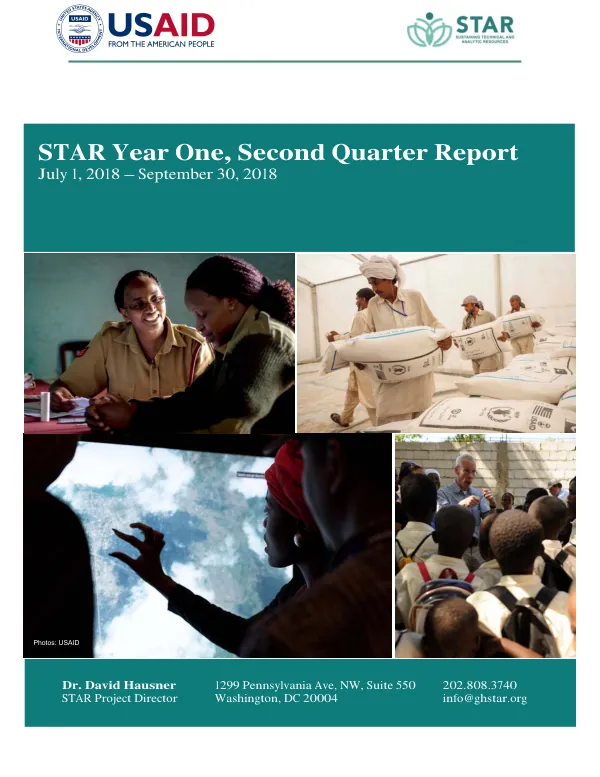
STAR Year One, Second Quarter Report
The STAR project, a Sustaining Technical and Analytic Resources initiative, began its second quarter in 2018 with a focus on finalizing start-up tasks and required deliverables.
2018 · 15 pages
Sign in to readA free account is required to download.
Abstract
The project's implementing teams made significant progress in various areas, including Recruitment and Outreach, Performance Management, Academic Partnerships and Communications, Learning, Technical Advisory Group, and Global Operations. Recruitment and Outreach efforts focused on developing the recruiter portal/database, creating recruitment content for the website, and scheduling outreach conferences for fall 2018. The team also worked with Performance Management to determine STAR position levels and salary structure. Outreach addressed several challenges, including quickly evaluating conference importance and registering before budget approvals. The Recruitment team fielded requests for information on how to become a STAR Fellow from interested parties, including NGOs. USAID/South Africa confirmed interest in a civil society Fellowship that could support capacity-building efforts for the Mission and local organizations. The team is also in talks with PricewaterhouseCoopers (PWC) about a rotational Fellowship for PY2. Potential new Fellowship opportunities were explored, including a civil society Fellowship, a medical officer placement, and a rotational Fellowship with a private sector partner. The USAID tuberculosis (TB) division expressed interest in funding 60 TB Fellows at ministries of health in 26 countries. STAR was in discussions in Q2 about scopes of work. The Learning team completed tasks in four key areas in Q2, including reviewing global competencies' literature, mapping and identifying relevant courses, organizing a STAR Learning retreat, and developing templates and tools for the first set of incoming Fellows. The team assessed peer-reviewed literature, CUGH global health competencies, the FSN competencies framework, and 50 documents to form the foundation of the STAR Global Health Competencies and Milestones Framework. The STAR Global Health Competencies and Milestones Framework includes eight core competencies and 18 technical competencies, of which eight are skills-based and 10 are content area based. The technical competencies will be elective areas of focus that will be chosen based on the candidate's area of interest and scope of work. All competencies were categorized using a five-level hierarchical milestones model that define the core knowledge, attitudes, and skills required to achieve expertise within a competency domain. The Performance Management team successfully onboarded and oriented the first STAR Fellow, a Senior Monitoring and Evaluation Advisor for USAID's Office of Maternal and Child Health and Nutrition. The teams continued to develop and refine the orientation process for Fellows. During Q2, the Performance and Recruitment teams also worked to develop Fellowship level classifications and proposed a compensation strategy for STAR that aligns with PHI's compensation policies. The Technical Advisory Group (TAG) prepared a PY1 workplan and budget and developed a monitoring and evaluation plan. In addition, UCSF began drafting a list of potential Technical Advisory Group (TAG) members. Global Operations implemented a new support model that was successfully utilized in support of the current Fellow. The STAR project's implementing teams made significant progress in Q2, laying the groundwork for future success. The project's focus on strengthening capacity, promoting innovation, and improving global health outcomes will continue to drive progress in the coming quarters.
Related documents