JOHNS HOPKINS UNIVERSITY
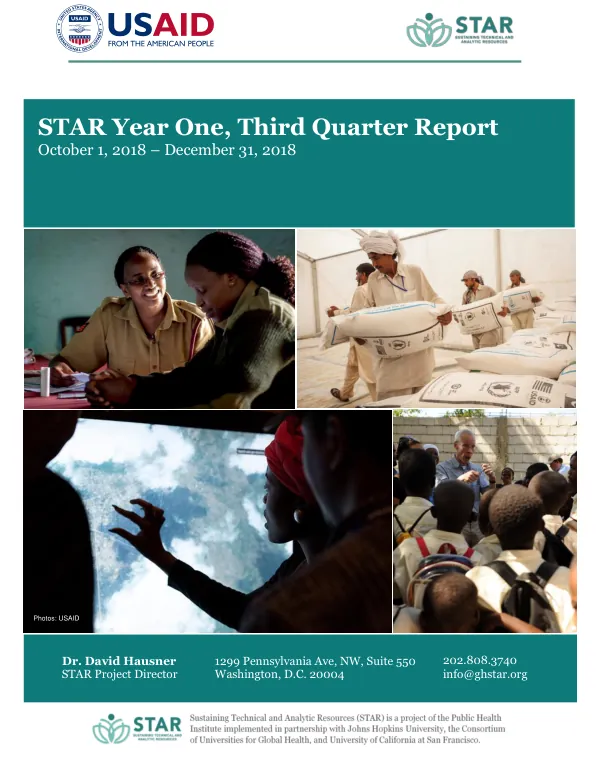
STAR Year One, Third Quarter Report
The STAR Project, a collaborative effort between USAID and various academic and private sector partners, aimed to strengthen the capacity of diverse American and low-and-middle-income country health professionals to make innovative contributions to global health.
2018 · 17 pages
Sign in to readA free account is required to download.
Abstract
The project's primary focus during the third quarter of 2018 was on transitioning and onboarding nine Fellows and an Intern from the Global Health Fellows Program-II (GHFP-II). The Recruitment and Outreach team attended several outreach conferences in the U.S. and low-and-middle-income countries, with the goal of introducing the STAR Project to a range of diverse global health professionals. The team developed a survey to evaluate the relevance of each event to target audiences and recruitment objectives. The Outreach and Communications teams trained staff on delivering a Project elevator pitch and talking points for applicants, and provided outreach materials to share with candidates. The Recruitment team finalized and tested several deliverables, including request forms for new Fellowships, STAR level classifications, and job description templates. The team received 10 job descriptions for transitioning participants and successfully placed the remaining transitioning Fellows and Intern in their new STAR levels. The Recruitment team also worked with USAID/Southern Africa on two potential civil society Fellowship positions and started regular weekly meetings with USAID/Washington's Tuberculosis Division to plan for recruiting and hiring. The STAR Project's Academic Partnerships team formed and launched the STAR Committee, comprised of 26 academicians. The team started a literature review on partnerships and conducted an initial mapping of existing global health collaboration and consortium platforms to support a knowledge-sharing systems strategy. The Communications team progressed platform and content development for STAR's website, which was scheduled to launch in early January. The team also developed and shared the STAR Editorial and Visual Branding guides. The Learning team finalized the STAR Global Health Competencies and Milestones. The team developed accompanying tools and assessments, which will be used to support Fellows in developing their learning objectives and Individualized Learning Plans (ILPs). The team also held its second retreat with participation from all STAR teams and partners, and attendee input helped develop a Theory of Change framework and contributed to the development of a group mentorship framework. The Technical Advisory Group (TAG) began recruiting and preparing for the first TAG meeting. The University of California, San Francisco (UCSF) identified educational resources relevant for STAR participants and began devising a new Global Human Development (GHD) curriculum. The Global Operations team developed a new support model, which has been successful in supporting the project's first 10 participants. The team made progress in developing key policies and the structure and content of onboarding and orientation activities. The STAR Project's Outreach team attended seven events, including conferences in the U.S. and low-and-middle-income countries. The team developed a survey to evaluate the relevance of each event to target audiences and recruitment objectives. The team also trained staff on delivering a Project elevator pitch and talking points for applicants, and provided outreach materials to share with candidates. The STAR Project's Recruitment team worked to prepare for 66 potential Fellowship positions for USAID and held discussions with several Missions. The team also held discussions with a private sector company and NGOs interested in hosting STAR Fellows. The team worked with USAID/Washington's Tuberculosis Division to plan for recruiting and hiring, and started regular weekly meetings with the division.
Related documents