USAID/NIGERIA
Strategic Assessment of Social Sector Activities in Northern Nigeria
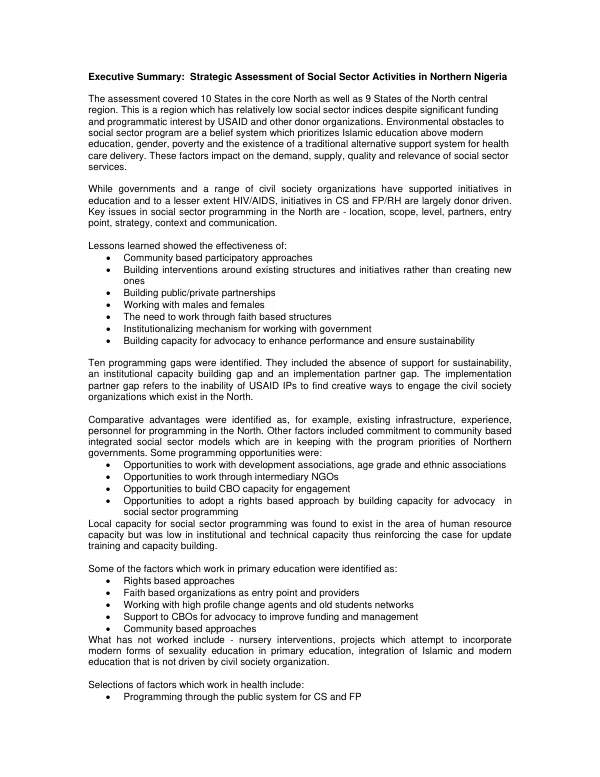
Strategic Assessment of Social Sector Activities in Northern Nigeria The assessment covered 10 States in the core North and 9 States in the southern part of the region.
2009 · 2 pages
Sign in to readA free account is required to download.
Abstract
This region has relatively low social sector indices despite significant investment and programmatic interest from USAID and other donor organizations. Environmental obstacles to social sector program success include a belief system that prioritizes Islamic education over modern education, as well as poverty and the existence of traditional alternative support systems for healthcare delivery. These factors impact the demand, supply, quality, and relevance of social sector services. Key issues in social sector programming in the North include location, scope, level, entry point, context, and communication. Lessons learned from the assessment highlight the effectiveness of community-based participatory approaches, building interventions around existing initiatives, and working with faith-based structures. Other effective strategies include building public-private partnerships, working with males and females, and institutionalizing mechanisms for working with government. Programming gaps were identified, including the absence of support for sustainability, institutional capacity building, and implementation partner gaps. The inability of USAID IPs to find creative ways to engage civil society organizations in the North is a significant challenge. Comparative advantages of existing infrastructure, experience, personnel, and personnel for programming in the North were also identified. These advantages include commitment to community-based integrated social sector programming, which aligns with the program priorities of Northern governments. Opportunities for programming include working with community-based organizations, age-grade associations, and intermediary organizations, as well as building capacity for advocacy and engagement. Local capacity for social sector programming was found to exist in the area of human resource capacity but was low in technical and institutional capacity, reinforcing the need for update training and capacity building. In education, factors that work include rights-based approaches, faith-based entry points, working with change agents and old students, and supporting community-based approaches. What has not worked includes nursery projects, modern forms of sexuality education, and integration of Islamic and modern education without civil society organization involvement. In health, factors that work include programming through the public system for CS and FP, rolling out FP/RH and primary education through community-based infrastructure, and using HIV/AIDS as an entry point for FP/RH. Other effective strategies include working with trade associations, building leadership, and integrating livelihood enhancement projects with prevention interventions. Several points for synergies were recommended, including community-based ECD programs linked to primary schools, capacity building for social sector CBOs, and incorporating back-to-school programs into out-of-school prevention interventions. Other recommendations include using the CAPA infrastructure to roll out FP/RH, education, and education programs, and supporting centers of excellence for integrated Islamic and modern curricula. Six transition recommendations were made, including rolling out social sector programs that were requested but not carried out in Vision and CAPA projects, building capacity for CBOs, documenting success stories and strategies for advocacy to policymakers, and developing strategic action plans and guidelines for advocacy to religious leaders.