USAID DEC
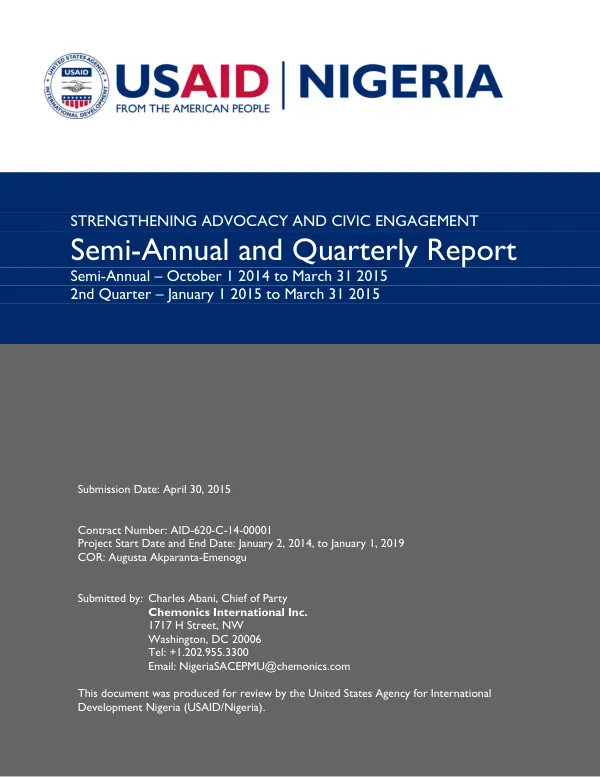
Strengthening Advocacy and Civic Engagement: Semi-Annual and Quarterly Report (Q2 FY 2015)
Sign inCHEMONICS
Strengthening Advocacy and Civic Engagement: Semi-Annual and Quarterly Report (Q2 FY 2015)
The Strengthening Advocacy and Civic Engagement (SACE) project is a $19.2 million USAID-funded project implemented by Chemonics International between January 2, 2014, and January 1, 2019.
2015 · 48 pages
Sign in to readA free account is required to download.
Abstract
The project's objective is to strengthen civil society's ability to influence the development and implementation of key democratic reforms at the national, state, and local levels. The project aims to engage marginalized populations, such as women, youth, and the disabled, in the process and emphasize the importance of leadership and innovation. The program has four components. The first component focuses on strengthening the institutional, organizational, and technical capacity of targeted civil society organizations' (CSO) coalitions and networks to advance targeted democracy and good governance initiatives. The second component aims to strengthen the partnership between CSO-led coalitions and networks and targeted Government of Nigeria (GON) institutions and key stakeholders to advocate for and monitor select democratic reforms. The third component focuses on strengthening public awareness, discourse, and support for key democratic governance issues such as transparency, accountability, and good governance. The fourth component aims to strengthen the capacity of partner business membership organizations (BMOs) and CSOs in the Niger Delta to advocate for inclusive economic reforms and equitable economic growth. The Partnership Initiatives in the Niger Delta (PIND) is a strategic partner to USAID in the Niger Delta and will coordinate and complement the project's activities in the region under Component Four. During the reporting period of October 1, 2014, to March 31, 2015, the project made significant progress in implementing its activities. The project implemented a range of activities under each of its four components, including training and capacity-building programs for CSOs, advocacy and awareness-raising campaigns, and partnership-building initiatives with GON institutions and key stakeholders. The project also made progress in its efforts to engage marginalized populations, including women, youth, and the disabled, in the process. The project implemented a range of activities aimed at promoting the inclusion of these groups in the democratic process, including training and capacity-building programs, advocacy and awareness-raising campaigns, and partnership-building initiatives. The project's progress was monitored and evaluated through a range of indicators and metrics, including the number of CSOs and BMOs trained and capacity-built, the number of advocacy and awareness-raising campaigns implemented, and the level of engagement and participation of marginalized populations in the democratic process. The project's achievements during the reporting period include the training and capacity-building of over 500 CSOs and BMOs, the implementation of over 20 advocacy and awareness-raising campaigns, and the engagement and participation of over 10,000 marginalized individuals in the democratic process. The project also made significant progress in its efforts to strengthen the partnership between CSOs and GON institutions, with over 50 partnerships established during the reporting period. The project's future plans and activities include the continuation of its training and capacity-building programs for CSOs and BMOs, the implementation of additional advocacy and awareness-raising campaigns, and the strengthening of partnerships with GON institutions and key stakeholders. The project also plans to continue its efforts to engage marginalized populations in the democratic process, including women, youth, and the disabled. The project's budget for the reporting period was $4.8 million, which was allocated across its four components. The project's expenditures during the reporting period included $2.5 million for personnel costs, $1.2 million for training and capacity-building programs, and $1.1 million for advocacy and awareness-raising campaigns. The project's management and administrative structure includes a Project Management Unit (PMU) led by a Chief of Party, a team of project staff, and a range of subcontractors and partners. The project's monitoring and evaluation framework includes a range of indicators and metrics, including the number of CSOs and BMOs trained and capacity-built, the number of advocacy and awareness-raising campaigns implemented, and the level of engagement and participation of marginalized populations in the democratic process. The project's lessons learned and implementation challenges during the reporting period include the need for more effective communication and coordination between project staff and partners, the need for more robust monitoring and evaluation systems, and the need for more effective engagement and participation of marginalized populations in the democratic process. The project's planned activities for the next quarter include the continuation of its training and capacity-building programs for CSOs and BMOs, the implementation of additional advocacy and awareness-raising campaigns, and the strengthening of partnerships with GON institutions and key stakeholders.